




Studies promoted by Health Secretary Robert F. Kennedy Jr. or others promoting changes in vaccine recommendations are facing fresh scrutiny in recent weeks.
Journals have retracted or removed two of the papers, and are investigating at least two others, based in part on complaints from self-identified vaccine advocates.
Researchers who conducted the studies say they’re being unfairly targeted.
“Any paper that would raise a question regarding vaccines and the safety, especially of the childhood vaccination schedule, are under question,” Brian Hooker, chief scientific officer at Children’s Health Defense, and author of one of the studies, told The Epoch Times.
The studies were published years ago. One was released in 2010.
Hooker and Kennedy referenced two in their 2023 book, “Vax-Unvax: Let the Science Speak.” Those and other papers show “the complexities of vaccine safety science beyond the very simplistic picture that health officials and the media customarily paint,” Hooker and Kennedy said in the book.
The Department of Health and Human Services, which Kennedy now leads, did not return a request for comment by the time of publication.
The Centers for Disease Control and Prevention, part of the department, in 2025 cited one of the papers when reversing its stance on whether vaccines can cause autism. The CDC now says it is possible.
Charlotte Kuperwasser, director of the Tufts Convergence Laboratory of Biomedical, Physical, and Engineering Sciences, cited another study when presenting to the CDC’s vaccine advisory panel in the fall of 2025. At the next meeting, Aaron Siri, Kennedy’s onetime lawyer, pointed to three of the papers when presenting to the CDC’s vaccine advisory panel, which voted to recommend narrowing federal guidance for several vaccines. The CDC adopted the recommendations, but a federal judge blocked them in March.
“These attacks have nothing to do with an objective search for the truth,” Siri told The Epoch Times via email. “Rather, they are targeted assassinations of articles that do not fit the religious belief of vaccine proponents.”
Removal
Elsevier’s Toxicology Reports in April removed a paper by Neil Miller, an independent researcher with the New Mexico-based Institute of Medical and Scientific Inquiry, that was cited by Kennedy and Hooker. The paper had examined more than 2,000 infant deaths reported to the Vaccine Adverse Event Reporting System (VAERS) and found that many of them occurred within seven days of receiving a vaccine.
“While the findings in this paper are not proof of an association between infant vaccines and infant deaths, they are highly suggestive of a causal relationship,” Miller wrote.
The removal notice says that readers raised concerns following the 2021 publication of the paper “regarding potential research errors and methodological flaws in this article.”
Responses by Miller to questions from the journal were not satisfactory, including to resolve the inference of a correlation between vaccination and sudden infant death syndrome, Lawrence Lash, editor-in-chief of the journal, concluded. The journal removed the paper, which means it is no longer accessible on its website, “given the potential implications for medical practice.”
Miller told The Epoch Times that the journal forwarded complaints from one person and that he responded thoroughly. The journal later removed the article over the purported flaws.
“Despite my requests, they never specified what the methodological flaws were,” Miller said.
“From further correspondence, I gathered that they were likely referring to concerns about reporting bias.
“However, I had already addressed this possibility in my paper, offering an alternative explanation.”
Miller had acknowledged in his paper that doctors and parents might have been more likely to report deaths to the database if they happened close to vaccination. He says, however, that the fact that more deaths happened on the day after vaccination, compared to the day of vaccination, “may suggest the presence of an incubation period—the interval between vaccination and the full manifestation of a reaction that could potentially lead to death,” and is one piece of evidence undercutting claims of reporting bias.
An Elsevier spokesperson told The Epoch Times via email that two individuals brought concerns to the journal in 2025, prompting an investigation.
“We conducted a thorough assessment which ultimately led to the decision to remove the publication, following careful review and consultation with relevant experts,” the spokesperson said.
“We stand by the decision that the recommendations and conclusions presented in the paper may pose potential risks to public health and could potentially be applied in clinical practice, resulting in harm to patients.”
Dr. Pierre Kory, founder of the Leading Edge Clinic, said that the paper should not have been removed.
“All analyses and conclusions have limitations, but Miller drew on numerous data sources beyond his VAERS analysis to demonstrate the temporal association between vaccination and death,” Kory told The Epoch Times via email.
Magdalen Wind-Mozley, a scientist who has worked with the Oxford Vaccine Group, who says “vaccines work,” and who filed complaints about Miller’s paper, highlighted the development.
“To any vaccine advocate out there who sometimes despairs: we can get these papers removed, we can get them retracted—perhaps the tide is turning now?” Wind-Mozley wrote on Facebook.
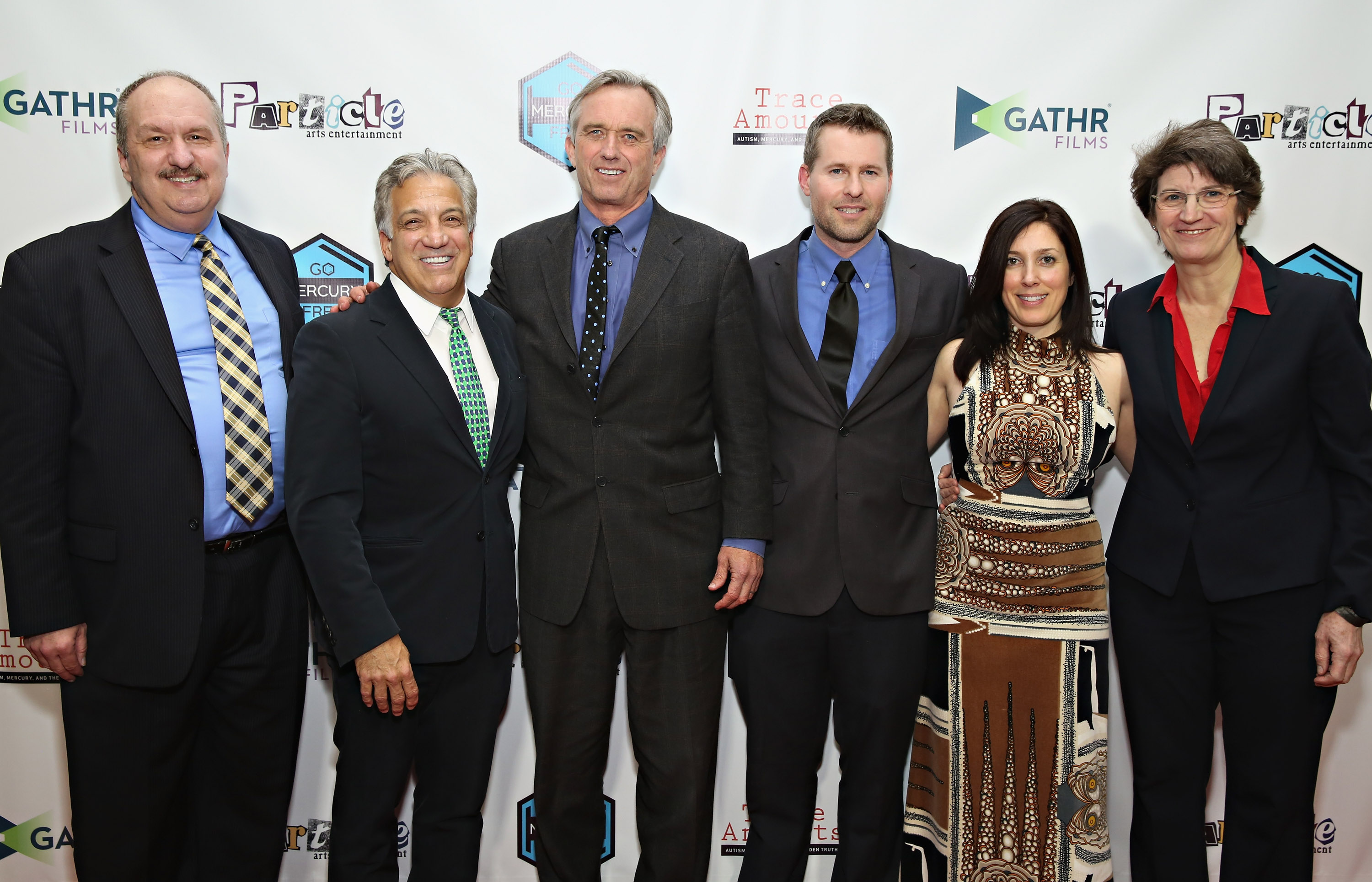 Brian Hooker (L) stands with Robert F. Kennedy Jr. (3rd L) and others at the screening of ‘Trace Amounts’ at the New York University School of Law in New York City on March 24, 2015. (Cindy Ord/Getty Images for Trace Amounts)
Retracted
Another study featured in Hooker and Kennedy’s book, and cited by the CDC, examined the odds of being diagnosed with autism following hepatitis B vaccination.
The authors utilized data from national surveys and vaccination records and estimated that boys who were vaccinated early were more likely to be diagnosed with autism, versus boys who were never vaccinated or who received a vaccine no earlier than one month of age.
The Journal of Toxicology and Environmental Health, which published the study in 2010, retracted it in May. The journal said in a retraction notice that after hearing concerns about the study, it engaged with the authors and hired an independent reviewer to review the work.
The reviewer, who was not identified, concluded that “due to fundamental methodological flaws the study’s conclusions are unsound,” the journal said.
Taylor & Francis, the journal’s publisher, declined to provide any additional information.
Carolyn Gallagher and Melody Goodman, the authors, had said in the paper that they could not determine causality and that the study was subject to bias from uncontrolled factors.
“Our findings do not suggest that the risks of autism outweigh the benefits of vaccination; however, future research into hepatitis B vaccination scheduling is warranted,” they wrote.
Goodman, now the dean of New York University’s School of Global Public Health, told The Epoch Times in an email that the researchers stand behind the study’s methodology.
“When we did this research more than 15 years ago, we saw the study’s limitations—the small sample size, missing/incomplete data, and potential bias from unmeasured or uncontrolled factors—and said so within the paper,” she said.
“This research, which began as a student project, used publicly available data collected by the CDC and statistical analyses that are standard in public health research.
“The paper was never meant to stand alone as the final word on this issue, which is precisely why we called for larger, stronger studies to evaluate this topic—and which other researchers have subsequently done.”
Dr. John Su, a CDC official, told the CDC’s vaccine advisers in 2025 that available studies did not identify increased risks for children who received a hepatitis B vaccine early in life.
Mark Blaxill, an adviser to the CDC, told the advisers about the findings from Goodman’s paper, as well as other studies that identified issues following hepatitis B vaccination.
The advisers voted to recommend hepatitis B vaccination only for newborns whose mothers tested positive for hepatitis B, or who had an unknown vaccination status. Other children should receive a hepatitis B vaccine no earlier than 2 months of age, the advisers said. The CDC adopted the advice, but that was one of multiple updates stayed by a judge in March. An appeal is pending.
Under Investigation
At least two other papers are being investigated.
Sage Open Medicine on May 18 added an expression of concern to an article coauthored by Hooker and Miller that had concluded, based on data from three medical practices, that children vaccinated before turning 1 had a higher risk of developmental delays, asthma, and ear infections.
Sage said the article was under investigation and that the expression would remain until the investigation concluded and a final decision was made on whether to keep the paper in place.
Miller and Hooker say the investigation was triggered by a person who wrongly alleged that their data came from an undisclosed source.
Hooker said the original peer-review process took 11 months and involved multiple rounds of revisions. He said that since the publication of the study, concerns have been raised, but the authors have addressed them, and the journal has not taken any action until now.
Sage has stopped engaging with Hooker over the allegations, which he described as internet rumors.
Sage did not return a request for comment by the time of publication.
Autoimmunity, meanwhile, has said it is investigating an article published in 2025 that found that the amount of promoter-enhancer DNA in Pfizer’s COVID-19 vaccine was above the regulatory limit. The authors said that people who received multiple shots faced “significant and unquantified risks to human health.”
The study’s corresponding author, University of Guelph pathobiologist David Speicher, did not respond to a request for comment.
A spokesperson for Taylor & Francis, which publishes Autoimmunity, told The Epoch Times in an email that the investigation “includes additional independent expert assessment and review of associated editorial processes” and that “since that investigation is currently ongoing, we cannot comment further about the article at this stage.”