



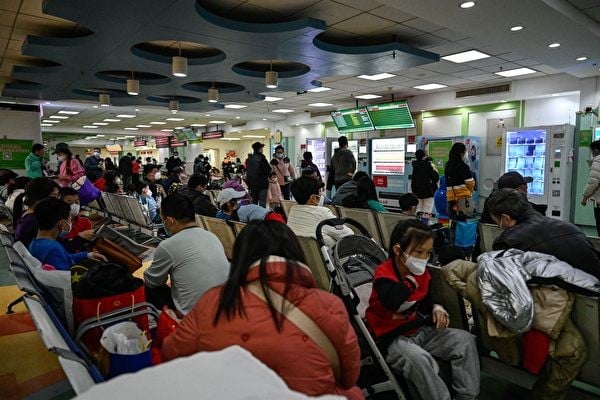
China is experiencing yet another widespread disease outbreak, with hospitals reaching full capacity in various regions and a surge in respiratory infections, including cases of “white lung” in children. Beijing has reported the simultaneous spread of 16 viruses, with COVID-19 infections ranking second among infectious diseases. Virology experts emphasize that boosting immunity is vital in preventing viral infections and share key strategies for enhancing immune response.
On Nov. 30, Beijing released its epidemic update for the 47th week of 2023 (Nov. 20 to 26). The city reported 16 notifiable infectious diseases, with 72,475 cases that week, where COVID-19 ranked second among the city’s infectious diseases.
The top five diseases in terms of case numbers are as follows:
- Seasonal influenza.
- COVID-19 virus infection.
- Hand, foot, and mouth disease.
- Other infectious gastroenteritis.
- Syphilis.
Together, these account for 99.4 percent of reported notifiable infectious diseases.
Official Reports vs. Public Accounts
Not long ago, Chinese media reported a surge in the demand for pediatric medical services in Shanghai. Data from three specialized children’s hospitals indicated an average of 6,000 daily outpatient visits, marking a 50 percent increase compared to the same period in 2022.
Yingshuo Wang, director of the Outpatient Department at the Children’s Hospital of Zhejiang University School of Medicine, noted that outpatient visits for October reached 456,000, representing an increase of over 90,000 visits compared to the same period last year.
At the Second Hospital of Jilin University in Changchun, a section of the outpatient lobby has been converted into a pediatric infusion area. Many young patients and their family members are receiving intravenous treatment while seated in the waiting room.
Li Yuchuan, director of the Outpatient Department at Beijing Children’s Hospital, explained that the hospital’s internal medicine department currently receives over 7,000 patients daily, far exceeding its capacity. “Influenza, respiratory syncytial virus, and others have become the primary pathogens during this peak of infection, replacing Mycoplasma pneumoniae,” said Mr. Li.
Mr. Li stated that although there is currently a higher number of pediatric patients, the types and severity of respiratory diseases have not changed, and the rate of severe respiratory infections remains low.
However, there is a notable discrepancy between the official statements and the accounts given by the public.
Zhang Yan (pseudonym), a resident of Beijing, shared with The Epoch Times: “In some high schools in Haidian District, there are serious group infections in certain classes, with attendance rates as low as around one-third. The situation is equally severe in kindergartens near the China Academy of Railway Sciences in Chaoyang District, where attendance rates range from one-third to one-half, and it is even more critical for smaller classes.”
Xu Ran (pseudonym), a resident of Tianjin, stated: “There is no medicine in small clinics. The community hospital near my house is quite large, equipped with all kinds of facilities, and has plenty of doctors. However, they do not have medicine, and they also do not conduct blood tests for those under 16 years old.”
Mr. Lan, a resident of Changchun, reported that his daughter’s family of three has all contracted the virus. “After the grandson got infected, he transmitted it to his parents. Both clinics and hospitals are overcrowded, underscoring the severity of the situation. The azithromycin prescribed by the doctor did not work, and after a CT scan, their lungs appeared white,” he said. “We had to request leave from school for our grandson. Attendance at school is really low, and many children are exhibiting symptoms of ‘white lung,’ prompting concerns about a potential new variant of the virus.”
Dr. Ryoichi Nakahara from the University of Tokyo in Japan told The Epoch Times that countries worldwide are closely monitoring China’s situation. The primary concern among people is the accuracy of information. However, COVID-19 testing is not included as an option in the available laboratory tests.
In November, the World Health Organization (WHO) requested information from China’s National Health Commission, including laboratory results and data on the latest trends in the spread of respiratory diseases. Before this, the cases had been reported by the media and the global pandemic monitoring system ProMED.
ProMED is among the earliest institutions to detect virus outbreaks, including SARS, Middle East Respiratory Syndrome (MERS), and COVID-19. On Nov. 22, ProMED issued a warning about a widespread outbreak of an unidentified respiratory disease (pneumonia) among children in China.
Boosting Immunity Is Key to Preventing Viral Infections: Experts
Dr. Yuhong Dong, an expert in virology and infectious diseases in Europe, has previously pointed out that antiviral drugs only temporarily suppress virus replication and provide momentary relief from symptoms; there is no permanent cure. Therefore, the key to preventing viral infections is to boost immunity.
In 2022, British scientists conducted a human challenge study involving 36 unvaccinated volunteers aged 18 to 29 who had not been previously infected with COVID-19. During the experiment, the volunteers were exposed to intranasal drops of the SARS-CoV-2 virus. Only 18 people from the group contracted COVID-19.
Why do some people have stronger immunity? Dr. Dong and Hu Naiwen, a traditional Chinese medicine (TCM) physician at the Shanghai Tong Te Tang in Taipei, Taiwan, shared insights on enhancing immune function during interviews with The Epoch Times.
In Western medicine, both external and internal factors are emphasized. External factors refer to viruses, microorganisms, and other pathogens from the external environment, while internal factors pertain to the body’s ability to resist these external threats.
Dr. Dong explained: “Humans are born with innate immunity, serving as the body’s defense force. From the respiratory epithelial cells to the internal organs, multiple layers of immune cells work together to combat external viruses and bacteria.”
In addition to physical bodies, humans have spiritual, mental, and cognitive aspects. Physics has demonstrated the ability to measure components emitted by the body, such as infrared and ultraviolet rays, electromagnetic waves, trace metal elements, and other substances invisible to the naked eye.
Dr. Dong further elaborated that the human body is a complex combination of substances and energy fields capable of releasing significant energy. Bacteria and viruses, being susceptible to ultraviolet rays, can be instantly eradicated within a certain energy field where their survival is incompatible.
“If a person possesses a particularly strong energy field, they can block viruses at a distance of half a meter to one meter from their body. This explains why some individuals remain uninfected even in environments with a high viral load,” she said. “Individuals with positive thoughts and emotions tend to exhibit stronger energy fields.”
Dr. David R. Hawkins, a renowned American psychologist, collaborated with Nobel laureates in physics to conduct clinical experiments over nearly three decades. Utilizing the fundamental principles of human kinesiology and sophisticated physics instruments, he discovered that various levels of human consciousness correspond to distinct energy vibration frequencies, as indicated by physics indices.
Dr. Dong summarized Dr. Hawkins’ research, noting that thoughts like fear, anger, rage, jealousy, hatred, and self-doubt represent negative energy. When someone summons the courage and strength to resist these detrimental influences, their body transitions to a positive energy level, encompassing qualities such as sincerity, kindness, tolerance, peace, rationality, and forbearance.
Dr. Hawkins concluded that the frequency range for the energy levels achievable by human consciousness spans from 1 to 1,000.
Dr. Dong noted that very few instances are documented in history of individuals reaching the highest level of this energy scale, 1,000. In traditional Chinese culture, such a level signifies profound enlightenment through disciplined cultivation, often associated with awakened consciousness and the status of a great sage.
Mr. Hu also discussed the internal factors of human illness from a spiritual perspective. He stated that excessive joy, anger, worry, overthinking, grief, fear, and shock can all contribute to the development of illness.
“In traditional Chinese medicine, it is believed that joy affects the heart, anger harms the liver, grief impacts the lungs, excessive worry and overthinking harm the spleen, and excessive shock harms the kidneys. All of these factors are related to an individual’s temperament, emotions, and daily behavior,” explained Mr. Hu. “Maintaining a balanced state in both the physical and spiritual aspects can prevent viruses from invading the body. This aligns with what Western medicine refers to as having a strong immune system.”