
Commentary
The diplomatic pressure against Israel over the Gaza war is rising. Photos of starving children are having an international effect. The UK, France, and Canada have all threatened Israel with economic consequences. France apparently wants to preemptively recognize a Palestinian state.
Some argue that Israeli Prime Minister Benjamin Netanyahu is prolonging the war so that he can retain power. Most Israelis blame him for the intelligence failure that allowed the terrorist group Hamas to commit the Oct. 7, 2023, massacre. Without the war, his coalition could crumble.
Whatever one believes about Netanyahu, it would be good if the original cause of the war were more often acknowledged. Israel’s worst critics ignore that Iran supports Hamas in periodically lobbing missiles or sending commando raids over the border. Hamas is guilty of anti-Semitic murder, rape, killing babies, taking mass hostages, and using human shields. Hamas allegedly seizes food and medical aid for resale and profits that amount to hundreds of millions of dollars. Yet more Palestinians support Hamas than the relatively moderate Palestinian Authority in the West Bank. Hamas approves of the West threatening Israel to get more aid shipments, and applauded the UK, France, and Canada on May 20.
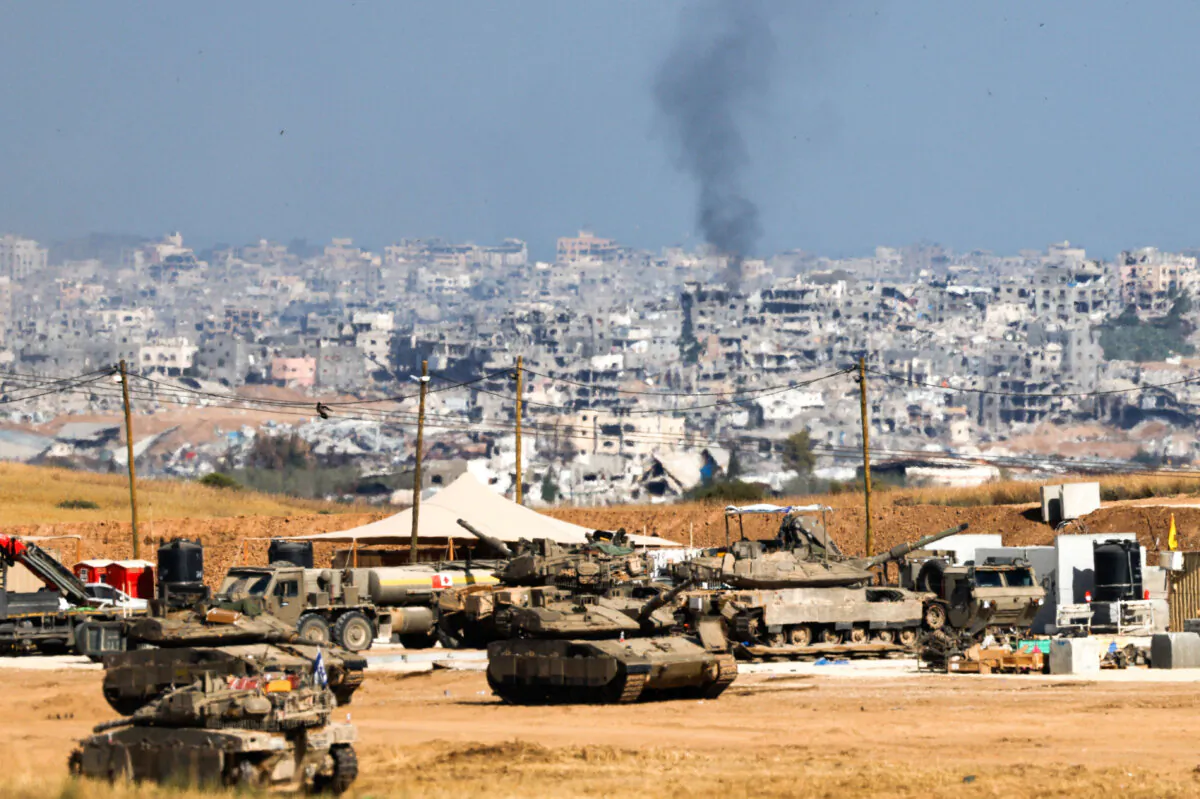
War entails the near complete collapse of morality on both sides. For the average soldier, his survival and the survival of the two soldiers to his right and his left are paramount. Civilian lives in the line of fire are discounted. As a result, the civilian casualties in the Gaza Strip are devastating and number far too many. Forced displacement is an ongoing war crime. After the deaths of 1,200 people at the hands of Hamas in Israel, an assault on Hamas by the Israel Defense Forces has killed tens of thousands in the Gaza Strip. Most of the buildings are damaged. Chaos, hatred, and callousness on all sides has and is leading to an escalating spiral of yet more violence in which innocent civilians are dying.
Despite the lopsided military capabilities of the two sides, it bears remembering that Israel did not start this war. It is a result of centuries of anti-Semitic violence that includes the Roman conquest of Israel in 63 B.C., the offensive renaming of the region as “Palestine” in the 2nd century A.D., the Arab conquest in the 7th century, unfair “jizyah” taxes imposed by Muslims on Jews, and the unequal treatment of the Jewish people under the Ottomans starting in 1517.
After 1917, the UK welcomed Jews back to their homeland under a new multicultural Palestine mandate for Jews and Arabs. But some Arabs attacked new Jewish immigrants starting in the 1920s, including through farm raids, riots, and killings. These attacks entailed opportunistic looting, and can be described as anti-immigrant and racist violence rather than “anti-Zionism.”
As the British could not fully protect them, Jews formed self-defense groups. This was the nucleus of the future Israeli state. They attempted to deter further attacks through retaliation in kind—including the taking of Palestinian land. The Arab–Israeli War of 1948 caused the outmigration or forced eviction of hundreds of thousands of people on both sides. Arab and Iranian terrorist and proxy attacks, including airline hijackings that started in 1968, grew in sophistication and deadliness. Jewish retaliation in the form of both violence and the taking of land led to the steady growth of the state of Israel, but at the cost of increasing anti-Semitism around the world.
The best prescription to end the violence is to accept the status quo. Freeze the borders where they are—yet remove foreign-funded terrorists such as Hamas that keep sparking more violence. The violence serves the interests of the Shiite mullahs in Iran, who are allied with Russia and China. It justifies their rule and anti-Zionism in the eyes of many Muslims and sparks conflict between Sunni Arabs and Israel. This is why the mullahs fund Hamas, a Sunni terror group, to lead the attack on Israel. It is no coincidence that the regime in Iran puts Sunnis in the lead instead of the Hezbollah and Houthi terrorist groups, both of which are Shiite and in the rear of the fight. Iran knows that the minute Hamas relinquishes its arms and hostages, the war is over. Then, Israel can make peace with Saudi Arabia.
As noted in the pages of The Jerusalem Post in April: “The rational answer to Israel’s growing challenges is to ally itself more closely with regional actors that have demonstrated their trustworthiness: Saudi Arabia, which took part in shooting down Iranian missiles in April 2024; Egypt and Jordan, which have kept their peace agreements with Israel through coups, internal protests, and the current polarizing war; and the Palestinian Authority, which has maintained security coordination with Israel, invaded terror strongholds, and serves as the most significant bulwark against Iranian, Hamas, and Islamic Jihad influence in the West Bank today.”
Israel’s potential diplomatic normalization is exactly why the mullahs keep the war going, by paying, arming, and training new Hamas terrorists when the old Hamas terrorists are killed. Yet regular Gazans have been brainwashed into supporting Hamas in large numbers and disbelieving video evidence of the Oct. 7 massacre. Sadly, this leads Israel to disvalue their lives. To a supporter of Israel, saving the life of a single Israeli soldier could be worth hundreds of Palestinian lives. This is what leads to the bombing of suspected Hamas militants despite the likelihood of dozens of civilian deaths.
The return of mutual respect for human life starts with the acceptance of the other’s right to exist. Israel has in the past stopped short of mass evictions of Palestinians from the Gaza Strip and the West Bank. For some time, many accepted and worked for a two-state solution that the Arab states tend to require as a precondition for normalization. After the Oct. 7 massacre, the viability of that solution suffered. Israelis could no longer trust Palestinians to use their state, were they to be given one, peacefully and responsibly. There would be nothing keeping a sovereign Palestine from importing the most advanced weaponry and targeting Israel, as Hamas had so effectively done on Oct. 7, 2023, and before, with far less powerful means.
Now, the most discussed “solution” is what amounts to guarded villages in which aid recipients are separated from Hamas by U.S. military contractors. Admittance and food would be provided only to those not associated with terrorism. In British Malaya in the 1950s and during the Vietnam War in the 1960s, similar counterinsurgency strategies went by various names, including “new villages” and “strategic hamlets.” Detractors call this strategy “apartheid.” It could over time become something more akin to U.S. reservations for Native Americans.
The plan to further separate the warring sides has its downsides, but at least some Gazan civilians could be saved and weaned from the evil beliefs of Hamas. Leaving them to their own devices in semi-national entities such as the Hamas-controlled Gaza Strip has been a disaster for Palestinians. No strategy to end the war will be easy or perfect. All involve moral trade-offs. Let’s support those that have the least negative impacts on civilians, and at least try to free Palestinian public opinion from the darkness of Hamas’s propaganda.
Views expressed in this article are the opinions of the author and do not necessarily reflect the views of The Epoch Times.
 Friends Read Free
Copy
Facebook
Tweet
Friends Read Free
Copy
Facebook
Tweet