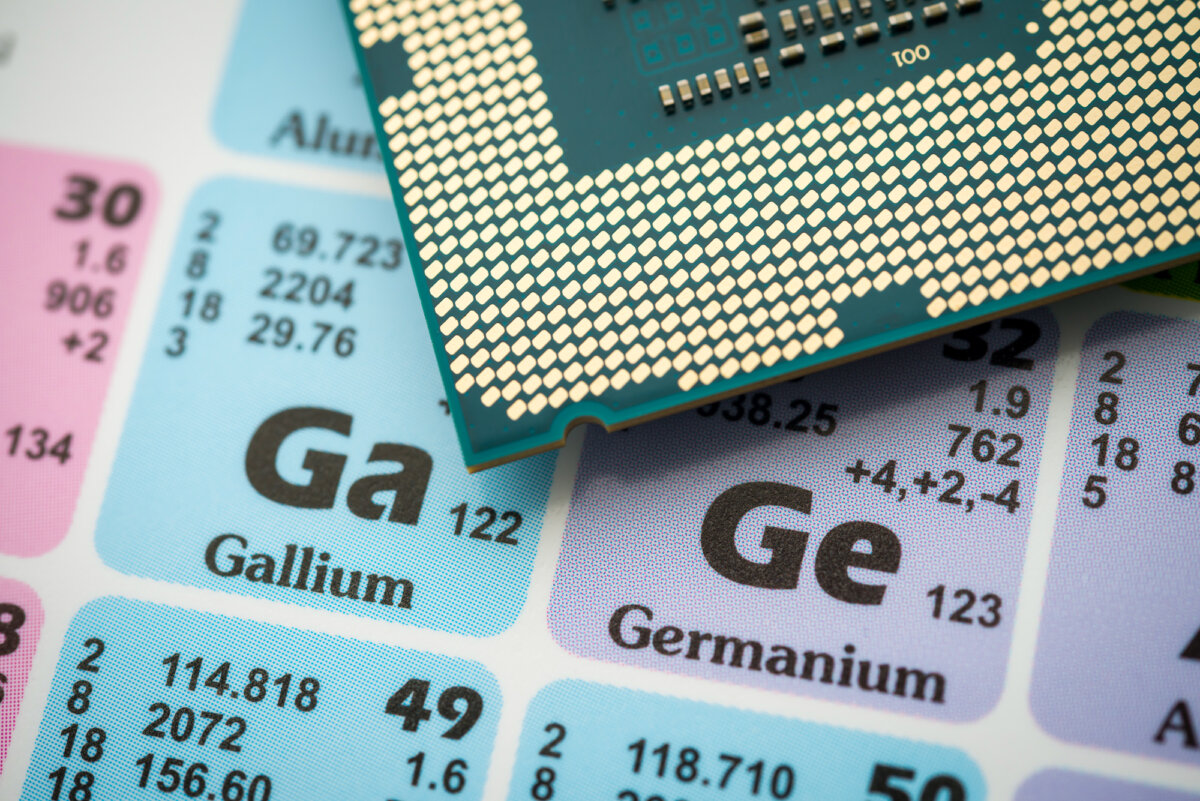

The Department of War (DOW) will invest an estimated $174 million to build a new gallium production facility in Australia to secure the supply chain for the strategic metal.
The investment will be made through equity financing at Alcoa’s Wagerup alumina refinery in Western Australia, the DOW said in an Aug. 31 statement. Alcoa of Australia, a subsidiary of Alcoa Corporation, which is based in Pennsylvania, will continue to run the facility, which is expected to produce 100 metric tons of gallium metal per year.
The element gallium plays a critical role in modern defense technologies, such as high-performance semiconductors used in ground-based missile defense systems, advanced radar for maritime and aerial platforms, and precision electro-optical/infrared sensors used for missile guidance and thermal imaging.
It’s also critical for secure tactical and satellite communications, as well as for solar cells that power civilian and military satellites.
“Securing a reliable supply of gallium is essential for the DOW,” the department said. “This project works to build long-term resilience in the existing global supply chain.”
According to the U.S. Geological Survey, the United States imports low- and high-purity gallium material from China, Canada, Germany, and Japan.
The investment in the Wagerup refinery is a multinational effort that includes Export Finance Australia, the Japanese government, and Japan’s Sojitz Corporation, the DOW said.
“This landmark agreement with our key allies, Australia and Japan, will secure a vital supply of gallium for our defense industrial base, strengthening our collective security and economic resilience for years to come,” Michael Cadenazzi, assistant secretary of war for industrial base policy, said in the statement.
In a report published in July last year, the Center for Strategic and International Studies said that China accounts for 98 percent of the world’s primary gallium supply. This poses a threat to U.S. access to the material.
Gallium is not found in its elemental form in nature. It is a byproduct extracted during a process that turns bauxite into alumina. In 2024, China accounted for around 60 percent of global aluminum output, which contributed to its monopoly in gallium as well.
Given China’s dominance in gallium output, any export restrictions can have serious impact on U.S. military tech.
In July 2023, Beijing established licensing requirements for gallium export in retaliation for U.S. and European restrictions on semiconductor exports to China. In 2024, the Chinese regime also banned gallium exports to the United States. In November 2025, China temporarily lifted restrictions until November of this year.
The $174 million investment by the DOW is one of the latest steps taken by the Trump administration to resolve the nation’s supply vulnerability.
In September last year, the Department of Energy’s (DOE) Office of Fossil Energy and Carbon Management announced up to $6 million in funding for research and development to establish a secure gallium domestic supply chain.
“The U.S. has not recovered primary gallium in nearly four decades,” Tala Goudarzi, principal deputy assistant secretary of the Office of Fossil Energy and Carbon Management, said in the statement.
“With this funding, we aim to change that by tapping existing processing streams and supporting innovators who can recover gallium here at home—showcasing how American technology can outpace current methods and unlock a new supply,” Goudarzi said.
In April this year, DOE said its Office of Critical Minerals and Energy Innovation selected five projects to set up the domestic supply chain for gallium, proposing roughly $5.4 million in combined funding.
One of the projects focuses on extracting gallium by recycling scrap. Another aims to use a new process to recover gallium at higher temperatures.
 Friends Read Free
Copy
Facebook
Tweet
Friends Read Free
Copy
Facebook
Tweet