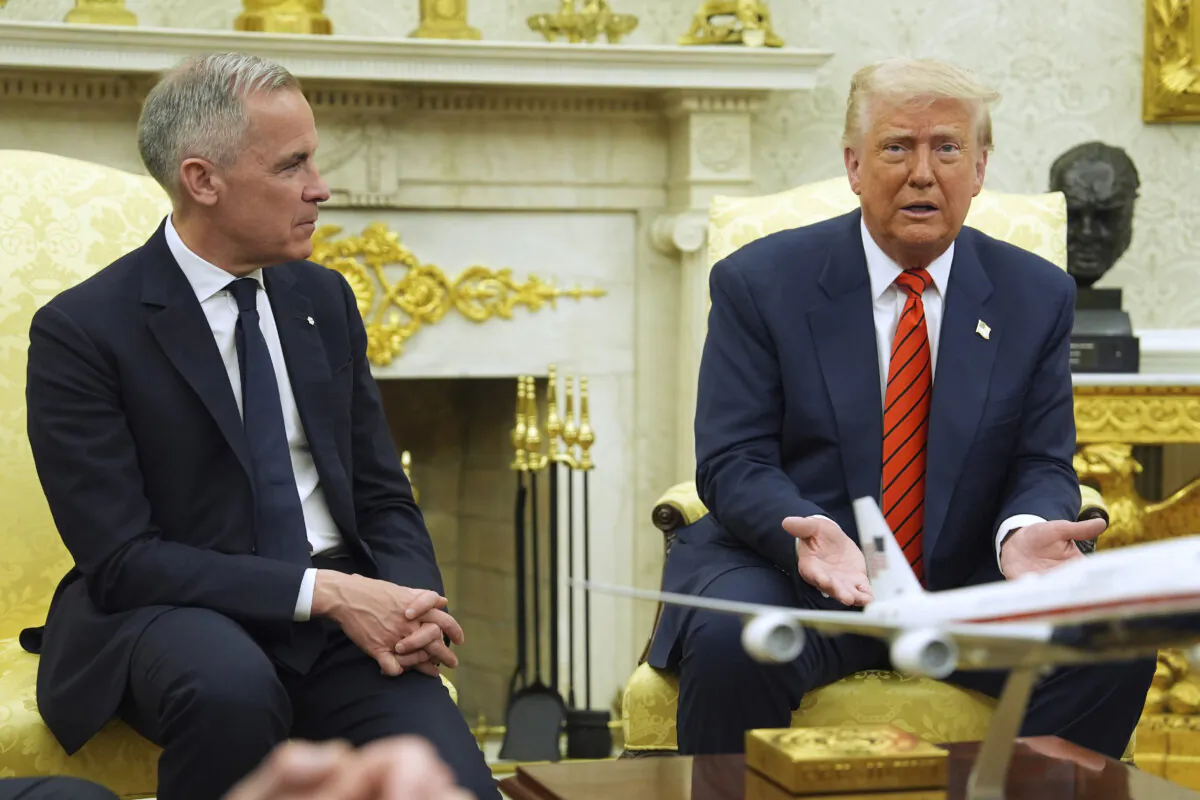

U.S. President Donald Trump said on July 31 it would be “very hard” to reach a trade agreement with Canada after Prime Minister Mark Carney announced plans to recognize a Palestinian state.
Trump’s remarks come one day ahead of the Aug. 1 deadline for a new tariff agreement between the two nations. Canada is the second-largest U.S. trading partner, buying $349.4 billion of U.S. goods in 2024 and exporting $412.7 billion to the United States.
If no deal is reached, the U.S. is set to impose a 35 percent tariff on all Canadian goods not covered by the United States–Mexico–Canada Agreement (USMCA).
“Wow! Canada has just announced that it is backing statehood for Palestine. That will make it very hard for us to make a Trade Deal with them,” Trump stated in a Truth Social post.
On July 28, Canadian Prime Minister Mark Carney said trade negotiations with the United States were in an intense phase and suggested that a deal may be possible.
Carney has previously acknowledged that it was unlikely Canada would avoid tariffs altogether, indicating that while a tariff-free agreement was improbable, the size and scope of the tariffs were still under discussion.
“We haven’t really had a lot of luck with Canada. I think Canada could be one where they’ll just pay tariffs, it’s not really a negotiation,” Trump told reporters at the White House on July 25.
The looming 35 percent tariff on Canadian goods entering the United States would be an increase from the current 25 percent level for non‑USMCA-compliant imports, which was imposed on Canada over President Donald Trump’s border security concerns related to fentanyl and illegal immigration.
In response, Ottawa has introduced a number of measures, including allocating $1.3 billion for border security and appointing a “fentanyl czar.”
Washington has signaled that it expects more steps to be taken.
Trump said that if Canada responded with counter-tariffs, it could lead to further tariff increases by the United States. Canada has not announced any countermeasures. Carney said the government has consistently defended workers and businesses and will continue to do so ahead of the Aug. 1 deadline.
Japan and the European Union have signed trade deals with the United States that still include tariffs of up to 15 percent on key exports, such as steel and aluminum.
The UK–U.S. Economic Prosperity Deal, agreed to in May, includes a 10 percent tariff on the first 100,000 British cars exported annually to the United States, rising to 25 percent beyond that. UK steel shipments will face no tariffs, avoiding the 25 percent sectoral levy.
Palestinian Recognition Tensions
Trump’s remarks come after Carney said on July 31 that Canada plans to recognize Palestinian statehood at the 80th U.N. General Assembly in September, conditional upon reforms by the Palestinian Authority. These reforms include holding general elections in 2026, in which the terrorist group Hamas can play no part, and rejecting the militarization of a Palestinian state.
Carney said that he had spoken with Palestinian Authority President Mahmoud Abbas and discussed the humanitarian situation in Gaza and a two-state solution.
While Carney said that Canada continues to support Israel’s right to exist in peace and security, he said that a lasting peace requires a viable and reformed Palestinian state.
Israel rejected Carney’s statement on recognizing a Palestinian state.
“The change in the position of the Canadian government at this time is a reward for Hamas and harms the efforts to achieve a ceasefire in Gaza and a framework for the release of the hostages,” the Israeli Foreign Ministry said on July 31.
Canada’s announcement follows similar statements by France and the UK.
U.S. officials have criticized the move by the European nations to recognize a Palestinian state.
“The United States will not participate in this insult but will continue to lead real-world efforts to end the fighting and deliver a permanent peace,” U.S. State Department spokesperson Tammy Bruce said on July 28.
 Friends Read Free
Copy
Facebook
Tweet
Friends Read Free
Copy
Facebook
Tweet