
U.S. President Donald Trump used a seemingly joking reference to the term “governor” with Prime Minister Mark Carney during a recent summit of global leaders in Egypt. Trump said his error in addressing Carney as “president” during his speech was significantly better than referring to him as a “governor,” as he had called Carney’s predecessor Justin Trudeau.
The exchange was captured on a hot mic after Trump’s Oct. 14 speech during the summit that gathered more than 20 world leaders to finalize a peace agreement between Israel and Hamas.
The summit represented the first step in a cease-fire arrangement orchestrated by Trump that led to the release of hostages by the Hamas terrorist group in exchange for the release of Palestinian detainees by Israel.
Trump during his speech referred to Carney as “the president” of Canada, saying the leader had called him to ask about the summit being held in the resort city of Sharm el-Sheikh.
Carney turned his head abruptly toward Trump, appearing surprised, after the president addressed him with the incorrect title.
“I appreciate you being here very much, Mr. President, fantastic,” Trump went on as he turned to address Carney who was standing on the stage along with other world leaders.
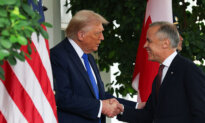
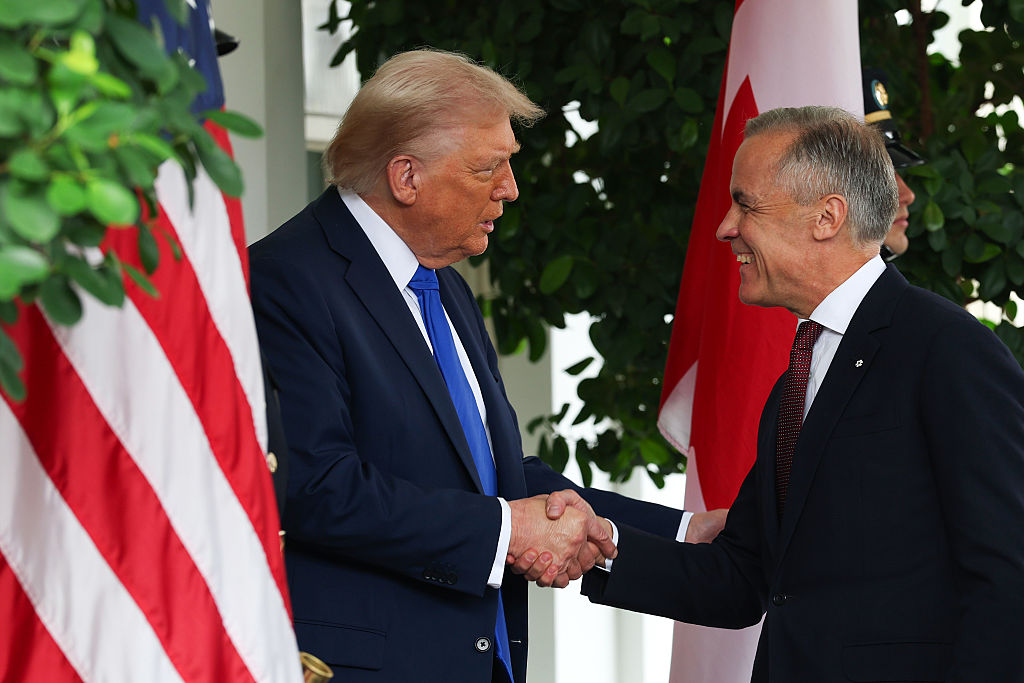
Trump asked the media to leave at the conclusion of his speech and was still standing near a microphone when Carney approached him and the pair shook hands.
“I’m glad you upgraded me to president,” Carney quipped.
“Oh, did I say that?” Trump said with a smile and playfully slapped Carney’s shoulder. “At least I didn’t call you governor.”
Trudeau-Trump Relationship
The “governor” reference comes nearly a year after Trump first used that term for a Canadian prime minister, and seven months after Trudeau stepped down as prime minister and Liberal leader in March, when he was succeeded by Carney.
Trudeau and Trump had a strained relationship, particularly during the president’s second term in office. The pair began volleying verbal barbs at one another after their meeting in Florida last November.
Trudeau visited Trump’s Mar-a-Lago estate a few weeks after Trump won the Nov. 5 election, but before he officially took office. The meeting was to address Trump’s threat to slap a 25 percent tariff on imports from Canada unless it stopped illegal border crossings and the flow of illicit drugs such as fentanyl into the United States.
It was at that meeting that Trump first said Canada should become the 51st U.S. state and Trudeau could be the governor. What was initially described as a joke was taken more seriously after Trump continued to make similar remarks on social media.
Trump referred to Trudeau as the “governor” of the “Great State of Canada” in a Dec. 10 social media post and also commented on Trudeau’s Jan. 6 announcement that he would step down as prime minister once a new leader had been chosen.
“Many people in Canada LOVE being the 51st State,” Trump wrote on his Truth Social platform on Jan. 6. “The United States can no longer suffer the massive Trade Deficits and Subsidies that Canada needs to stay afloat. Justin Trudeau knew this, and resigned.”
A day later he shared a map depicting Canada and the United States, with the American flag superimposed over both and suggested getting rid of the “artificially drawn” border between the two countries, saying the United States “basically protect[s] Canada” already.
Trudeau responded to Trump’s remarks on Jan. 7, saying there “isn’t a snowball’s chance in hell that Canada would become part of the United States” and also referred to the president as “Donald” during a speech in March, rather than the usual “Mr. Trump” or “Mr. President.”
The speech was in response to the 25 percent tariffs the White House imposed on all Canadian imports not covered under the United States-Mexico-Canada Agreement (USMCA), a move that Trudeau referred to as “a very dumb thing to do.” Ottawa responded in kind with retaliatory tariffs.
Carney-Trump Relationship
Carney, who campaigned on an “elbows up” approach to dealing with the United States has met with Trump three times since he took over from Trudeau at the end of April. None of the meetings have resulted in Trump easing tariffs on Canada, but the pair have shared a much friendlier relationship than Trudeau had with the president.
Trump has called Carney a “world-class leader” while the prime minister has referred to his American peer as “a transformative president” who he credited with helping to broker peace in a number of recent conflicts.
Despite the apparent good will between the two leaders, Trump has increasingly leveraged more tariffs against Canada since spring, raising its 25 percent tax on all imports that do not adhere to the USMCA to 35 percent on Aug. 1.
Trump has also implemented a 50 percent tariff on copper, aluminum, and steel imports, a 25 percent tariff on all cars and trucks not built in the United States, and a 35 percent tariff on softwood lumber.
He more recently put a 100 percent levy on branded drugs whose manufacturers don’t have plants in the United States, a 25 percent tax on heavy-duty trucks, a 50 percent levy on kitchen cabinets and bathroom vanities, and a 30 percent tariff on upholstered furniture. The tariffs took effect on Oct. 1.
Carney has responded by removing all of the tariffs that Canada had earlier slapped on American goods with the exception of its 25 percent tariffs on U.S. steel, aluminum, and auto imports.
He told reporters in an Aug. 22 press conference that Canada already has a better trade deal with the United States than “any other country,” and said that Ottawa now needs to do everything it can to “preserve this unique advantage” of lower tariffs relative to other countries.
Carney met with Trump in Washington last week to discuss trade. However, Trump said it would be more challenging for Canada to reach an agreement compared to other nations due to its close proximity to the United States, which he referred to as a “natural business conflict.”
 Friends Read Free
Copy
Facebook
Tweet
Friends Read Free
Copy
Facebook
Tweet