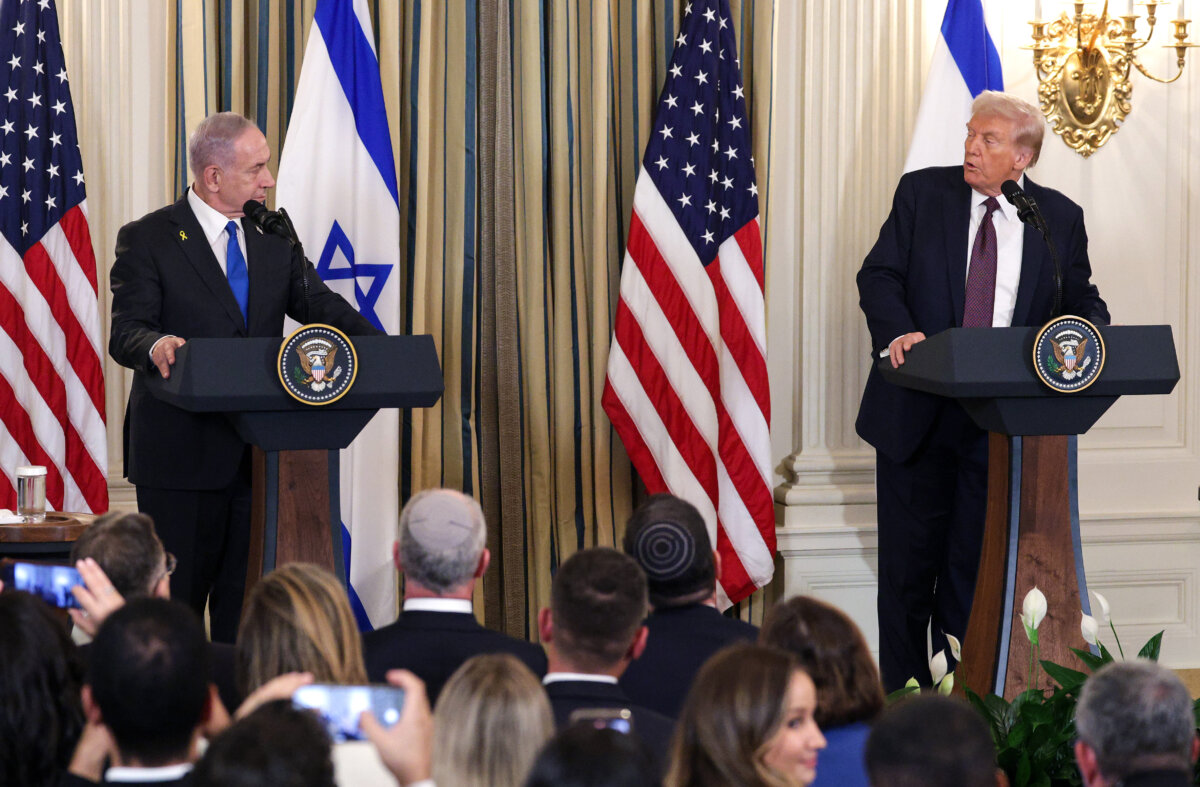

U.S. President Donald Trump invited Israeli Prime Minister Benjamin Netanyahu to the White House “in the near future,” during a phone call between the two leaders late on Dec. 1, the prime minister’s office said.
“The two leaders stressed the importance and obligation of disarming Hamas and demilitarizing the Gaza Strip, and discussed expanding the peace agreements,” Netanyahu’s office said in a Dec. 2 statement.
The visit would be Netanyahu’s fifth since Trump’s return to office in January. The leaders have met repeatedly in both the United States and Israel this year, holding talks and press conferences focused on Gaza and the October cease-fire that ended the conflict there after more than two years.
Trump has on numerous occasions voiced his support for Netanyahu and his leadership throughout the duration of the conflict between Israel and the terrorist group Hamas. Following the announcement of the cease-fire on Oct. 8, Trump attended the Knesset and described Netanyahu as a “good man” who knows “how to win.”
Netanyahu’s office said last month that Trump urged Israeli President Isaac Herzog to issue a full pardon for Netanyahu, who remains on trial for corruption charges. On Nov. 30, Netanyahu publicly requested a pardon.
The United States has also been pushing for the expansion of the Abraham Accords, a series of normalization agreements between Israel and Arab states signed in late 2020.
In May, Trump urged Syrian President Ahmed al-Sharaa to join the accords, and after their meeting in Washington on Nov. 10, the president stressed the importance of a strong dialogue between Damascus and Jerusalem.
Trump said on Dec. 1 that he is “very satisfied” with the progress of Syria’s interim government under Sharaa, formed after the overthrow of Bashar al-Assad in December 2024.
“It is very important that Israel maintain a strong and true dialogue with Syria, and that nothing takes place that will interfere with Syria’s evolution into a prosperous State,” Trump wrote in a Dec. 1 post on Truth Social.
Trump added that Sharaa is working toward “a long and prosperous relationship” between Israel and Syria.
Strained Relations
Amid the U.S. efforts to stabilize the region, the Israeli–Syrian relationship remains complicated.
The core dispute centers on the Golan Heights, a strategic plateau Israel captured from Syria in 1967 and later annexed. Trump recognized Israeli sovereignty over the area in 2019.
Israeli forces have maintained a presence in parts of Syria since the collapse of the Assad regime.
In July, the Israel Defense Forces (IDF) conducted a series of operations in Syria’s Sweida Province, which Netanyahu said were intended to protect members of the country’s Druze minority, who have been targeted by Sunni Bedouin fighters and remnants of Assad-aligned security forces.
During a visit to the buffer zone on Nov. 19, Netanyahu said that Israel attached immense importance to its defensive and offensive capabilities in the area, protecting its Druze allies, and safeguarding the country and its northern border opposite the Golan Heights.

Tensions rose again on Nov. 28 when six Israeli soldiers were wounded during an operation near the Syrian village of Beit Jinn, about four miles east of the buffer zone separating Israel from Syria along the Golan Heights.
The IDF said the raid targeted individuals linked to the Jamaa Islamiya militant group. According to the IDF, armed terrorists opened fire on Israeli troops, triggering return fire and close-air support from helicopters, drones, and fighter jets.
The military said the operation “concluded with all suspects apprehended and several terrorists eliminated.”
Syrian state news agency SANA, which reported 13 people killed and dozens wounded, said Israeli forces shelled Beit Jinn at 3:40 a.m. local time and Israeli troops entered the village. Residents confronted the Israeli forces, which responded, leading to “violent clashes,” it added.
Syria’s foreign ministry said the Israeli attack killed more than 10 civilians, including women and children, damaged property, and forced residents to flee their homes, accusing Israel of committing a “full-fledged war crime.”
Najat Rochdi, the U.N.’s deputy special envoy for Syria, condemned Israel’s incursion as “a grave and unacceptable violation of Syria’s sovereignty and territorial integrity, further destabilizing an already fragile environment.”
 Friends Read Free
Copy
Facebook
Tweet
Friends Read Free
Copy
Facebook
Tweet