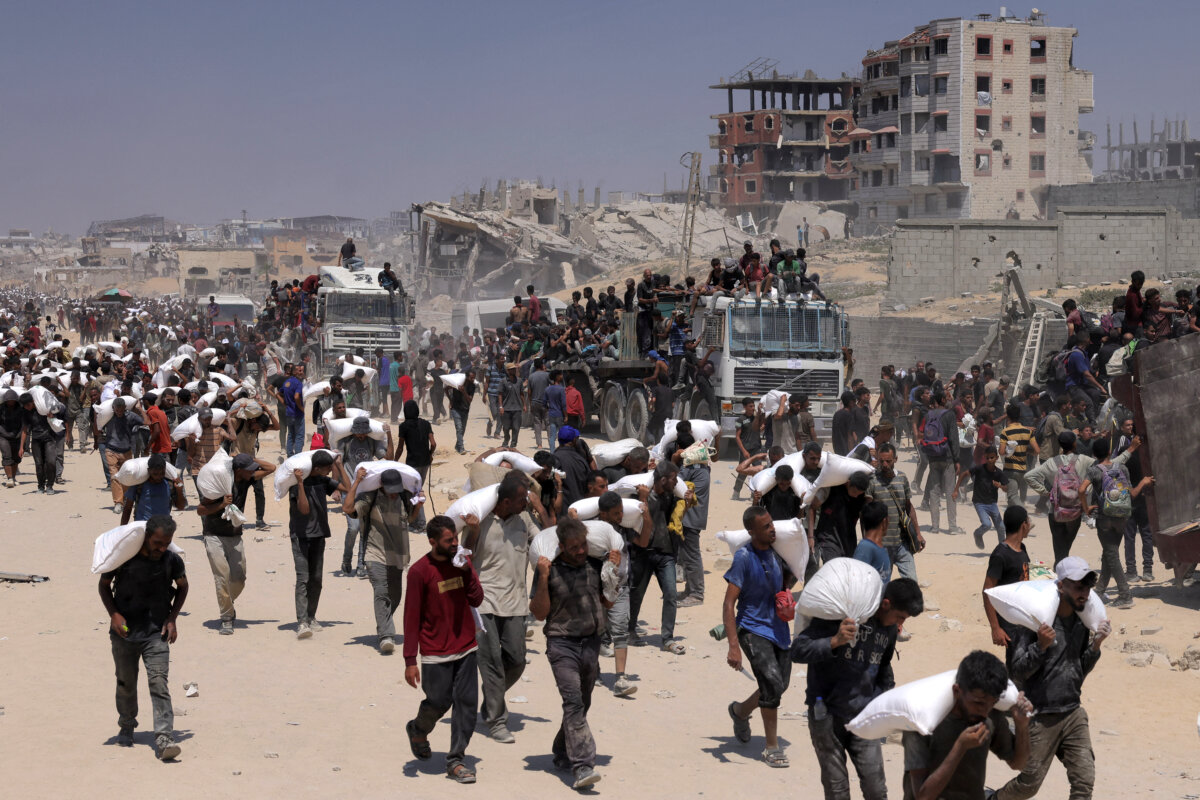

A U.N.-backed global food security body on July 29 stated that a worst-case scenario of famine is unfolding in the Gaza Strip, while humanitarian aid remains largely insufficient, a claim denied by Israeli authorities.
The Integrated Food Security Phase Classification (IPC), a global standard for assessing the severity of food insecurity, reported that famine thresholds have been reached for food consumption in most of the Gaza Strip and for acute malnutrition in Gaza City.
Governed by a multi-agency partnership, including the U.N. Food and Agriculture Organization and intergovernmental institutions, the IPC stated that malnutrition rose rapidly in the first half of July and that hospitals face a rapid increase in hunger-related deaths of children younger than 5.
The IPC did not provide evidence for its claims of malnutrition-related admissions to hospitals and hunger-related deaths among children in the Gaza Strip. The figures presented in the IPC report are based on sources that are not publicly available and could not be independently verified by The Epoch Times.
The IPC alert follows recent comments by U.S. President Donald Trump, who said that in his view, some of the children in the Gaza Strip were experiencing what he described as “real starvation” and that such suffering could not be faked.
In a bid to address the growing humanitarian crisis, Trump said on July 28 that the United States would establish food centers in the Gaza Strip that would not be surrounded by fences and that the nation could contribute up to $60 million toward the effort.
Other international efforts, coordinated by Israel, the United Arab Emirates, and Jordan, have also intensified this week to deliver aid to the enclave.
The UK has announced plans to work with Jordan to get aid into the Gaza Strip and to evacuate children who need critical medical assistance to the UK for treatment.
IPC Assessment
The United Nations described the context of the IPC alert as “stark,” citing the agency’s figures of one in three people now going without food for days at a time.
On July 30, the U.N. warned of “widespread starvation, malnutrition, and disease” that drive a rise in hunger-related deaths, which is the third famine indicator.
U.N. officials have described the latest IPC report as a “disaster” and “another alarm call.”
“This is not a warning,” U.N. Secretary-General António Guterres said. “It is a reality unfolding before our eyes. The trickle of aid must become an ocean. Food, water, medicine, and fuel must flow in waves and without obstruction. This nightmare must end. Ending this worst-case scenario will take the best efforts of all parties—now.”
According to IPC criteria, a famine is officially declared in an area when at least 20 percent of households face extreme food shortages, acute malnutrition reaches critical levels, and hunger-related deaths rise significantly.
The most severe category, IPC Phase 5 (Catastrophe), describes families with no access to food and no coping strategies left, facing imminent starvation and death.
Even if less than 20 percent of the area’s population is affected, households can still be classified under this category, even if the area as a whole does not meet full famine thresholds.
In May, the IPC stated that nearly half a million people in the Gaza Strip were living in “catastrophic” conditions.
Israel maintains that it does not have a policy of causing starvation in the Gaza Strip and that there is no starvation taking place.
The Coordination of Government Activities in the Territories (COGAT), which operates under Israel’s military, criticized the U.N.’s analysis for overlooking the large influx of aid during the hostage-release deal—25,200 trucks, mostly carrying food. It noted that the IPC relies on U.N. data, which, during the cease-fire, captured only about one-third of the actual aid delivered.
In its own analysis, Israel said the IPC report excluded Israeli-supplied data and omitted significant improvements in aid delivery, such as expanded crossings, airdrops, field hospitals, and private sector contributions.
Aid Efforts
Speaking to reporters on July 29, Israeli Foreign Minister Gideon Sa’ar said anyone concerned about the humanitarian situation should consider who is responsible for the suffering of Palestinians in the Gaza Strip and for the continuation of the war.
“There is only one, clear answer: [the terrorist group] Hamas,” he said.
Israeli Prime Minister Benjamin Netanyahu has pledged to continue working with international agencies, the United States, and European nations to ensure that large amounts of humanitarian aid flow into the Gaza Strip.
The statement follows a tactical pause in military operations in parts of the Gaza Strip to allow for the increased delivery of humanitarian aid, which was announced on July 27.
COGAT, which blames the Hamas terrorist group for looting aid convoys, said Israel has invested significant efforts in advancing the humanitarian response. On July 30, it reported that more than 200 aid trucks were collected and distributed by the U.N. and international organizations on July 29.
More than 220 additional trucks entered the Gaza Strip and are currently awaiting collection and distribution, alongside hundreds of others still queued for U.N. pickup, it noted.
COGAT also said four tankers of U.N. fuel entered the territory to support the operation of essential humanitarian systems.
Efforts to distribute aid to the Gaza Strip include the operation of the Gaza Humanitarian Foundation (GHF), a U.S.-backed, Israeli initiative launched in May.
The IPC stated that most of the food distributed by the GHF is not ready-to-eat and requires water and fuel to prepare, resources that it stated are largely unavailable in the territory. It noted that accessing GHF distribution points often requires long, risky journeys, with uneven access across regions.
U.S. State Department spokesperson Tammy Bruce said on July 29 that the GHF has been effective in keeping aid from falling into Hamas’s hands.
Trump confirmed on July 28 that the GHF will be part of the new U.S. plan to establish food centers in the Gaza Strip.
 Friends Read Free
Copy
Facebook
Tweet
Friends Read Free
Copy
Facebook
Tweet