

Explainer
Ottawa is bolstering the enforcement of tax laws and coordinating inspection blitzes with provincial governments in an effort to uncover trucking companies that are manipulating the system and fostering unsafe driving practices on Canada’s highways.
Alberta is also acting to increase safety by shutting down several driving schools and commercial trucking firms that fail to comply with provincial regulations. In addition, the province has said it may increase fines for truck drivers who collide with bridges, as data shows that Edmonton’s High Level Bridge was hit by commercial carriers 15 times in 2025.
The Canadian crackdown on the trucking industry comes at a time when its southern neighbour is adopting new measures for the sector after a series of fatalities on U.S. roads. The accidents have been linked to foreign drivers operating large trucks that authorities say weren’t qualified to operate, and many of those drivers weren’t able to speak English to pass the required certifications.
US Crackdown
The issue received increased scrutiny after an Indian national truck driver who speaks little English allegedly caused a fatal crash in Florida.
Harjinder Singh was operating a semi-truck on the Florida Turnpike in St. Lucie County last August when he attempted an illegal U-turn. His trailer blocked all lanes, causing a minivan to collide with it at high speed, killing three occupants.

The Department of Homeland Security (DHS) said Singh obtained a commercial driver’s licence in California despite being an illegal immigrant who had failed an English language proficiency assessment.
The 28-year-old native of India has since been charged with three counts each of vehicular homicide and manslaughter.
A similar case occurred in California in the summer of 2024, when the driver of a commercial 18-wheeler allegedly failed to stop at a lane closure, causing a multi-car pileup that left a 5-year-old girl in a coma for three weeks, according to a post from Homeland Security. She now lives with life-altering injuries. The DHS said the driver, Partap Singh, entered the country illegally in 2022.
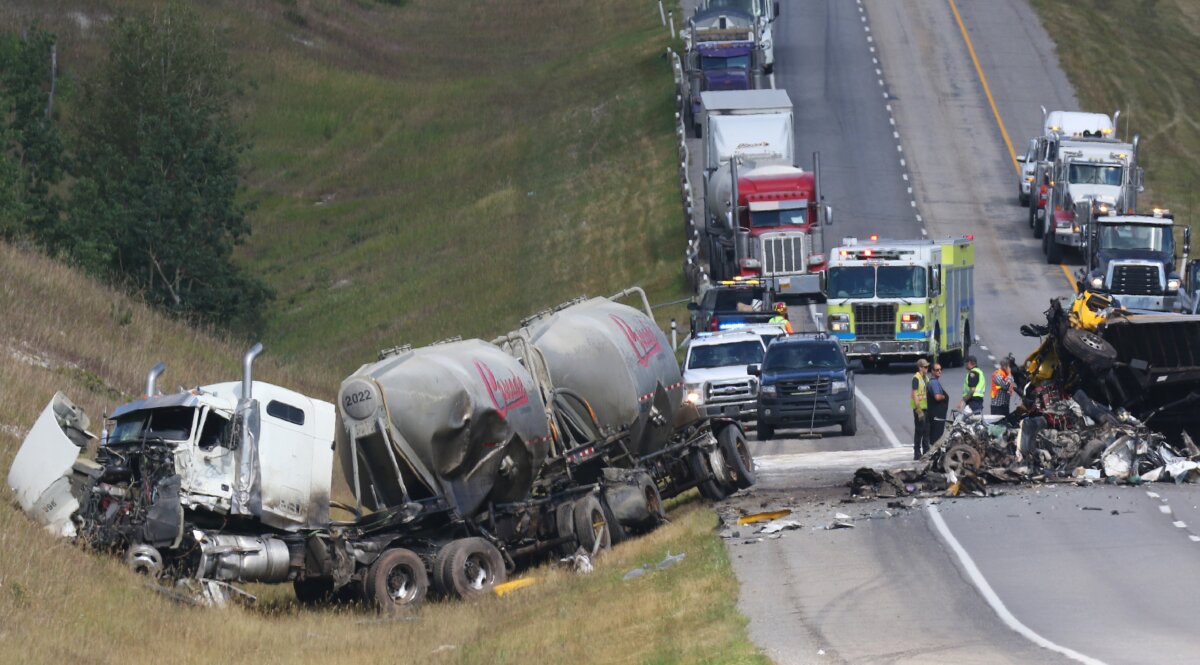
Another Indian national, whom DHS also described as entering the United States illegally in 2022, was involved in a fatal crash in November 2025. The collision occurred after the semi-truck and trailer being driven by Rajinder Kumar jackknifed, blocking both lanes of an Oregon highway. An SUV collided with the truck, killing both occupants.
The series of crashes has sparked concern about commercial licences being issued in the United States despite drivers being unable to read English road signs.
The English language proficiency (ELP) standard has been a long-standing U.S. law, but the White House said enforcement had weakened over the years, prompting U.S. President Donald Trump to sign an executive order in April 2025 to bolster commercial drivers requirements.
U.S. Secretary of State Marco Rubio announced shortly after the fatal Florida crash that worker visas for commercial truck drivers would be paused.
An audit performed by the Department of Transportation (DOT) found that some states were not enforcing English language proficiency measures, leading the department to announce restrictions on immigrants obtaining commercial driver’s licences in September.
The issue has been polarizing in the United States, marked by political divisions.
Florida, the state in which the fatal accident occurred, was quick to make changes. The state is actively enforcing the existing federal ELP mandate, in addition to carrying out immigration status checks. Drivers who do not meet the English proficiency requirement are immediately taken off the road.
The DOT determined that some Democrat-led states like California, Washington, and New Mexico, were found to be lax in enforcing English language proficiency measures, and the federal department demanded that the states present a plan for change or risk losing federal funding.
While Washington and New Mexico implemented changes, California did not, and the DOT withheld more than US$40 million in funding from California in October 2025 for non-compliance.
California has disputed the Trump administration’s assertions that it is failing to enforce existing ELP standards, arguing that its current testing process already meets requirements.
The U.S. federal government set a Jan. 5 deadline for revoking all commercial driver licences for foreign drivers, but the California Department of Motor Vehicles (DMV) recently announced an extension to March 6 to allow some drivers to re-test, a move that the DOT has signalled could lead to additional cuts of US$160 million in federal funding.
The Federal Motor Carrier Safety Administration (FMCSA) on Dec. 30 said it will issue more than US$118 million in grants to improve roadway safety in the United States, boost commercial vehicle enforcement, and offer high-quality training for military veterans entering the trucking industry.
Call for Changes in Canada
The Canadian Trucking Alliance (CTA) has described recent U.S. actions as a wake-up call to address licensing and immigration issues and prevent similar problems from occurring in Canada.
In an August 2025 press release, the CTA said foreign drivers are crucial for addressing severe driver shortages but also stressed the need for better oversight, licensing integrity, and crackdowns on schemes of unscrupulous trucking companies attempting to avoid the rules.
The group said changes in the United States will also impact Canada. It advocated for stricter rules against exploitation and fake licences while also ensuring compliant fleets aren’t harmed.
“The announcement by Secretary Rubio should be the clearest signal yet the non-compliant segment of the Canadian trucking industry which erodes the integrity [of] driver licensing, training, safety compliance and immigration systems, must be dealt with immediately,” the CTA said in the press release. “The growth of unsafe and unethical trucking fleets undermining lawful and compliant cross-border operators must end.”
Unscrupulous trucking companies “endanger and abuse” the labour rights of the truck drivers they employ by subjecting them to hazardous working environments and other unreasonable demands, the CTA said, such as operating commercial vehicles for which they lack the necessary qualifications.
Canada has been grappling with a truck driver shortage and has relied on immigration to fill the gap, granting temporary work permits in a bid to address the shortfall. Federal figures show that immigrants account for nearly 34 percent of all transportation sector workers. An analysis of government data by trucking-focused publication Trucknews.com found that more than 10 percent of the government-reported abuses of the temporary worker program occur in the trucking sector, and most monetary penalties go unpaid.
Several trucking companies in Canada were found to be violating the rules of the temporary foreign worker program, including one Manitoba-based company that was fined $258,000 for failing to provide adequate wages and safe working conditions.
An Alberta-based company was fined $152,250 for similar violations the same year. Both companies were slapped with a five-year ban from the program.
Driver Inc. Concerns
The Canadian Trucking Alliance (CTA) and the Truck Training Schools Association of Ontario have also voiced concern about driver misclassification, commonly referred to as the Driver Inc. system, a contentious practice within the Canadian trucking sector that is often tied to the hiring of foreign drivers.
Trucking firms using this model classify their drivers as independent contractors, enabling them to reduce expenses by evading payroll deductions such as for the Canada Pension Plan (CPP) and Employment Insurance (EI). This misclassification also denies drivers access to benefits and results in the government losing billions in tax revenue.
The practice has been described by the CTA as a crisis of “fairness, safety and long-term stability” that fuels labour abuse and creates an uneven playing field for compliant carriers.
Employing this model enables unscrupulous companies to gain an unfair competitive edge, with projected cost reductions reaching as high as 35 percent, which ultimately undermines compliant carriers that adhere to established labour and tax regulations, the CTA says. The organization estimates that this tax evasion scheme costs the Canadian government more than $5 billion annually in lost tax and benefit contributions.
Government Crackdowns
Federal and provincial governments are partnering to combat the use of the Driver Inc. method through inspection blitzes at stations in Ontario, Alberta, and British Columbia. These roadside checks with provincial transportation authorities and Employment and Social Development Canada (ESDC) are designed to identify worker misclassification in real time.
Alberta carried out a weeklong assessment of commercial driver status and classification in July 2025, during which 195 drivers were stopped at inspection stations. Among these, 20 percent were suspected of being misclassified, which included a number of temporary foreign workers.
The issue, which is also rampant in Quebec, was highlighted by Bloc MP Xavier Barsalou-Duval during an October 2025 press conference in which he referred to Driver Inc. as “a downright cancer in the trucking industry.”
“For three consecutive years, fatalities involving commercial vehicles have increased in Canada,” Barsalou-Duval said. “Between 2023 and 2024 in Quebec, we’re talking about a 35 percent increase in fatalities.”
He noted that Quebec truckers protested in various cities in late September to demand stricter trucking rules and better oversight in the industry.
Atlantic Provinces Trucking Association executive director Chris McKee told the federal Standing Committee on Transport, Infrastructure and Communities that Driver Inc. has weakened the trucking industry to the point that compliant companies are being forced to downsize fleets and reduce truck counts.
“We are seeing them pause or scale back employee benefits, such as health and dental benefits and RRSP contributions,” he told the MP committee during his Oct. 9 testimony. “In worst-case scenarios, they are laying off staff just to stay afloat and to compete against the bad actors that are flooding our marketplace.”
Government Measures
Aside from inspection blitzes, Ottawa has allocated $77 million over four years to the Canada Revenue Agency (CRA) to boost monitoring, auditing, and enforcement of the tax rules for the trucking industry.
As part of government measures, in early December 2025 Canada’s federal tax authority announced the reinstatement of penalties for failure to report service fees on T4A slips for the 2025 tax year and subsequent tax years.
Businesses that derive more than 50 percent of their income from trucking will incur fines for not reporting to the CRA payments to Canadian-controlled private trucking companies for services exceeding $500 in a calendar year. These payments must be reported on the T4A slip by Feb. 28, 2026.
Alberta has also introduced measures to target driving schools that may be flaunting the law. The province last fall mandated the closure of five driver training schools, suspended the operations of 13 commercial trucking companies, dispatched 39 “disciplinary letters,” imposed fines exceeding $100,000, issued six action plans to address issues, and revoked the licences of 12 driving instructors, according to an Oct. 3 government announcement.
“Anyone cutting corners or operating unsafe trucks will be removed from our roads,” Alberta Transportation and Economic Corridors Minister Devin Dreeshen said in the statement. “Alberta truckers have earned a reputation as some of the most trusted drivers in the country, and we will not allow a few bad actors to undermine that trust.”
The province indicated that it is focused on improving information exchange with the federal government and is intensifying efforts to combat “chameleon” trucking carriers that modify their names or locations to evade provincial regulation.
Alberta’s transportation ministry told The Epoch Times on Dec. 29, 2025, that it was also contemplating strengthening penalties to safeguard bridges from collisions involving commercial trucks, noting that as of Nov. 18, 2025, Edmonton’s High Level Bridge had been struck by commercial carriers five times.
 Friends Read Free
Copy
Facebook
Tweet
Friends Read Free
Copy
Facebook
Tweet