



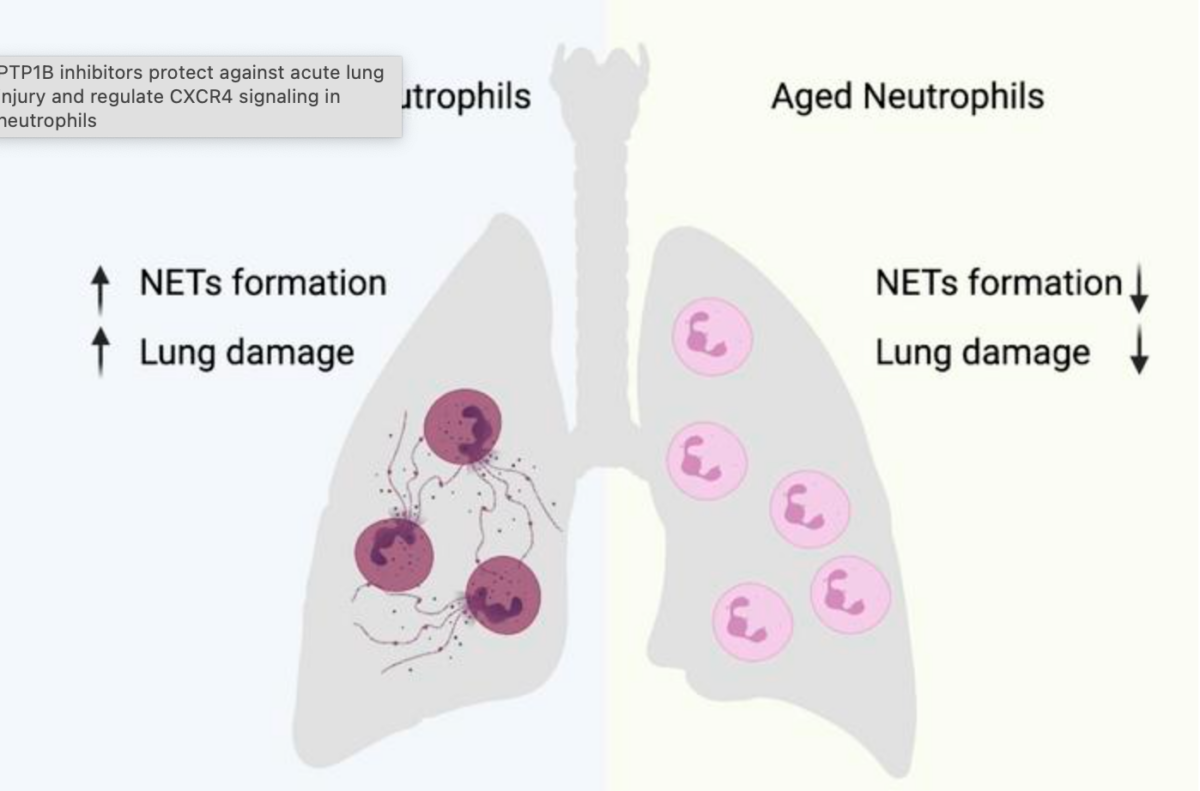
Acute lung injury is inherently a life-threatening disorder which can lead to acute respiratory distress syndrome (ARDS), a common global cause of death due to COVID-19.
The consequence of acute lung injury, ARDS, can come from many causes, but the overaction of neutrophils is one of the prominent signs of it.
Neutrophils are a type of white blood cells that can make up 50-75 percent of all kinds of white blood cells in humans. They play a leading role in defending against infection for the body. However, the aberrant activation of neutrophils will easily backfire on lung tissues because lung tissue is saturated with blood vessels.
In a recent study conducted by Nicholas Tonks, Caryl Boies professor of cancer research at Cold Spring Harbor Laboratory (CSHL), and his team, a drug candidate was found to have the effects of preventing lethal lung inflammation in mice.
This drug candidate is used to inhibit PTP1B, a protein that regulates signaling events of basic importance to homeostasis and inflammation, and regulates adaptive and innate immune cell signaling.
The function of PTP1B is controversial and dependent on cellular context and stimuli. In this study, PTP1B is said to be a negative regulator.
Researchers have found that PTP1B inhibitors can improve survival and ameliorated lung damage in the transfusion-related acute lung injury mouse model. Treatment with PTP1B improved survival in additional models of sepsis.
In addition, treatment with PTP1B causes the increase of neutrophils, which are inherently critical for the initiation of transfusion-related acute lung injury. However, this PTP1B inhibitor can induce an aged-neutrophil phenotype in vivo.
According to the study, neutrophil aging links to the disease. As neutrophils age, they become less dangerous. Neutrophil aging was highlighted as a “programmed disarming,” decreasing neutrophil capacity to inflict damage after infiltrating the lung. Therefore, regulating neutrophil aging may protect lung tissues from damage.
“An aged neutrophil is like a soldier without a weapon,” Nicholas Tonks’ graduate student Dongyan Song explains. “So regardless of how many neutrophils flood an area, they won’t be able to do serious damage.”
Linking to severe inflammatory conditions such as COVID-19, Tonks says, “When you think about COVID-19, acute lung injury and ARDS underlie the fatal aspects of the disease. And so, when the pandemic took hold, we were wondering whether there was anything we could do to help, to provide an understanding of this aspect of the disease and suggest ways it could be treated.”
This project was part of a program of COVID-related research at CSHL. According to Tonks, this collaboration was essential to this discovery. He and his student want to understand more about how PTP1B inhibitors affect the immune system and the PTP protein family which was discovered by Tonks 30 years ago.
They hope to find more new treatments and preventative measures for various inflammatory diseases. His lab is currently working with DepYmed, Inc. to take PTP1B inhibitor drug candidates into clinical trials.
In targeting proteins like PTP1B, Tonks increases more study of other small molecule drug candidates like PTP1B inhibitor so that he can provide new approaches for treating other leading diseases including cancer, metabolic and neurodegenerative diseases.