



Researchers in California say they’ve discovered a biological “switch” that triggers cancer cells to self-destruct, which could open the door for improved treatments.
Scientists at the UC Davis Comprehensive Cancer Center in Sacramento found a crucial epitope, or a segment of a larger protein, on the CD95 receptor that releases a signal leading to cell death.
“CD95 receptors, also known as Fas, are called death receptors,” a UC Davis news release states. “These protein receptors reside on cell membranes. When activated, they release a signal that causes the cells to self-destruct.”
The UC Davis research team published the findings in the journal Cell Death & Differentiation on Oct. 14.
The study’s senior author, Jogender Tushir-Singh, an associate professor in the Department of Medical Microbiology and Immunology, said their discovery is the first to successfully target the kill “switch.”
“We have found the most critical epitope for cytotoxic Fas signaling, as well as CAR T-cell bystander anti-tumor function,” Mr. Tushir-Singh said in a statement.
Chimeric antigen receptor (CAR) T-cell therapies, which usually cost around half a million dollars, involve engineering patient T cells to attack tumors by grafting them with a specific tumor-targeting antibody.
So far, the CAR T-cell treatment has only demonstrated efficacy against leukemia and other blood cancers, but not for those suffering from solid tumors such as breast, lung, ovarian, and bowel cancer. However, experts are hopeful that modulating the death receptors could extend the benefits of CAR T-cell therapy to solid tumors.
“Previous efforts to target this receptor have been unsuccessful. But now that we’ve identified this epitope, there could be a therapeutic path forward to target Fas in tumors,” Mr. Tushir-Singh said.
As of Jan. 1, 2022, there were over 18 million Americans with invasive cancer, according to the American Cancer Society. In 2023, an estimated 1.9 million new cancer cases are anticipated in the United States, and roughly 609,820 cancer-related deaths are expected, making cancer the second leading cause of death after heart disease. These projections are based on reported cancer incidence and mortality data up to 2019 and 2020, respectively.
Historically, cancer tumors have been treated with surgery, chemotherapy, and radiation, which may show initial success, but researchers note that therapy-resistant cancers often reemerge.
To disrupt this pattern, researchers are exploring immunotherapies such as CAR T-cell treatments and antibodies that activate immune checkpoint receptors. While experts see this as promising, they note that these approaches have demonstrated effectiveness in only a very limited number of patients with solid tumors.
This is because tumor microenvironments “are good at keeping T cells and other immune cells at bay.”
“It doesn’t matter how well we engineer the immune receptor-activating antibodies and T cells if they cannot get close to the tumor cells. Hence, we need to create spaces so T cells can infiltrate,” Mr. Tushir-Singh emphasized.
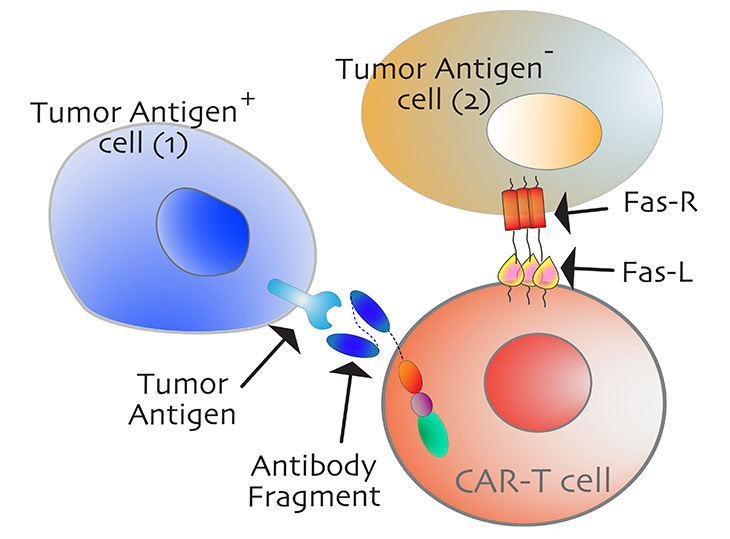
The new discovery of the epitope, which the UC Davis release referred to as a switch, could effectively have a “one-two punch against tumors” by killing tumor cells while also making immunotherapies more effective.
The researchers believe that death receptors, like Fas, could provide a breakthrough by triggering programmed cell death in tumor cells. Developing drugs that enhance death receptor activity could become a crucial tool against tumors. But no Fa agonists have made it to clinical trials. However, researchers hope this new discovery could change that.
The study also suggests that tumors with a mutated version of the Fas receptor epitope may not respond to CAR T-cell therapy.
This discovery could lead to new tests identifying patients who would benefit most from CAR T-cell immunotherapy, with researchers believing it “sets the stage” for the development of antibodies that activate the cancel cell kill switch, potentially for solid tumors.
“This is a definitive marker for bystander treatment efficacy of CAR T therapy,” Mr. Tushir-Singh said. “But most importantly, this sets the stage to develop antibodies that activate Fas, selectively kill tumor cells, and potentially support CAR T-cell therapy in solid tumors.”