



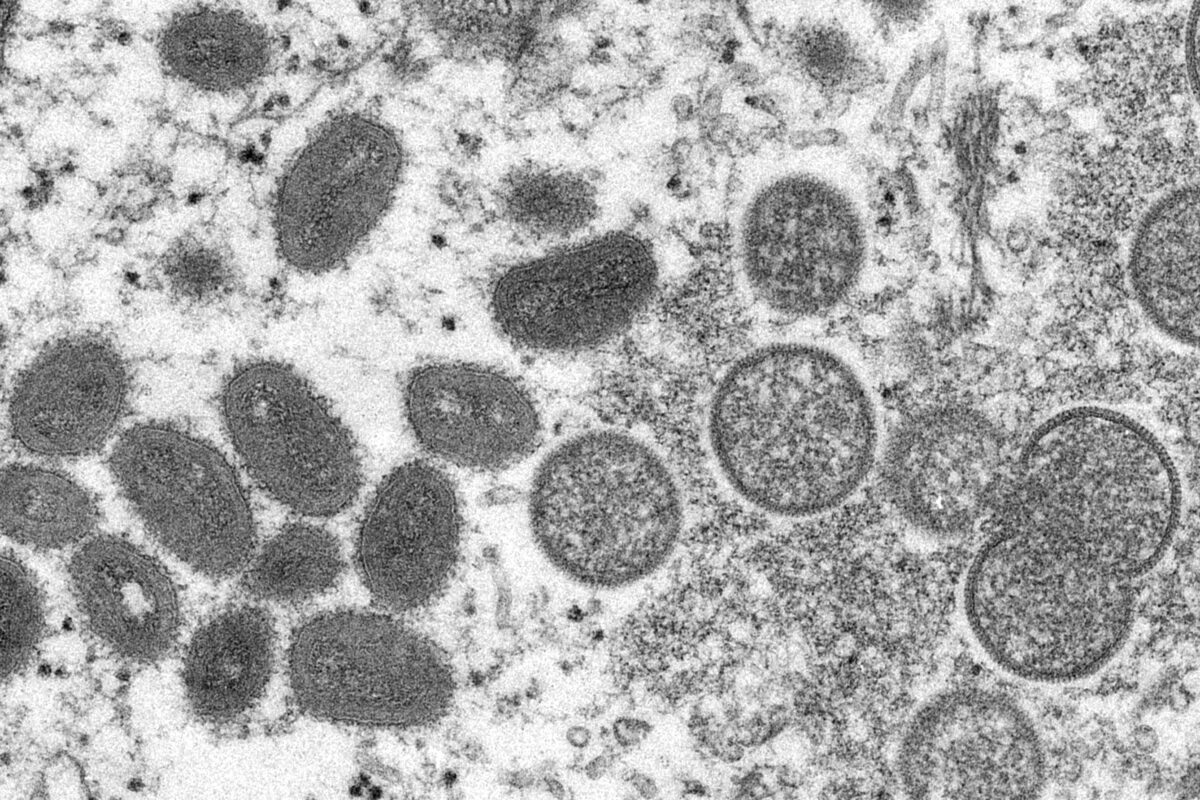
The World Health Organization (WHO) has identified the first incidence of sexual transmission of a severe strain of monkeypox (mpox), reported in a man who engaged in homosexual activity.
The first known case of sexually transmitted Clade I monkeypox virus (MPXV) infection was identified in a Belgian resident who was visiting the Democratic Republic of the Congo, the WHO said in a Nov. 23 post. There are two known strains of MPXV: Clade I and Clade II, with the former being the more virulent strain.
The Belgian resident was homosexual, the organization said, adding, “During his travel in the Democratic Republic of the Congo, he visited discretely operating known clubs of men who have sex with men and had several sexual contacts.”
“He showed symptoms on the day of his arrival in the country, and with the mpox incubation period most often being more than one day, available information suggests that exposure took place outside the Democratic Republic of the Congo.”
The man arrived in the country on March 15 and admitted to experiencing anal itching and discomfort on the same day. On March 17, he developed anal lesions and blisters on his genitals. On March 23, the individual consulted a doctor and was subsequently identified as being infected with Clade I MPXV.
Authorities contacted 27 individuals whom the man had come into contact with during his stay in the Democratic Republic of the Congo. Five cases of infection were identified—four men and one woman. The Belgian resident went back to his country on May 5 after recovering.
“This cluster of mpox cases represents the first documented sexual transmission of MPXV Clade I. It is also the first described transmission of MPXV Clade I among men who have sex with men,” the WHO stated.
An additional man, also homosexual, was confirmed to be infected later on.
Since 2022, an “epidemic” of MPXV infections that are also sexually transmitted has been ongoing globally. However, this outbreak is from the less-virulent Clade II strain of the virus and is also “mainly driven” by homosexual contact.
“All countries, including their health authorities and clinicians/health care workers, should take note that the global mpox outbreak is ongoing; and, furthermore, the occurrence of sexual transmission of the Clade I virus has been confirmed,” the WHO stated.
“It is therefore strongly advised that countries continue to follow the Standing Recommendations of the Director-General of the WHO issued in August 2023.”
Overall, Congo reported 12,569 suspected cases of monkeypox between Jan. 1 and Nov. 12, which is the “highest number of annual cases ever reported,” the organization stated.
This included 581 suspected monkeypox deaths. “The risk of mpox further spreading to neighboring countries and worldwide appears to be significant,” the WHO stated.
US Infections
Data from the U.S. Centers for Disease Control and Prevention (CDC) show that the 2022–2203 global mpox outbreak had led to 92,048 confirmed infections as of Nov. 21. Of these, 90,076 cases were identified in locations “that have not historically reported mpox.”
The largest number of infections in this outbreak has been reported in the United States, with 31,186 cases, followed by Brazil, with 10,967 cases. Spain reported 7,647 infections, and Mexico, Colombia, and France registered more than 4,000 cases each.
The United States also reported the largest number of deaths, with 55 of the infected individuals dying. Mexico registered 32 deaths, Peru, 20, and Brazil, 16.
A May 26 report by the CDC stated that monkeypox “disproportionately affected gay, bisexual, and other men who have sex with men.”
As of Oct. 26, there were 28,550 monkeypox infections among U.S. men compared to 877 among women and 343 among transgender individuals.
According to the CDC, people with monkeypox often get a rash on their “hands, feet, chest, face, or mouth or near the genitals.” During the virus’ incubation time—three to 17 days—no symptoms are seen.
Rashes can develop through several stages, including scabs, before they heal. They can initially look like pimples or blisters and can be itchy and painful.
Other symptoms include fever, chills, headaches, exhaustion, and muscle aches. Symptoms usually start after three weeks of exposure to the virus.
“A person with mpox can spread it to others from the time symptoms start until the rash has fully healed and a fresh layer of skin has formed,” according to the CDC.
The Clade I type of the virus has a fatality rate of about 10 percent, according to the CDC.
Monkeypox infections in the 2022–2023 outbreak are from Clade II, or more specifically, Clade IIb, which are “rarely fatal” since “more than 99 percent of people who get this form of the disease are likely to survive,” it stated.
“However, people with severely weakened immune systems, children younger than 1 year of age, people with a history of eczema, and people who are pregnant or breastfeeding may be more likely to get seriously ill or die.”