



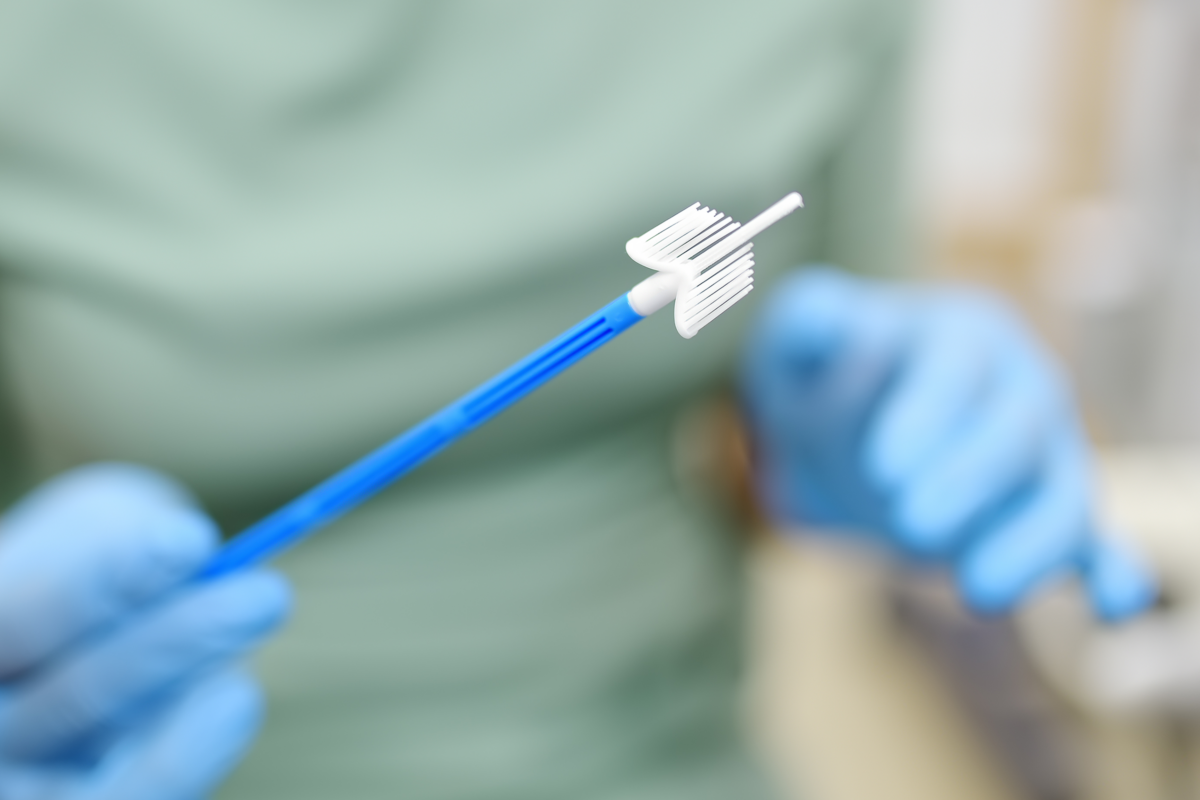
Women will soon be able to screen for cervical cancer from the privacy of their homes, according to new federal updates on cervical cancer screening guidelines.
New guidance from the Health Resources and Services Administration (HRSA) now includes a self-collection test as an official screening option.
The change primarily affects women ages 30 to 65, who are advised to test for the presence of human papillomavirus (HPV), either through self-testing or in a clinical setting. HPVs are strongly linked to cervical cancer.
In contrast, women ages 21 to 29 are still advised to undergo Pap smears, which cannot be self-administered.
The new at-home test option will be covered by private insurance starting in January 2027.
“It just gives them [women] another kind of option and tool in the toolkit to make sure that everybody gets the screening that we recommend,” Dr. Nicholas Teodoro, obstetrician-gynecologist, assistant professor and associate director for Global Women’s Health at Stony Brook Medicine, told The Epoch Times, adding that, overall, it’s “really good” for patients.
The new guidelines aim to address gaps in screening.
About half of women diagnosed with cervical cancer have never been screened or are not up to date with screening, according to the Centers for Disease Control and Prevention.
How the New Screening Works
The updated guidance from HRSA recommends that women ages 30 to 65 have a high-risk human papillomavirus (hrHPV) test every five years.
They can also opt for a combination of HPV and Pap tests every five years, or a Pap test alone every three years if HPV testing isn’t available, as the previous guidelines advised.
The hrHPV test can be done by a doctor, though testing kits approved by the U.S. Food and Drug Administration also allow women to self-test and send their results to a laboratory for testing. The testing kit uses a self-collecting device similar to a tampon.
HPV causes most cervical cancers, and this test checks for the virus strains most likely to lead to the disease.
Only FDA-approved tests are recommended for self-collection. In May 2024, the FDA approved tests that allow patients to self-collect samples in a clinical setting, and in May 2025, it approved the first at-home self-collection kit, available by prescription.
A positive HPV result does not mean cancer. It indicates that further testing with a health care provider may be needed to check for precancerous cells or early-stage cancer.
For women aged 21 to 29, it’s still recommended that they have a pap smear test every three years rather than the new self-collection test. Pap smears test for the presence of cervical cancer cells rather than the HPV virus.
Why Expanding Access Matters
Dr. Joan Tymon-Rosario, a gynecologic oncologist at Northwell Health Cancer Institute, told The Epoch Times that expanding screening options, especially the new updates of self-collected HPV testing, will help women who face barriers to traditional in-office examinations.
“It’ll increase participation and early detection,” she said. “So that over time, this will gradually lead to an expected significant reduction in cervical cancer incidence, and hopefully, mortality.”
Regular screening is critical because cervical cancer often develops without symptoms. When caught early, it has a 90 percent survival rate. However, when diagnosed at an advanced stage, that rate drops to just 20 percent, Tymon-Rosario noted.
Cervical cancer screening has been a major public health success over the past 50 years, reducing incidence and deaths by more than 50 percent, according to the American Cancer Society.
Cervical cancer is one of those cancers that’s largely preventable, noted Teodoro, and there are three methods by which it can be prevented.
The first is vaccination. “The HPV vaccination is really effective because cervical cancer is caused by human papillomavirus or HPV,” he said.
The second is screening, which includes Pap tests or HPV testing.
“And then the third is treatment,” Teodoro said, of pre-cancers identified by screening. In most cases, treatment involves thermal ablation or cryotherapy of the pre-cancerous tissue.
He cautioned that in the short term, there might be a bump in identification of pre-cancers, especially in women who’ve never been screened or high-risk groups that don’t get screening at all.
“But long-term,” he added, “As we treat those pre-cancers, we’re going to see a decrease in cervical cancer overall, and we think that we can get to a near elimination of cervical cancer globally.”
The guidance also aligns with recent FDA approvals.