



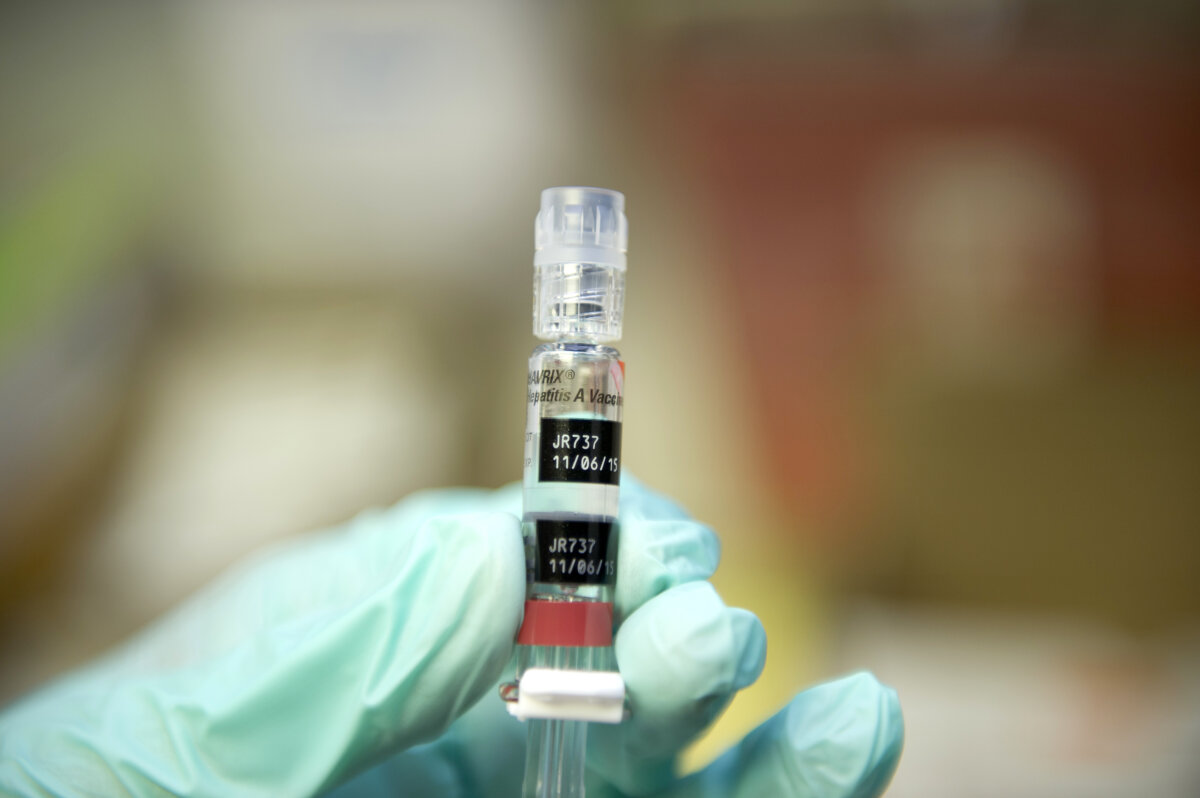
A vaccine trial partially funded by the United States is on hold pending a review, African officials announced on Jan. 22.
There is no record of an ethics committee meeting to review the trial, Guinea-Bissau’s Health Minister Quinhi Nantot said during a news conference held by the Africa Centers for Disease Control and Prevention.
“We think they did not meet and did not address the matter properly,” he said, according to a translation of his remarks, which were made in Portuguese.
Africa Centers for Disease Control and Prevention Director-General Jean Kaseya told the briefing that clinical trials should not be conducted in Africa unless they are approved by national regulators and ethics committees, and that he supports whatever decision Guinea-Bissau officials ultimately make regarding the U.S.-funded trial.
The trial is paused but is expected to ultimately proceed following further evaluation, a spokesman for the U.S. Department of Health and Human Services, the parent agency of the U.S. Centers for Disease Control and Prevention, told The Epoch Times in an email.
“The CDC is funding a gold-standard, independent study designed to answer questions about the broader health effects of the hepatitis B vaccine,” the spokesperson said. “This research aims to fill existing evidence gaps to help inform global hepatitis B vaccine policy and is based on the highest scientific and ethical standards.”
The U.S. CDC in late 2025 said it was providing $1.6 million for the trial in Guinea-Bissau, a small country in western Africa where about 19 percent of the population is estimated to have hepatitis B.
The trial was proposed by the Bandim Health Project of the University of Southern Denmark, which has been studying vaccines in Guinea-Bissau for years.
Dr. Frederik Schaltz-Buchholzer, the principal investigator for the trial, told The Epoch Times in an email that the trial was approved by the Guinea-Bissau National Committee of Ethics but is now on hold while the country’s health officials review the protocol.
“The story is basically that media interest in the trial exploded when the allocation of a grant from the US CDC was published and several US-based commentators immediately attacked the study project, despite not having even seen the protocol,” he said.
“This misinformation reached Guinea-Bissau, for which reason the Minister of Health placed the trial on hold to liaise with the Africa CDC and review the project, in order to calm down the situation and gather information in order to decide whether the research project shall proceed.”
The trial is designed to take advantage of “a unique window of opportunity” ahead of the introduction of a universal recommendation in Guinea-Bissau that newborns receive a hepatitis B vaccine, the Bandim Health Project’s website says.
Critics, such as officials with the Africa Centers for Disease Control and Prevention, have raised concerns about the study because it would involve some infants not receiving a hepatitis B vaccine.
Schaltz-Buchholzer has defended the proposed research on X, arguing that absent the study, no infants would receive an early dose of a hepatitis B vaccine under Guinea-Bissau’s current vaccine schedule.
The U.S. CDC had for decades universally recommended early hepatitis B vaccination, but recently stopped recommending the vaccination at birth for infants born to women who test negative for the virus.
Officials said the change was made in part because there is a dearth of data from randomized, controlled trials of the vaccine, versions of which were approved based on safety monitoring of just four or five days, according to regulatory documents.
“We would never approve a vaccine based on data like those today,” Dr. Tracy Beth Hoeg, acting director of the Food and Drug Administration’s Center for Drug Evaluation and Research, said during a meeting.
The Associated Press contributed to this report.