



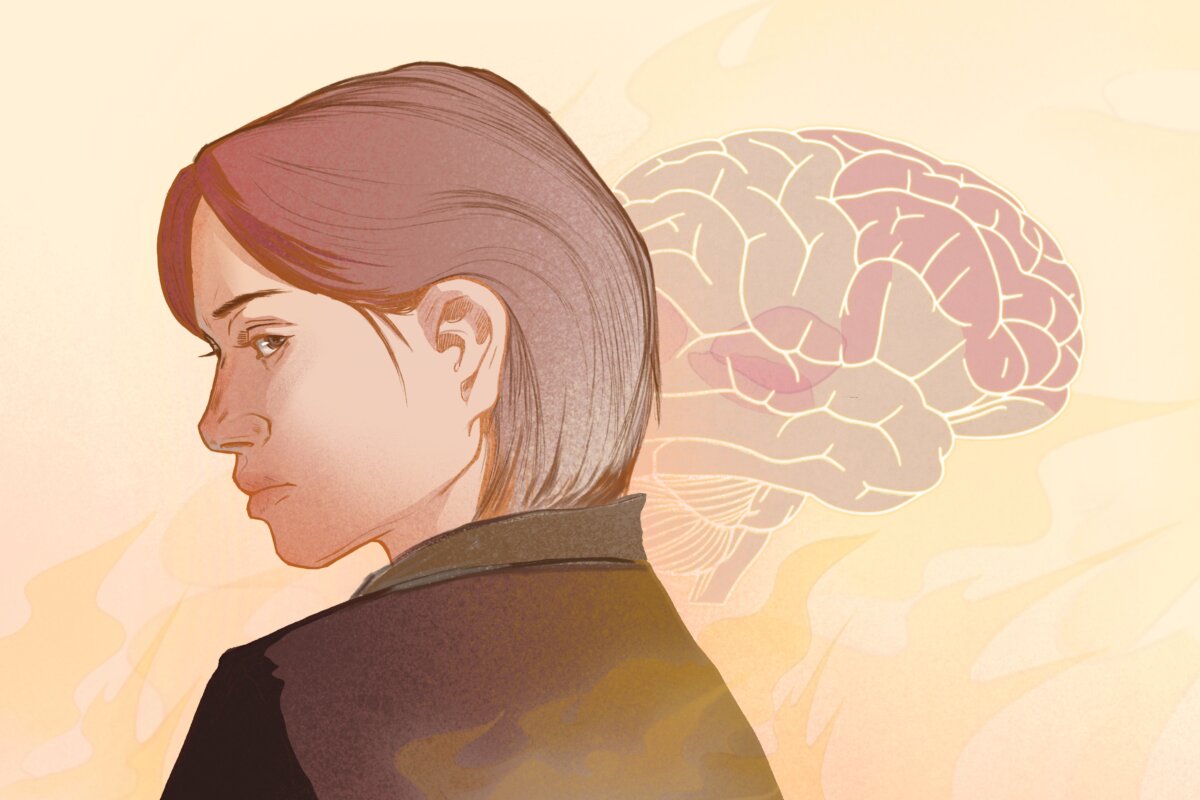
When you catch a glimpse of someone you hate, your brain generates a very unique neural pattern.
Hate increases activity in brain regions involved in aggression and strategic evaluation while silencing empathy. It is like your brain beginning to prepare to “tackle” a person. The more you hate someone, the stronger the signals.
Even though we all may have experienced hate, our deepest self is incompatible with it, Steven Stosny, therapist and founder of Compassion Power, told The Epoch Times.
“If hate becomes chronic, we lose our humanity,” he said.
The Neuroscience of Hate
The brain’s hate “switch” prioritizes aggressive behavior and negative judgment.
Hate selectively deactivates the right superior frontal gyrus—the area involved in regulating impulsive responses and understanding others’ feelings.
This very restricted deactivation in the hater’s brain cuts off the neural “brakes” that keep aggressive impulses in check, turning the hater irrational and making him fixated on the target.
Mitchell Landers, a postdoctoral scholar in the department of psychology at the University of California, told The Epoch Times that both love and hate involve intense assessment of the other person, but in opposite directions.
Both lovers and haters experience temporarily impaired judgment under intense emotions, which explains behaviors such as “lovers overlooking flaws, and haters manufacturing them,” Landers said.
Hate activates several regions in the brain’s outer and inner layers—especially the putamen and insula.
The putamen prepares you to act, and the insula acts as a sensor. When hijacked by hate, those regions can compel a hater to take retaliatory actions, such as confronting and harming the target of his hatred.
Hate self-reinforces. The more you hate, the more your brain is wired to hate—it is like a low-dose poison that quietly erodes empathy.
How Hate Poisons the Hater
Hate can switch off the brain’s empathy circuitry. One study found that participants who were exposed to hate speech about minority groups became less empathetic to the suffering of not just the minority group but of other people as well, demonstrating that hate spreads.
Over time, diminishing empathy leads to a collapse of compassion.
The hated person’s very existence is the hater’s core problem, Landers said.
“When you’ve estimated that someone has a negative association value—that their welfare runs contrary to yours—it makes sense that concern for their suffering would diminish,” he said.
A person is not just unable to empathize with a person’s pain, but becomes numb or even starts feeling good about it, he said.
Hatred’s close connection with aggression and hostility puts the hater at risk of mental and physical health issues. People who are hostile experience breakdown in relationships and are therefore more stressed and more prone to depression.
Physically, hate-driven behaviors such as anger and aggression trigger the release of stress hormones, which affect the immune system and lead to inflammation. Stress hormones suppress the activity of natural killer cells, which impairs a person’s ability to fight infections, including cancer.
Stress response linked to anger and aggression also impairs your blood vessels’ ability to relax properly, which is critical for good circulation. This disruption is one of the primary drivers of stroke and cardiovascular diseases.
A meta-analysis published in the Journal of the American College of Cardiology found that anger and hostility increase coronary heart disease risk by 19 percent in healthy people and increase the chance of poor prognosis by 24 percent in patients with existing heart conditions.
What makes this poisoning emotion stick?
Where Does Hate Come From
Hate is often rooted in unresolved anger.
Landers’s 2025 research sheds light on how the transition from anger to hatred happens.
“[Anger is] a bargaining mechanism,” Landers said.
You feel angry when you assume that the relationship is worth saving. When someone does not appear to care as much as you believe that he or she should, anger bargains by pushing others to change how they treat and value you.
“That’s why angry people want to talk, want explanations, want apologies,” he said.
When anger repeatedly fails to repair the relationship, it begins to transition toward hate.
Hate assumes that the relationship is not worth saving, so it seeks to neutralize that very person. From the hater’s point of view, the hated person’s very existence makes the hater’s life worse.
“No amount of talking will change the fact that a romantic rival exists, or that a competitor took your promotion, or that someone’s presence in your community fundamentally threatens your interests,” Landers said.
Hate turns off only when the target is sufficiently distanced or depowered, he said. The challenge is that achieving these outcomes often involves force or aggression. The aggressive, hostile actions that hatred drives one to take ultimately reinforce the feeling of hate, Landers said.
This self-reinforcing quality creates a hate trap.
Hate often stems from helplessness, Jessica Russo, a licensed clinical psychologist, told The Epoch Times.
When you register someone as a threat, there is a subconscious sense of weakness and helplessness. To counter the threat, people may use a “shield of hate” to protect themselves.
“Hate is a very intense kind of shield,” Russo said, but by using hate to protect oneself, people end up making themselves even more vulnerable.
“We need to get to the bottom of what is behind that, what they’re trying to protect themselves from,” she said.
Russo believes that compassion can dismantle the shield of hate by restoring hope and removing darkness. The antidote is to rebuild exactly what hate erodes.
[series_posts_list][/series_posts_list]
A Cure for Hate
Humans possess a core value: an instinctive sense of self-worth rooted in the belief that every person is “a child of God.” Acting from this belief humanizes self and others, while hate dehumanizes both, Stosny wrote in his book “Manual of the Core Value Workshop.”
Therefore, to eliminate hate, one must cultivate its opposite: compassion.
“Compassion and hate are incompatible; the more we do one, the less able we are to do the other,” Stosny said.
Compassion is a very broad concept, and everyone has their own understanding of it. But generally, it is about recognizing that humans are flawed and suffering, yourself and others included, which allows you to understand and extend sympathy to everyone.
Many people mistakenly believe that compassion is dismissing bad behavior, Stosny said. However, compassion is not about forgiving behavior but about understanding the hardships that lead others to behave badly.
“Compassion reduces but never tolerates or excuses bad behavior—because behavior that violates humane values is self-destructive,” he said.
Compassion begins with the self, and compassion for self and compassion for others go hand in hand.
When someone fails to practice self-compassion by not understanding and healing his own emotional hurt, that discomfort turns into resentment and anger, Stosny said, and the person starts blaming others for his pain.
To catch unprocessed anger or resentment before it hardens into hate, Stosny recommends watching for early warning signs:
- Intolerance of hurt or emotional discomfort
- Coping with the internal discomfort by blaming it on others
- Inability to see other perspectives
It is critical to break the hate loop—to pull the brain out of a state of being threatened or powerless, Russo said. She recommends beginning by imagining feeling compassion toward what threatens you or discomforts you. Then try to break down the unhealthy perspective that is fueling hate. Ask yourself: “Alright, so if I’m feeling hatred, that means I’m feeling threatened. What am I so scared of?”
Fundamentally, hate comes from an “I am the victim” mentality, Yashpal Jogdand, a social psychologist, told The Epoch Times.
Those who believe that they are the exclusive victims tend to express stronger hate, he said. It is therefore important to recognize that “both sides have suffered,” thereby breaking the cycle of blame and guiding people toward empathy.
When we embrace the other person as part of us, he said, we start seeing our “shared humanity” in everybody around us.