


Barbra, a 52-year-old schoolteacher, came to my office scared and exhausted. Her hot flashes were so sudden and intense that she had stopped driving altogether, afraid she might lose control behind the wheel. At night, she slept with the windows wide open—even in winter—yet still lay awake for hours, heart racing, mind unsettled.
Like many women in midlife, Barbra had been told that menopause was simply a matter of declining estrogen. What she wasn’t told was why her body could no longer regulate heat, sleep, or emotional calm.
Chinese medicine offers a crucial perspective.
When the Body Loses Its Thermostat
From a Western medical standpoint, menopause involves significant changes in the autonomic nervous system, which is the control center for temperature regulation, heart rate, blood pressure, sleep, and stress responses. As estrogen declines, many women experience a shift toward increased “fight-or-flight” activity with reduced “rest-and-digest” capacity.
Common menopausal symptoms arise from these imbalances: hot flashes, night sweats, insomnia, anxiety, palpitations, and rising cardiovascular risk. Yet although hormone levels describe what is changing, they don’t fully explain why some women suffer while others transition smoothly.
Hormones tell only part of the story.
The ACES Framework: 4 Dimensions of Health
In my clinical practice and teaching, I use the ACES model to understand health comprehensively:
- Anatomy: physical structures and organs
- Chemistry: hormones, neurotransmitters, and biochemical processes
- Energy: the flow and regulation of vital force through the body
- Soul/Spirit: meaning, purpose, virtue, and connection
Most modern medicine focuses primarily on anatomy and chemistry. However, menopause reveals the profound influence of energy flow and psychological well-being—soul and spirit—on our physical health. When we address all four dimensions, healing becomes not only possible but also sustainable.
The Body’s Cooling System: Understanding Yin and Yang
In my books—including “Facing East: Ancient Health and Beauty Secrets for the Modern Age” and “Clinical Acupuncture and Ancient Chinese Medicine”—I emphasize that menopause is not a disease to be cured but a whole-body transition that tests the body’s ability to regulate itself.
Classical Chinese medicine focuses on functional balance: how well the body adapts to change. In this view, health depends on the balance between yin and yang. Yin represents cooling, nourishing, and anchoring forces—tranquility and stability. Yang represents warmth, excitement, and activity forces—high energy and movement.
Barbra’s symptoms—intense heat surges, anxiety, and sleeplessness—suggested that her yin reserves had declined, leaving yang relatively unchecked. Without sufficient yin to anchor the body, heat rises, the mind becomes restless, and sleep becomes elusive.
In Western terms, this parallels autonomic nervous system instability: difficulty downshifting out of stress mode and regulating body temperature. Different languages—same physiology.
Why the ‘Kidney’ System Matters
Patients often ask why ancient Chinese medicine associates menopause with the kidney. The word “kidney” confuses many because Western medicine links menopause to ovarian aging, not kidney failure.
The distinction is crucial: In the Chinese medical system, “kidney” refers to a functional and energetic system rather than to the anatomical organ. It governs development, long-term reserves, reproduction, aging, bone and brain health, and the body’s capacity to cool and restore itself over time.
Remarkably, classical Chinese medicine recognized that the ovaries are part of the kidney system. Thousands of years before modern endocrinology, ancient physicians recognized a deep connection between reproductive function and the deep reserves of kidney energy that sustain us throughout life.
In this view, menopause reflects a natural decline in kidney reserves. Symptoms arise not because something has gone wrong but because the body needs support adapting to a new phase of life.
The Spiritual Dimension: Where Energy Meets Soul
Here’s what conventional medicine often misses: Psychological (spiritual) well-being has powerful regulatory effects on the body.
Research has shown that a higher level of social support and mindfulness throughout menopause may reduce menopausal symptom frequency and severity.
In my clinical experience, women who maintain strong faith, cultivate virtue, nurture meaningful relationships, and live with clear purpose often transition through menopause far more smoothly than those who don’t—regardless of their hormone levels.
These observations are not mystical thinking. When we live with integrity, maintain loving connections, and experience our lives as meaningful, the nervous system receives constant signals of security. Purpose calms the fight-or-flight response. Virtue—living in alignment with our values—reduces internal conflict that manifests as physical tension and heat. Faith provides an anchor during uncertainty.
Conversely, women experiencing deep loneliness, loss of purpose, fractured relationships, or spiritual disconnection often suffer more severe menopausal symptoms. Their bodies are burdened with not only the fight against hormonal changes, but also existential stress.
In these circumstances, the ACES model becomes essential, looking at both one’s chemistry and one’s soul. A woman’s sense of meaning in life directly influences her autonomic regulation, which in turn affects how her body manages the hormonal transition of menopause.
Barbra’s healing involved not only acupuncture and herbs, but also reconnecting with what gave her life purpose—her teaching, her relationships with her grandchildren, and her faith community. As her soul found an anchor, her energy stabilized. As her energy stabilized, her body could finally cool.
Restoring Balance: Kitchen Medicine
We helped Barbra rebuild her internal cooling capacity through daily, sustainable diet practices.
In traditional Chinese medicine theory, what we eat can either increase internal heat—yang—or help replenish cooling reserves—yin. I recommended that Barbra take a daily tea made with goji berries and chrysanthemum flowers. Goji berries traditionally nourish deep kidney reserves, while chrysanthemum releases heat from the head, easing restlessness and mental fog.
I also encouraged Barbra to eat more foods that support long-term vitality, such as black beans, black sesame seeds, and blackberries. In classical Chinese medicine, dark-colored foods correspond to the kidney system and help rebuild yin reserves depleted during the menopausal transition.
Acupressure: Calming From Within
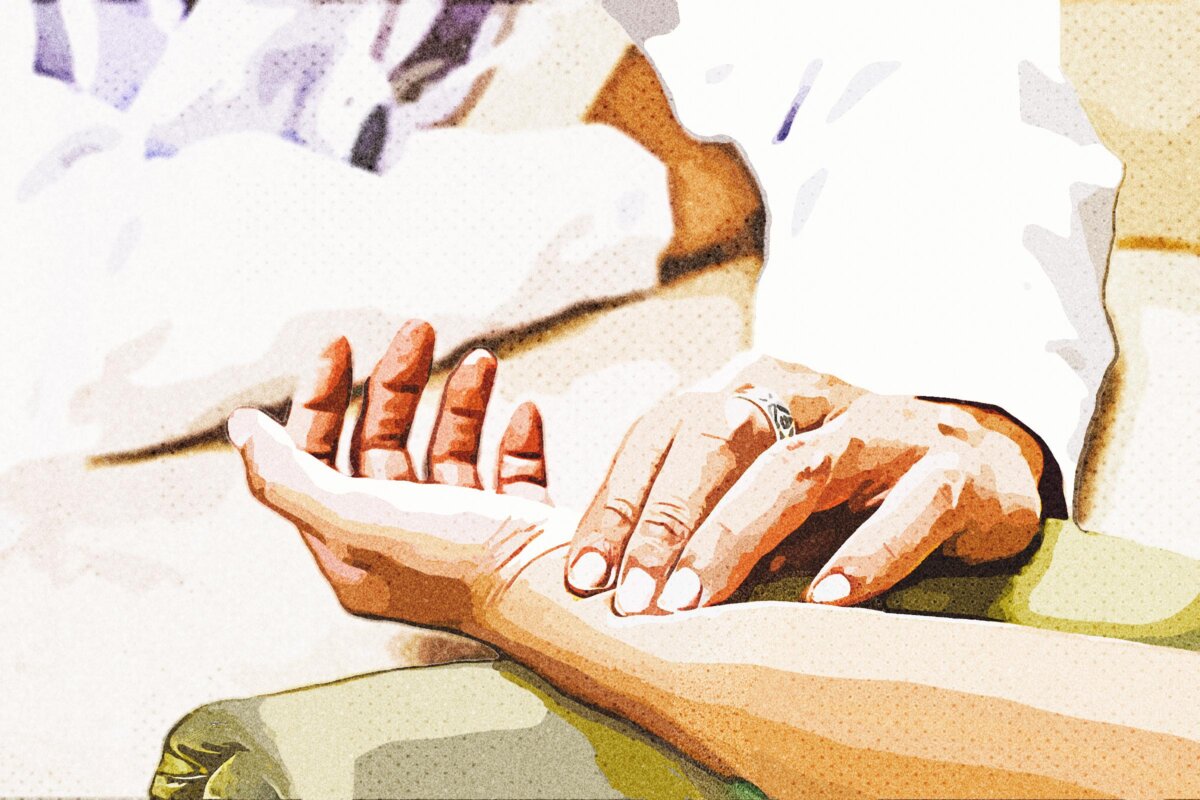
Because Barbra’s anxiety was so intense, I taught her simple acupressure she could use at home.
One key acupoint was spleen 6 (san yin jiao), located four finger-widths above the inner ankle bone. This point connects three major systems involved in regulation and grounding. Gentle pressure for several minutes before bedtime helps settle the nervous system and support sleep.
Many patients describe this practice as helping their bodies downshift out of a state of constant alertness—precisely what the dysregulated autonomic nervous system needs during menopause.
Restorative Movement
Barbra’s instinct had been to push through her symptoms with her willpower. Unfortunately, overexertion often worsens depletion of our willpower during times of challenge, which is exactly what she experienced.
Instead, I recommended Barbra try qigong—slow, breath-centered movement that promotes circulation and calm without exhausting the body. These practices retrain the nervous system to help the body feel safe again. When the body feels safe, it can cool.
The Emotional Dimension
Menopause is not only biological—it’s emotional. In classical Chinese medicine, the energetic “heart,” which includes the anatomical heart, houses the “shen,” often translated as spirit or mind. When sleep is disrupted and internal heat rises, the shen becomes unsettled, leading to anxiety and emotional fragility.
By cooling internal heat and restoring rhythmic balance through acupuncture and herbal support, we gave Barbra’s shen a place to rest.
Within weeks, she was sleeping through the night. Soon after, she felt confident enough to return to driving. Her life had opened back up.
Self-Care Practices: A Daily Protocol
Practical steps women experiencing menopausal symptoms can integrate into their routines include:
Morning
- Drink goji berry and chrysanthemum tea
- 10 minutes of gentle qigong or walking in nature
- Connect with purpose: prayer, meditation, or reflection on what gives your life meaning
Throughout the Day
- Include cooling foods, such as cucumber, watermelon, and mung beans
- Add kidney-nourishing dark-colored foods, such as black beans, black sesame, and blackberries
- Limit spicy foods, caffeine, and alcohol, as they generate internal heat
- Nurture relationships, as meaningful conversation calms the nervous system more powerfully than any supplement
Evening
- Acupressure at spleen 6 for three to five minutes
- Keep the bedroom cool and dark
- Avoid screens one hour before bed
- Practice gratitude by reflecting on positive aspects of your day, which signals safety to your nervous system
Weekly
- Consider acupuncture to support autonomic regulation
- Take Epsom salt baths to relax the nervous system
- Engage in activities that provide connection and meaning
These practices work not by forcing change, but by supporting the body’s natural capacity to regulate and restore balance across all four ACES dimensions.
Women are advised to seek immediate conventional medical evaluation for acute, severe, or rapidly progressive symptoms, including but not limited to chest pain, shortness of breath, acute neurological changes, severe infection, uncontrolled bleeding, or sudden functional decline. The ACES framework emphasizes timely escalation to conventional care when safety or diagnosis requires it, and integrative support once stability is achieved.
Integrating Care
Classical Chinese medicine does not reject Western medicine—it offers a crucial perspective that is largely missing. Western approaches excel at anatomy and chemistry, providing essential diagnostic tools and interventions when needed. Chinese medicine specializes in regulation, adaptation, and building resilience.
Both traditions increasingly recognize what ancient physicians always knew: The soul dimension cannot be separated from physical health.
Menopause is not simply the loss of hormones. It is a test of the body’s ability to regulate heat, stress, sleep, and emotional balance. When we address all four ACES dimensions together—anatomy, chemistry, energy, and soul—healing becomes possible.
Once regulation is restored, questions about hormonal therapy can be approached more thoughtfully and safely. In a future article, I will explore the differences between bioidentical hormones and standard pharmaceutical treatments.
Menopause is not an ending. It is a transition—one that deserves understanding, support, and respect for the whole person: body, mind, energy, and soul.
Lidan Du-Skabrin, who holds a doctorate in nutrition, contributed to this article.
Views expressed in this article are the opinions of the author and do not necessarily reflect the views of The Epoch Times. Epoch Health welcomes professional discussion and friendly debate. To submit an opinion piece, please follow these guidelines and submit through our form here.