



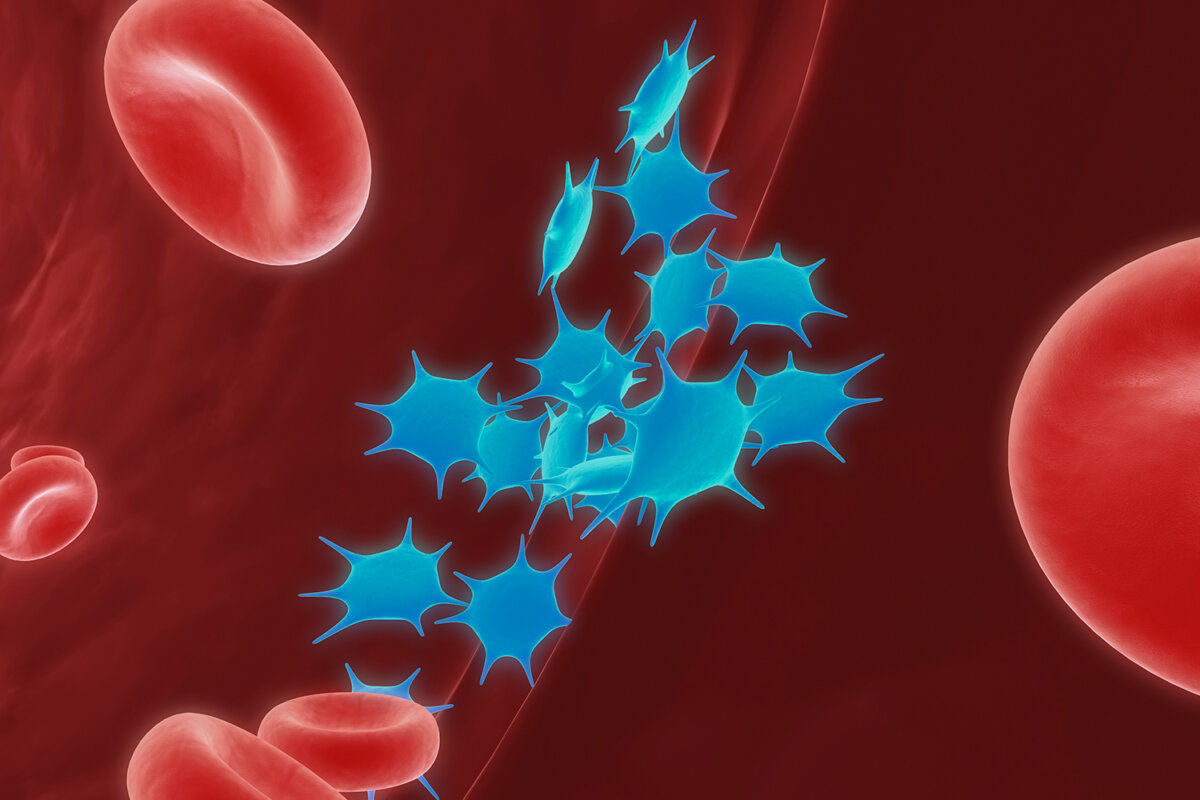
In early 2021, some patients were developing a rare yet life-threatening condition in which their blood would clot after getting a COVID-19 vaccine.
In these patients, their bodies were mistakenly attacking their own platelets, causing them to clump together and resulting in blood clots and low platelet counts. Researchers didn’t know why.
Now, a new study may offer an answer.
In a study published in The New England Journal of Medicine, researchers in Australia, Germany, and Canada analyzed 100 patients who took adenovirus vaccines and developed vaccine-induced immune thrombotic thrombocytopenia, also known as VITT.
They found that VITT was likely driven by a change in the antibodies, causing them to switch from harmless to harmful.
“This was the missing link that explains how a normal immune response can, in very rare cases, become harmful,” Jing Jing Wang from Flinders University said in a press release.
COVID-19 adenovirus vaccines are made from a modified adenovirus—a type of virus that is used to introduce COVID-19 genetic materials into human cells to mimic an infection. They were phased out after reports of VITT side effects.
Harmful Antibodies
When the immune system encounters foreign invaders like viruses, bacteria, and vaccines, which mimic an infection, one way the body fights them off is to mass-produce antibodies.
These antibodies bind to the foreign invader, putting a target on its back so that other immune cells can kill it.
When patients were given the adenovirus vaccine, their bodies produced many antibodies that targeted components of the vaccine.
When antibodies are mass-produced, new changes are introduced to create the optimum antibody that can kill off invaders. In the case of VITT, some antibodies developed a single change that produced a harmful antibody instead.
Since some parts of platelets and adenoviruses share similarities, this single error made the new antibodies more likely to bind to platelets rather than adenoviruses.
“To have all these factors working together in the antibody is very rare, explaining the exceptional rarity of this complication,” Tom Gordon, head of immunology at Flinders Medical Centre, told The Epoch Times in an email.
“Exactly how or why this specific mutation occurs, I am not sure. It might all just be a random event,” Dr. Theodore Warkentin, a co-author of the study and professor emeritus of pathology and molecular medicine at McMaster University, told The Epoch Times.
These antibodies bind to platelets, forming a mini traffic jam inside blood vessels—essentially a blood clot.
Other Predisposing Factors
The single error is only one part of the story.
Digging back further into patients’ medical histories, researchers found that these patients also had two other contributors: a prior adenovirus infection and a certain genotype.
Most of the patients were able to mount a very fast response to the vaccine, which suggests they were likely infected with adenoviruses before.
Of the 100 VITT patients analyzed, all inherited a common gene that is present in 60 percent of people of European descent, which may explain why VITT was a greater concern in Western countries. In simple terms, many people in these populations carry the gene, and some had prior adenovirus infections that produced adenovirus antibodies.
When they got an adenovirus vaccine, their bodies mounted a stronger reaction than they would if they had not been exposed to adenovirus previously, and a select few then developed harmful changes to their antibodies, leading to VITT.
“We think VITT will only occur in patients who have the genotype,” Warkentin said. However, he added that there can always be exceptions.
His research has found that adenovirus infections can also cause similar blood clotting, and he suspects that other viruses may cause the same condition.
Unpredictable Reactions to Vaccines
The researchers say the finding could allow vaccine manufacturers to create safer formulations that do not cause this dangerous reaction.
Previous research by the same authors established that VITT was likely caused by the adenovirus aspect of the vaccine, not other components.
Other studies have linked COVID-19 infection and mRNA vaccines to rare blood-clotting events, potentially related to spike proteins.
Though this study identified the mechanism for VITT, why the body triggers this reaction is still unknown.
“Immune responses are not uniform across the population; this randomness is genetically inbuilt across our population, poorly understood, and an area of considerable research,” Gordon added.
Whether a person develops adverse reactions depends largely on chance, Warkentin said.
Every person is different, and research shows that a small percentage respond differently than expected because immune responses vary.