



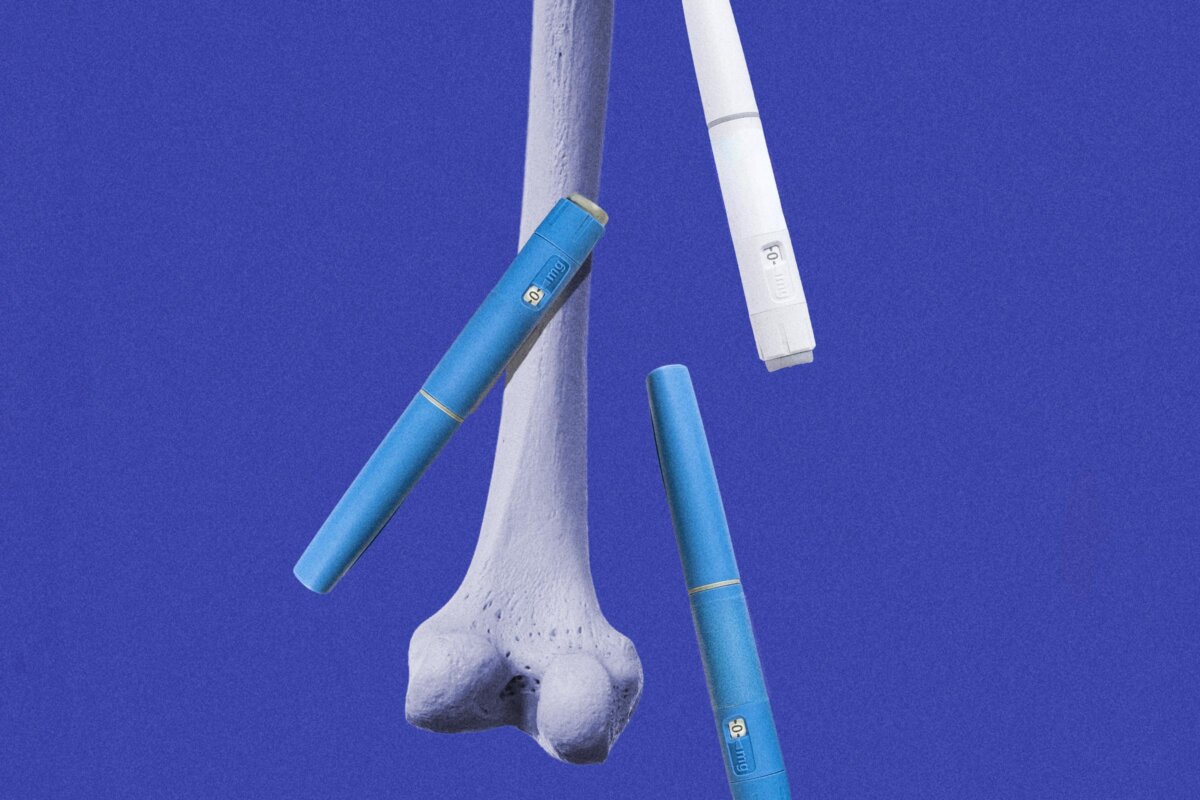
GLP-1 drugs are celebrated for shrinking waistlines and protecting hearts—but a new study looking at five years of data suggests America’s favorite weight loss drugs may be weakening bones.
The findings, presented at the 2026 annual meeting of the American Academy of Orthopaedic Surgeons, are observational—meaning that they show an association, not proof of direct causation. The study has not yet been peer-reviewed.
However, with tens of millions of Americans now taking GLP-1 receptor agonists such as semaglutide (sold as Ozempic and Wegovy), liraglutide (sold as Victoza and Saxenda), dulaglutide (sold as Trulicity), and exenatide (sold as Byetta), researchers say the signals are worth taking seriously.
GLP-1s’ Bone Problem
Researchers analyzed five years of medical records from more than 146,000 adults with obesity and Type 2 diabetes. The results showed that roughly 4 percent of patients taking GLP-1 drugs developed osteoporosis, compared with a little more than 3 percent of those not on the medication.
Bone-softening, also known as osteomalacia, was about twice as common among GLP-1 users—0.2 percent versus 0.1 percent—and gout rates were slightly elevated: 7.4 percent among users compared with 6.6 percent in the control group.
“We are just now reaching the precipice where five- and 10-year follow-up data are becoming available for patients taking GLP-1 medications,” lead researcher Muaaz Wajahath, a medical student at Michigan State University College of Human Medicine, said in a statement. “Any medication that sees this rapid adoption warrants close examination, particularly in orthopedics, where obesity and surgical intervention often overlap.”
The study findings contradict recent assertions of musculoskeletal protection and suggest that GLP-1 RA exposure may confer increased long-term skeletal risk, Dr. Giles Scuderi, orthopedic surgeon and vice president of Northwell Orthopedics, who attended the annual meeting of the American Academy of Orthopaedic Surgeons, told The Epoch Times.
Is It the Drug or the Weight Loss?
Experts are debating whether any increased risks are due to the drugs themselves, the rapid weight loss they promote, or the underlying conditions of the patients taking them, as both obesity and Type 2 diabetes independently increase inflammation and bone fragility.
“As with any weight loss, bone remodeling can occur if patients lose weight on these medications,” Dr. James J. Chao, a board-certified plastic surgeon specializing in body contouring, facial rejuvenation, and medical weight loss using GLP-1 drugs, and chief medical officer of VedaNu Wellness, who was not involved in the study, told The Epoch Times.
In weight loss, bone remodeling refers to the continuous cycle of breaking down old bone and replacing it with new tissue, which can become imbalanced during a calorie deficit.
While remodeling naturally maintains skeletal strength, significant weight loss often triggers a net bone loss because the body removes more bone than it replaces.
“If patients lose lean mass on these medications, bone health can be affected due to less strain being placed on bones,” he noted.
Rapid weight loss—regardless of method—has long been associated with some degree of bone density reduction, Dr. Fernando Ovalle Jr., an obesity medicine specialist who was not involved in the study, told The Epoch Times.
“We’ve seen it with bariatric surgery for many years and even with aggressive caloric restriction,” he said. “That’s not unique to GLP-1s.”
Do the Benefits Still Outweigh the Risks?
For most patients, the answer remains yes, at least for now. Ovalle pointed out that GLP-1 drugs have robust cardiovascular outcome data. They meaningfully reduce blood sugar, lower blood pressure and lipids, and cut the risk of heart attack and stroke.
“In high-risk patients, those benefits are substantial and often life-saving,” Ovalle said. This is why, in most cases, the metabolic and cardiovascular benefits of GLP-1s still outweigh any modest increase in fracture or gout risk, particularly when those risks can be monitored and mitigated by health care providers, he said.
Scuderi echoed that view.
“Since heart disease is a leading cause of death, the potential risk of muscle and bone problems might be less important,” he said.
However, health care providers need to play an active role in supporting patients on these medications, not simply prescribe them and step back, Scuderi said.
What Patients Should Do
Scuderi said he advises patients on GLP-1 therapy to prioritize adequate protein intake, ensure sufficient calcium and vitamin D, engage in regular resistance and weight-bearing exercise, and avoid excessive or rapid weight loss without nutritional support.
“Strength training, in particular, is critical,” Ovalle said. “Preserving muscle mass protects bone. If a patient loses weight but also loses significant muscle, fracture risk can increase regardless of the medication used.”
Those at higher risk include postmenopausal women, older adults, and patients with prior fractures.
“Regarding gout, rapid weight loss and changes in uric acid metabolism can transiently increase flares,” Ovalle said. “That’s something we’ve seen even outside of GLP-1 therapy.”
For patients concerned about bone health, Scuderi said he recommends that health care providers consider therapeutic doses of dietary supplements to enhance outcomes, retain lean mass, and reduce oxidative stress and inflammation.