



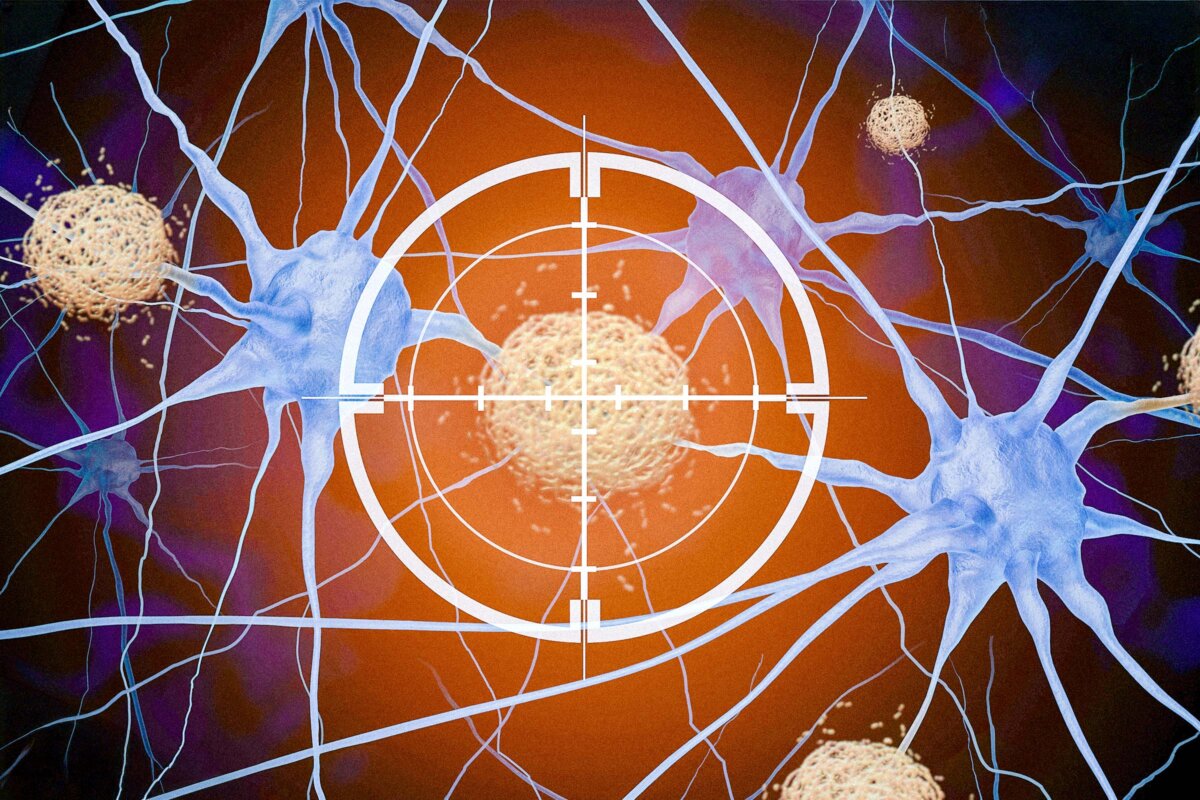
The drugs work exactly as designed—scrubbing toxic protein plaques from the brains of Alzheimer’s patients. The problem, a recent major analysis found, is that clearing the plaques doesn’t seem to help the condition.
A comprehensive review, published in the Cochrane Database of Systematic Reviews, evaluated seven monoclonal antibody drugs developed over the past 20 years to target amyloid beta, a protein that forms plaques in the brains of people with Alzheimer’s disease.
Analyzing data from 17 clinical trials involving more than 20,000 participants, the authors concluded that the drugs’ impact on cognitive decline was well below levels considered meaningful by clinicians but that the drugs carry real health risks.
“Unfortunately, the evidence suggests that these drugs make no meaningful difference to patients,” lead author Francesco Nonino, neurologist and epidemiologist at the IRCCS Institute of Neurological Sciences of Bologna, Italy, said in a statement.
Although early trials showed statistically significant results, “it is important to distinguish between [the findings] and clinical relevance,” he said.
“It is common for trials to find statistically significant results that do not translate into a meaningful clinical difference for patients,” Nonino said.
A Gap Between Biology and Benefit
The central paradox of anti-amyloid drugs is that they do what they set out to do. They clear amyloid beta from the brain. Yet that biological success has not translated into the clinical outcomes patients need.
There is now a convincing body of evidence showing that there is no clinically meaningful effect, according to Nonino.
Mohammed Abouelsoud is a neuroscientist developing an active neurostimulation platform for Alzheimer’s and founder at U: The Mind Company, which investigates noninvasive treatments for neurodegenerative disorders.
“There’s a real gap between biomarker changes and meaningful clinical outcomes,” Abouelsoud, who was not involved in the study, told The Epoch Times.
Abouelsoud pointed out that the field increasingly needs research that links the two and centers on patient-reported outcomes, such as quality of life.
“Findings like these will push guidelines toward more rigorous patient selection and likely accelerate interest in non-pharmacological approaches,” he said.
Peter Whitehouse, a professor of neurology at Case Western Reserve University, agreed with the review’s conclusions.
“Clinicians should assess if the minimal chance of functional improvement outweighs the costs to patients, families, and society,” he told The Epoch Times.
Increased Risk of Brain Swelling and Bleeding
Anti-amyloid drugs likely increase the risk of a condition called amyloid-related imaging abnormalities (ARIA), typically presenting as swelling or small areas of bleeding through MRI scans.
ARIA is categorized into two types: ARIA-E, which involves temporary swelling or fluid buildup in the brain, and ARIA-H, characterized by tiny spots of bleeding or iron deposits on the brain’s surface. These conditions often occur early in treatment, typically within the first six months, and tend to happen simultaneously. The condition is asymptomatic and typically resolves radiographically over time.
Risks Outweigh Benefits
Most cases are asymptomatic, meaning that patients do not notice any symptoms; however, when symptoms do occur, they often include headache, confusion, dizziness, visual changes, and nausea. Long-term effects remain unclear because of inconsistent reporting across studies.
“Clinicians should assess if the minimal chance of functional improvement outweighs the costs to patients, families, and society,” Whitehouse said.
Other potential risks associated with this class of drugs include infusion-related reactions such as flu-like symptoms and blood pressure changes that occur during or shortly after infusion.
There is also ongoing concern about unexplained brain volume loss observed in some patients taking these medications.
Research Shouldn’t Focus on Amyloid
The review’s authors suggest that future research should explore pathways beyond amyloid beta removal. They also emphasize that ongoing studies are currently focusing on different approaches to treating Alzheimer’s.
Senior author Edo Richard, a professor of neurology, expressed disappointment in the statement, noting the need for more effective treatments.
“Existing approved drugs offer some benefit for some patients, but there remains a high unmet need for more effective treatments,” he said. “Sadly, anti-amyloid drugs do not offer this and bring additional risks.”
Although the amyloid hypothesis may not be wrong, it’s increasingly clear that it’s incomplete, Abouelsoud said.
“Patients and clinicians deserve more options,” he said. “The question for the next decade is whether we can find approaches that produce meaningful functional benefit without the risk profile.”
Whitehouse was more blunt: There are no new drugs on the horizon, he said.