



You can now be treated for heart disease decades before you have symptoms.
You go in for a routine physical, feeling healthy. Your cholesterol comes back a little high—not alarming, just above the cutoff. In the past, your doctor might have said, “Let’s recheck next year.”
Under the 2026 cholesterol guidelines, you may be sent for more tests. You could leave with a statin—not because you are sick today, but because you might develop heart disease in 30 years.
The goal is to push prevention earlier and make it more precise, treating risk long before symptoms appear. Supporters say this “lower-for-longer” approach could prevent tens of thousands of heart attacks and strokes by catching disease earlier.
For many otherwise healthy adults, especially those in their 30s and 40s with modestly elevated cholesterol, the shift is far more complicated. The benefits are distant and statistical. The burdens—more tests, more appointments, a daily pill that could last decades—arrive now.
When Prevention Moves Earlier
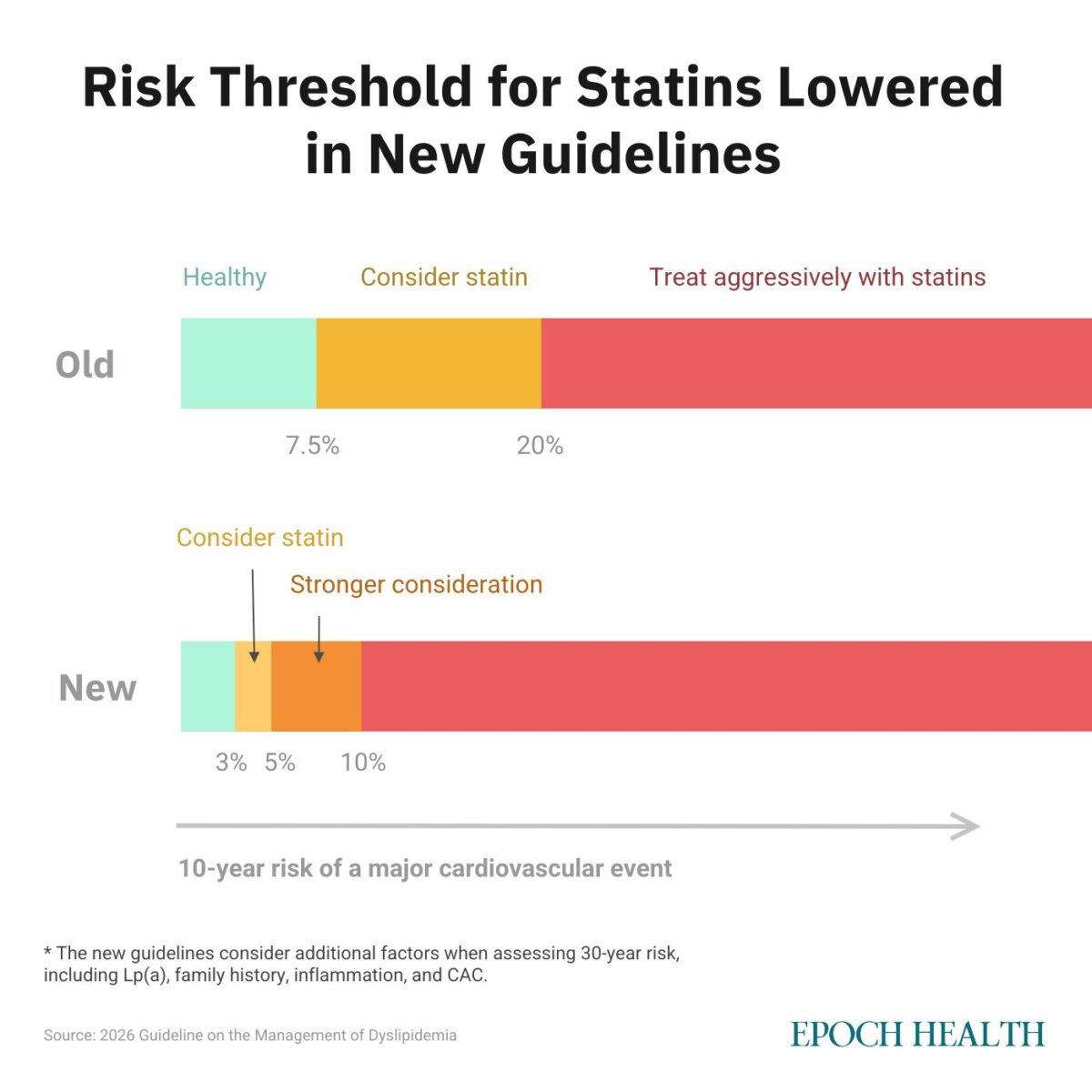
For decades, decisions about cholesterol treatment hinged on a simple question: What is this person’s risk of a heart attack or stroke in the next 10 years? The answer usually mattered most in midlife.
Now, clinicians are being asked to consider longer-term risk—sometimes starting in a person’s 30s.
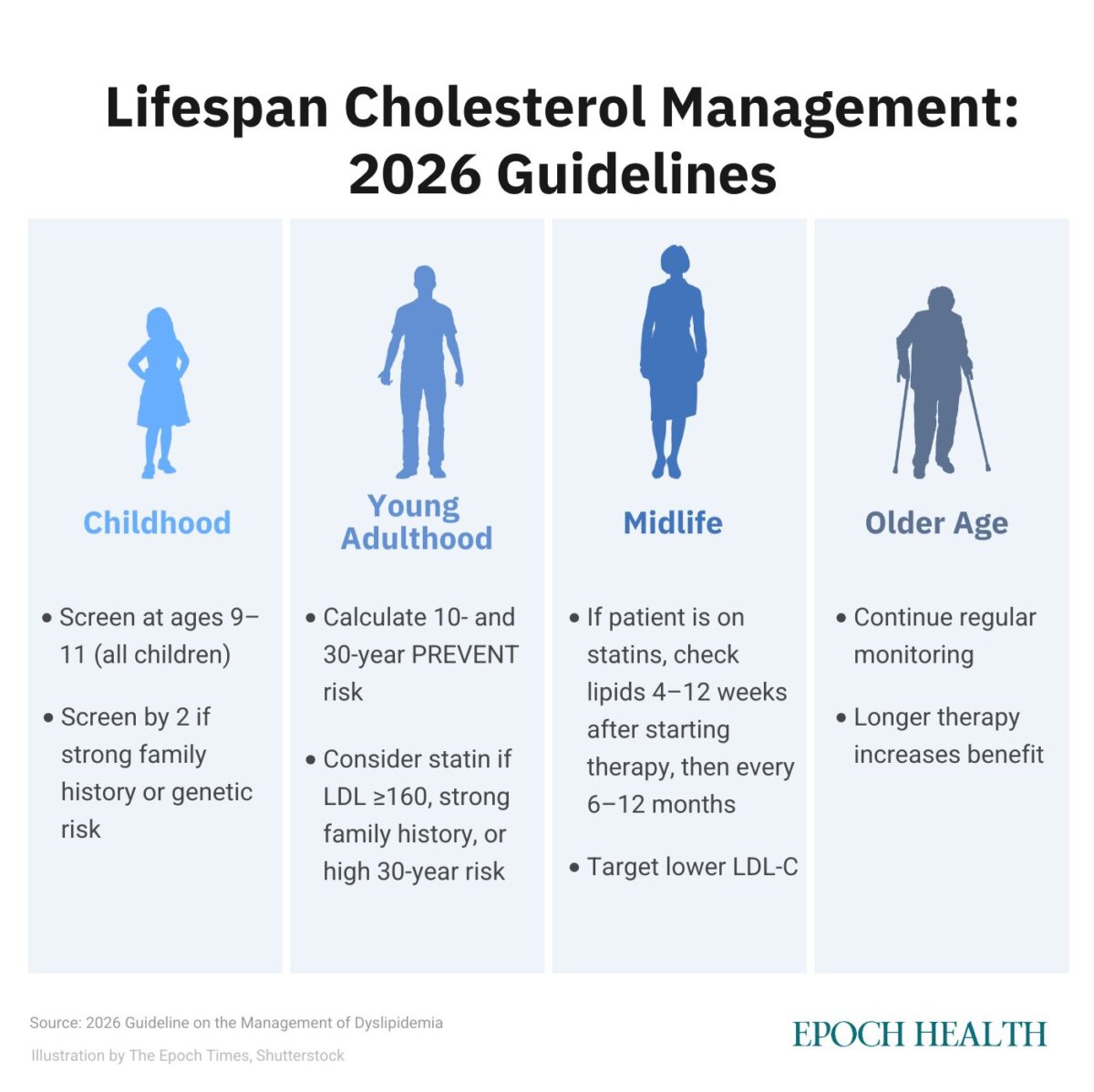
The 2026 guidelines add layers to what was once a simpler decision. Instead of focusing mainly on short-term risk, doctors are asked to calculate both 10- and 30-year risk, weigh “risk enhancers” such as family history or inflammation, and, in some cases, add tests such as lipoprotein(a) or coronary calcium scans.
A healthy 32-year-old with a low-density lipoprotein cholesterol level of 160 and a family history of heart disease may now be told to consider medication, even if the short-term risk is low. Screening starts earlier, too. The guidelines recommend cholesterol testing for all children aged 9 to 11, and as early as age 2 for those with a strong family history or inherited disorders.
A visit that once centered on a single number now pulls in age, blood pressure, smoking status, diabetes, and a long-term risk score calculated using a tool called PREVENT.
From there, testing can expand. A blood test may check for lipoprotein(a), a genetic risk factor carried by about one in five adults. A calcium scan may look for plaque building silently in the arteries.
The guidelines also set specific targets for low-density lipoprotein cholesterol, the so-called bad cholesterol. Targets are often below 100, 70, or even 55, with treatment adjusted over time to keep levels low.
“The goal is to motivate patients at an early age to improve their risk status to avoid having to deal with major heart attacks, strokes, and heart failure later in life,” Dr. Roger Blumenthal, who chaired the guideline committee, told The Epoch Times.
The goal is clear on paper. What happens in the exam room is something else.
What Actually Happens in the Exam Room
Most primary care visits last about 15 minutes. During that time, doctors review test results, manage chronic conditions, adjust medications, document the visit, and address any new concerns that brought the patient in.
The new guidelines ask doctors to carefully walk patients through several layers of risk factors and expected benefits. However, the system forces doctors to keep moving, and tests, prescriptions, referrals, and procedures often become the path of least resistance.
Blumenthal said the approach is less complicated in practice than it appears on paper.
“Primary care physicians have been implementing nuanced guidelines for years,” he said, noting that many welcome clearer targets and tools to guide care.
The guidelines reflect the best available evidence, he said, even if the health care system delivering them is imperfect.
In other words, the guidelines are built for nuance. The system is built for throughput.
Most statins are prescribed in primary care, in which clinicians juggle multiple issues during a single, compressed visit.
Dr. Gregory Katz, a cardiologist at NYU Langone Health, works in a different setting. He focuses solely on the heart. He begins by asking patients what matters most—how they feel about a daily pill, how much uncertainty they can tolerate, and how involved they want to be in decisions.
“When a conversation is focused, a meaningful discussion about risk can happen even in a short visit,” he told The Epoch Times.
However, most people in their 30s and 40s, he said, “don’t want to start medications at a really young age.”
Katz called the guidelines reasonable and said they will likely prevent heart attacks and strokes. Still, he said he questions how well the complexity translates into practice. Calculating a PREVENT score takes time. Adding a calcium score, then placing it in context, takes more.
“There’s a convoluted nature to the flowcharts,” he said. “It makes me wonder how many of the people who were involved in writing that algorithm actually take care of patients on a daily basis.”
In reality, the work falls to primary care doctors, among the most strained physicians in the system. Studies suggest that when time is short, prescribing goes up and shared decision-making goes down.
The guidelines imagine a different setup. Patients would review their risk before their appointment using calculators or decision tools and arrive with focused questions. Nurses or pharmacists might handle the initial counseling, leaving physicians to guide final decisions. The goal, Dr. Anjali Bhatla told The Epoch Times, is to make the visit about “refining choices,” rather than starting from scratch.
In most clinics, that infrastructure does not exist. The work gets squeezed into the visit.
“Without that time, we generally order more tests and prescribe more medicines—and sometimes neither is necessary,” Dr. David Rakel, a family physician at the University of Wisconsin, told The Epoch Times.
Dr. Venkatesh Murthy, a cardiologist at the University of Michigan, told The Epoch Times that the recommendations resemble care delivered in preventive cardiology clinics, rather than typical primary care visits.
“I have real concerns that the number and complexity of these recommendations will be difficult to follow in real practice,” he said.
Even the expectation that patients will come prepared has limits.
“Only a small subset of patients will be able to engage in these tools before appointments,” Murthy said. “Many do not.”
Blumenthal acknowledged the constraint.
“Clinicians have much less time to spend with their patients and counsel them,” he said.
The recommendations will “definitely” increase the number of patients in ongoing monitoring and treatment, he added.
The Cost of Knowing More
For some patients, a single number can change everything, and not always for the better.
Katz described a man who felt perfectly healthy until his wife’s coronary calcium score came back at zero. Curious, he also got a scan. His score was 1,400, a level that suggests a heavy burden of plaque. Instead of feeling reassured, he found himself pulled into a cascade of activity: a stress test, a cardiac catheterization, and a conversation about stents—all without symptoms.
“That’s the wrong way to use a calcium score,” Katz said. The test is meant to guide prevention, not set off a chain of invasive procedures—but once a number is in front of you, it can be hard to step back.
The shift is psychological, too. A person who walked in feeling well can leave as a patient, tracking numbers and living with the weight of being “at risk”—an identity that can follow him or her for decades.
There is a financial layer, too. A lipoprotein(a) test or coronary artery calcium scan typically costs about $75 to $150 out of pocket, although prices can be higher depending on the setting. Insurance coverage is uneven. Supporters argue that the up-front expense may prevent far more costly heart attacks and strokes later. However, the near-term burden falls on patients and already stretched primary care practices.
Once Treatment Begins, It Rarely Ends
A statin can become a decades-long commitment, sometimes escalating to additional drugs or injectable therapies. The medications are well-studied but not without trade-offs: muscle pain, fatigue, and a small increase in diabetes risk.
“There is a measurable decrement to quality of life to taking a pill every day,” Dr. Rita Redberg, a cardiologist at the University of California–San Francisco, told The Epoch Times. “It should only be done when the chance of benefit exceeds the chance of harm.”
Others worry about the timeline itself.
“If someone starts cholesterol drugs at 35, they may be taking them for 40 or 50 years,” cardiologist Dr. Jack Wolfson told The Epoch Times. “That is not prevention. That is a business model.”
The guidelines frame earlier testing and treatment as progress: Identify risk sooner, intervene earlier, prevent disease later. But for a patient who feels well, it can feel like an on-ramp to a highway of treatments that is hard to exit.
The 1st Step That Often Gets Skipped
The guidelines are not explicitly pro-statin. They are clear that lifestyle comes first. Diet, exercise, weight, sleep, and stress management come before scans, medications, and years of treatment. On paper, that order is unambiguous.
In practice, it is hard to follow. The current system offers little time, structure, or support to help patients make lasting changes, and little evidence that it does so consistently.
Blumenthal often encourages patients to spend six months working on lifestyle changes before considering medication. In reality, only about one in three sustain those changes.
Most patients already know what to do, Katz said. They know that exercise helps. They know that sugary drinks and heavily processed food do not. It’s one thing to understand nutrition in the abstract. It’s another to shop, cook, and eat differently at the end of a long day, or to build exercise into a schedule already stretched thin.
“These things are really, really straightforward,” Katz said. “But they’re not easy.”
Some models try to close that gap. Rakel pointed to the Whole Health System used in the Department of Veterans Affairs, which centers care around a patient’s goals and supports lifestyle change through a team-based approach.
However, such models remain the exception.
Lifestyle changes are generally “left up to individual clinicians and patients,” Blumenthal said, with many patients directed to educational materials from groups such as the American College of Cardiology and the American Heart Association.
Others see little coordinated effort at all. Katz was “not sure” of any policy-level initiatives, underscoring how diffuse those efforts remain.
Doctors are rarely given the time or tools to support patients in sustained lifestyle change, so a pill often becomes the next step.
In some cases, taking medication may even work against lifestyle change. Research using national health data has found that statin users tend to increase their calorie and fat intake over time, as well as their body mass index.
The result, Redberg said, can be a kind of false reassurance—lab numbers improve while unhealthy habits stay the same. Over time, the medication can begin to feel like protection, even when it was never meant to be.
Prevention Tomorrow—Patients Today
The case for acting earlier is straightforward. Heart disease remains the leading cause of death in the United States. Identifying and addressing risk sooner could change the trajectory for many before problems ever appear, Blumenthal said.
At a population level, the logic is compelling. Small reductions in risk, sustained over time, can prevent a large number of heart attacks and strokes.
For the younger, otherwise healthy people now pulled into care earlier, the picture is less certain.
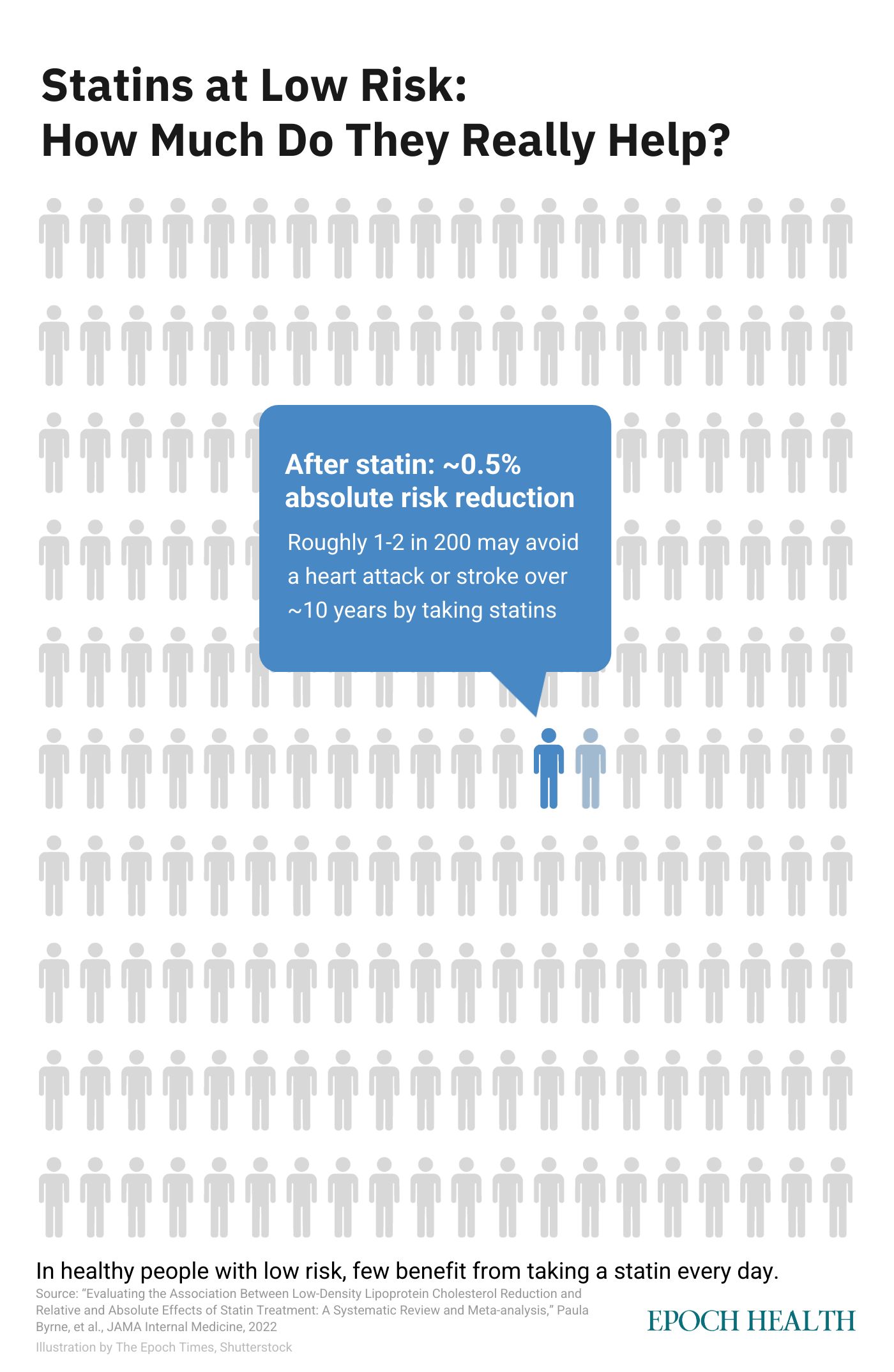
In large studies, most people taking statins will not directly experience that benefit. At a 3 percent 10-year risk, a statin may lower that risk by less than half a percentage point. Roughly one in 200 people might avoid a heart attack or stroke over a decade, Murthy said.
Redberg said: “It is always important to consider absolute risk. Relative risk can be misleading and not useful for any individual.”
The guidelines leave room for choice. Some patients will welcome more information and the chance to act early. Others may prefer lifestyle changes or watchful waiting.
However, by expanding who gets evaluated and how early, the guidelines ensure that far more people will face that decision, including many who feel entirely well.
Rakel said he sees that expanding gray zone as an opportunity, not a mandate.
“We give the best data we can based on the individual,” he said. “In the end, it is the patient’s choice.”
This article has been edited to include more common costs for lipoprotein(a) testing.