


A young woman in her 20s visited my clinic one day. She had been experiencing stress and insomnia as a result of her career change.
If she had visited a Western clinic, she might have received psychotherapy or been prescribed a sleeping pill. However, she came to me, a traditional Chinese physician, and I asked her to massage her hand.
She took the advice, massaging the center of her palm whenever she felt stressed or anxious. Over the following days, she found that her mind cleared, her anxiety subsided, and restful sleep returned.
In traditional Chinese medicine (TCM), the experience of sickness or stress, whether physical or mental, indicates a blockage in the body’s vital energy, known as qi. Restoring the flow of qi allows health and balance to return.
I witness this type of restoration in my clinic every day.
To understand why this massaging “trick” worked, let me guide you through TCM’s meridian system—the energy channels that carry qi—for an altogether different view of health.
The Invisible Energy Channels
In the first article of this series, we learned that TCM views the human body as an intelligent, dynamic system capable of repairing and rebalancing itself. Health is maintained by qi flowing through the body’s meridians.
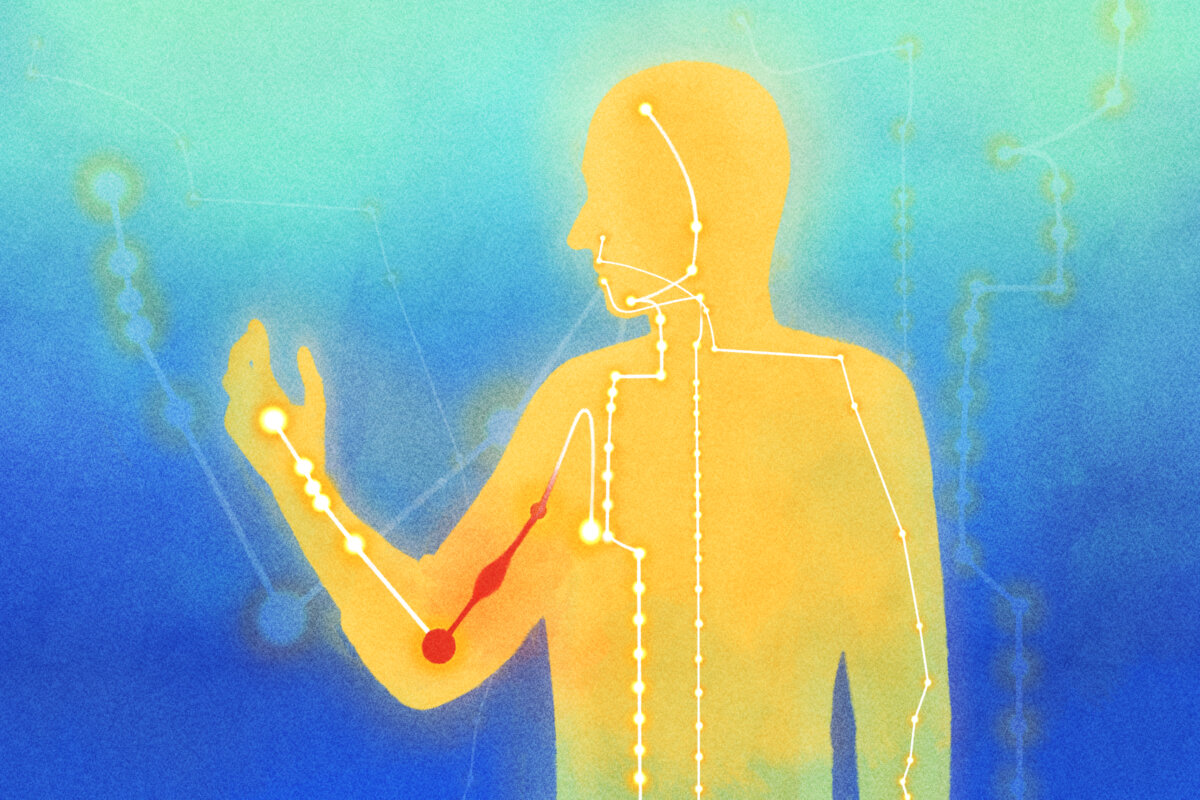
Meridians are similar to tributaries and canals, and they form a vast network that “irrigates” the body with qi flowing through them, nourishing every part of the body.
Just as there are access points on rivers, there are acupoints (acupressure points) on these meridians. Acupoints are specific sites along meridians where qi can be accessed, influenced, and redirected through gentle pressing or massage.
The human body has 12 main meridians, existing in six pairs, each linked to a specific organ and following its own specific pathway. Although meridians are present throughout the body, their pathways are often more easily perceived in the limbs, where the sensations of qi transmission are more noticeable.
The flow of qi within the meridians affects how your physical body and even your emotions function.
Western science has begun to explore the concept of meridians. CT and MRI scans have found that fascia—the body’s connective tissue—surrounds and supports muscles, bones, nerves, blood vessels, and organs, creating line-like structures that run similarly to those of traditional meridian routes.
Some researchers have proposed that the meridian system may correspond to the body’s fascia, although research is ongoing. Although the comparison of the fascia and meridians is intriguing, the full meridian system is more complex than the fascia.
Why Meridians Matter
In Chinese medicine, the main function of the meridians is to maintain a steady and continuous flow of qi.
When the flow of qi becomes disrupted or less balanced, it may indicate a state of disharmony. In such cases, people may experience a range of physical or emotional signs. Commonly described signs associated with qi imbalance or stagnation include:
- Stress, anxiety, or irritability
- Stiff muscles or aching joints
- Low energy, chronic fatigue, and poor digestion
- Insomnia and recurring headaches
To simplify this further, let’s go back to the stressed-out patient I mentioned earlier. What exactly happened when she pressed the center of her palm?
The area where she applied pressure is known as the palace of toil (or lao gong) acupoint. The lao gong acupoint is closely associated with emotional regulation and mental clarity. Stimulating this point promotes smoother circulation of qi and blood, particularly to the upper body and head.
In practical terms, the acupressure helps shift the body from a state of heightened stress and mental overactivity toward a calmer, more focused, and regulated state—exactly what’s needed during periods of intense study or performance pressure.
[series_posts_list][/series_posts_list]
Do-It-Yourself Healing Acupoints
You can incorporate some simple acupoint massage in your personal self-care routine.
When massaging acupoints, it is normal to feel mild sensations such as aches, heaviness, or slight pressure. However, if the pressure becomes uncomfortable or painful, reduce the pressure or stop; acupressure should help the body relax, not create additional tension. Avoid applying pressure to areas that are bruised, swollen, or inflamed or have varicose veins, as these areas are more vulnerable and may worsen with stimulation.
Limit each stimulation to about one to two minutes, and apply pressure on both sides of the body when applicable. Try to combine it with slow, relaxed breathing. Remember, consistency and gentleness are more beneficial than excessive or forceful stimulation.
3 Easy-to-Locate Acupoints
1. For Insomnia, Worry, and Emotional Regulation
An easy-to-find and commonly used acupoint located between the eyebrows is called yin tang, or the “hall of impression.” It is the location of the third eye, according to ancient cultures. The yin tang acupoint is aligned with the pineal gland and helps improve sleep quality and regulate emotional distress, leading to deep relaxation.
Gently massage the area in circular motions with your fingers for one to two minutes.
2. For Nausea and When Feeling Overwhelmed
Look for the soft area on the inner wrist, approximately three finger-widths below the wrist crease and between two prominent tendons. This point, known as “inner gate,” or nei guan in Chinese, is commonly used in traditional practice to address symptoms such as nausea and emotional tension.
Gently apply pressure or massage the area with your thumb for one to two minutes while breathing slowly and evenly.
3. For Pain Relief and General Well-Being
On the back of the hand, between the thumb and index finger, lies a very versatile acupoint called hegu, or the “joining valley.” It is commonly used for headaches, migraines, and toothaches, as well as the common cold and flu. It also helps calm stress and promote digestion.
Gently massage the area for one to two minutes while breathing slowly yet deeply.
Note: Do not stimulate this point if you are pregnant, as doing so might induce labor.
Your life’s vital energy loves fluidity. Being flexible and adaptable is the secret to health and longevity. So let your life-nourishing qi flow freely through you—and you’ll feel and stay healthy.