


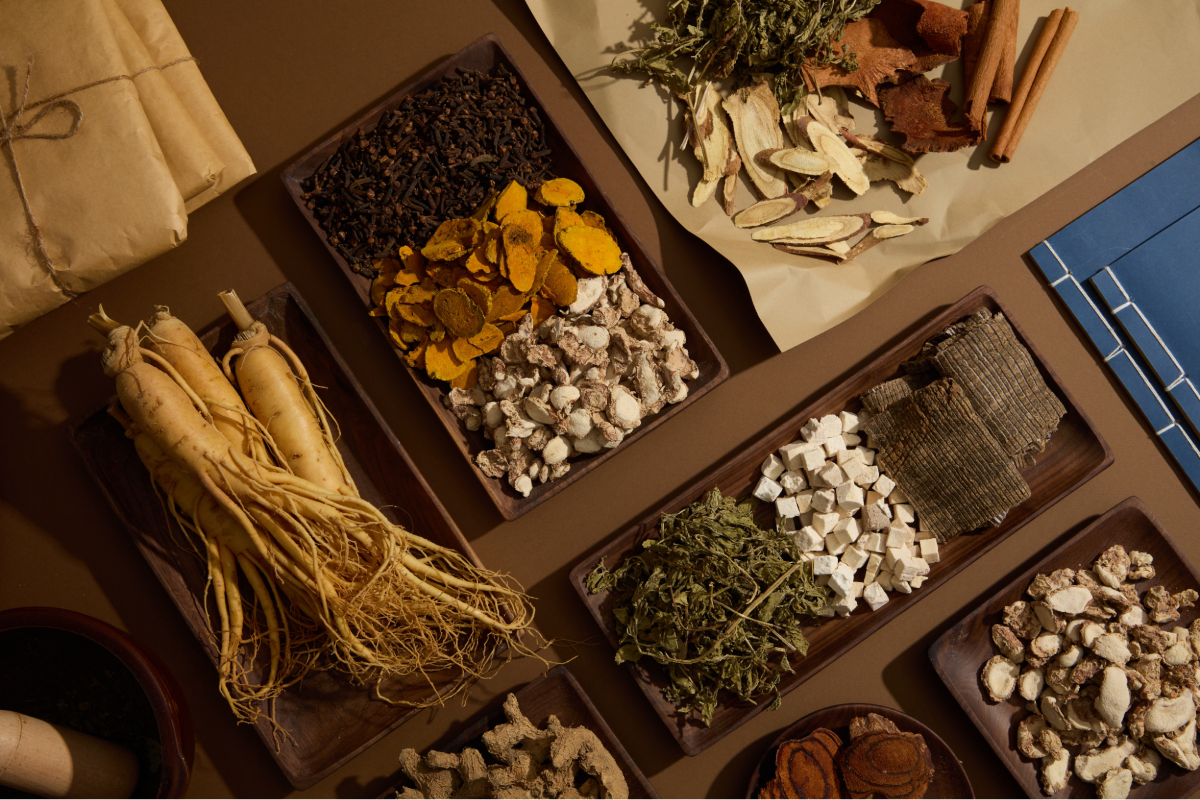
Many Chinese medicinal herbs cannot be used in their raw state. They need to undergo specific processing to improve their efficacy, eliminate toxicity, minimize side effects, and make them easier to preserve.
Transforming raw traditional Chinese medicine (TCM) ingredients into effective remedies is called TCM processing, also known as Pao Zhi. In addition to preparation—Pao Zhi optimizes herbs for better efficacy and absorption. It includes fire processing, water processing, and water-fire processing. The choice of dosage form and decoction method must be tailored to different conditions.
Chinese Medicinal Herbs Preparations
1. Fire Processing
There are four main fire-processing methods: calcining, baking, stir-frying with additives, and dry-frying. Dry-frying is the most commonly used method.
- Calcining: Directly heating the herb at high temperatures
- Baking: Similar to roasting sweet potatoes, where herbs are buried in hot ashes and baked
- Stir-frying with additives: Stir-frying herbs with substances like honey or salt
- Dry-frying: Dry-frying herbs without any additives
2. Water Processing
Water is most often used to process medicinal herbs—dipping, soaking, washing, etc. but wine or vinegar are sometimes employed instead of water.
3. Water-Fire Processing
This combines fire and water processing, such as steaming over water or boiling directly in water.
3 Main Medicinal Processing Means
The formulation method of TCM affects its efficacy, and different herbs require different preparation methods. The ancient Chinese medical text “Compendium of Materia Medica” states:
“Some medicines are best made into pills, some into powders, some are suitable for decoctions, some should be soaked in wine, and some are best prepared as medicinal pastes. Certain herbs can be used in multiple forms, while others should not be used in decoctions or wine. The formulation must align with the herb’s natural properties and should not be altered arbitrarily.”
This means that each herb has an ideal preparation method. The formulation should always follow the herb’s natural properties.
1. Pills
Pill form is suitable for relieving chronic conditions. Pills help dispel wind and cold, reduce chronic diseases, and break up the accumulated hard lumps in the body. If you are treating diseases involving upper burner organs like the lungs and the heart, the pills should be made in smaller sizes. They should also be wrapped with a thick layer of batter or paste so it does not dissolve rapidly to prolong their stay in the intestines and stomach.
For treating diseases of the lower burners, such as the bladder and kidneys, the pills are made larger and harder so they can stay in the intestines and stomach longer. If treating diseases involving the spleen or stomach within the middle burner, the pills should be made smaller.
In TCM, the upper, middle, and lower burners are collectively referred to as the triple burner, which divides the human body into three physiological and pathological domains. These three regions govern the main internal organs of the human body.
2. Decoctions
Decoctions are the number one choice for treating serious illnesses. Li Dongyuan, an eminent doctor in the Song Dynasty, once said: “Decoction is used to treat serious illnesses.” This means that decoction has a “cleansing” effect and can remove harmful substances from the body, making it suitable for treating more serious illnesses.
Decoctions also help cleanse the meridians (energy channels) and promote the circulation of qi (vital energy) and blood. Decoctions can also balance yin and yang in the body and restore the body to a healthy state. In such a form, the medicine can act faster and is also more powerful, good for quickly improving the condition.
However, due to their strong cleansing properties, decoctions may sometimes have a greater effect on the internal organs. For example, some people may experience diarrhea after taking a small amount of decoction, indicating that the purging effect is too strong. In such cases, it may be necessary to switch to pills or powders for treatment.
3. Powder
In regard to powders, Li Dongyuan said, “Powders are also used to treat acute illnesses.” This means that powders have a dispersing effect and are mainly used to treat acute illnesses. Powder can quickly dissipate evil qi in the body and is especially suitable for acute diseases that have just surfaced.
Herbs are ground into a fine powder and taken with hot water. For example, Yinqiao powder is a common powder that can effectively treat colds. The powder is suitable for fighting diseases caused by external factors such as wind, cold, heat, dampness, dryness, and fire, all regarded by TCM as exogenous or epidemic diseases.
3 Main Functions of TCM Herb Processing
Herb processing is a crucial technique in TCM. Using different processing methods achieves the following three functions:
1. Regulates the Efficacy of Drugs
Processing makes drugs more appropriate for treating specific conditions, such as with:
- Liquor: Helps guide the medicinal effects upward, making it suitable for treating discomforts on the head, chest, and other elevated parts
- Ginger: enhances the warming and dispersing properties.
- Honey: moderates the herbs’ potency and supports qi and internal organ function.
2. Enhances Absorption of Herbs
Certain processing methods help the body absorb herbal medicine more effectively. Examples include rice water, milk, and black bean licorice decoction processing:
- Rice water processing: Rice rinse water is used to prepare herbs. It has a lubricating effect, reducing dryness and aiding in absorption.
- Milk processing: This process uses cow’s milk or human breast milk to process herbs to remove excessive dryness, nourish blood, and reduce irritation.
- Black bean licorice decoction processing: Herbs are soaked in a decoction of black beans and licorice to neutralize toxicity and achieve a balancing effect.
3. Removes Undesirable Properties
Some processing methods help eliminate the undesirable aspects of certain herbs. For example, processing herbs using the urine of boys under 12 can reduce their harsh properties and guide their effects downward.
Additionally, specific parts of herbs that may cause adverse reactions are removed. For example, removing:
- Pulp of bottle gourd to prevent bloating
- Core of ophiopogon to reduce restlessness
- Lotus seed heart to lessen bitterness
Let Chinese Medicine Exert Its Maximum Effect
If you want to maximize the effect of Chinese medicine, the duration of its preparation and the method of decoction are both important. Most Chinese medicine can be divided into two major categories:
1. Qi-driven Herbs
Qi-driven herbs only need to be cooked briefly to release their odor and are suitable for treating conditions that need to be dispersed, such as inducing sweating to release the exterior and dispersing constrained stagnation.
For example, the medicinal effect of “Guizhi” decoction relies on the aroma of cassia twigs, which can be used for exogenous colds. The medicinal properties of Guizhi decoction mainly come from the cinnamon twig, peony, licorice, ginger, and jujube. In the past, they had to be crushed by our teeth. Today, they can be broken into pieces to foster the release of the aroma from the medicinal ingredients.
2. Substance-Driven Herbs
Substance-driven herbs need to be simmered—the longer they cook, the deeper their effects penetrate the body, making them suitable for treating deeper ailments. However, if cooked for too long, their dispersing effects may weaken. For example, kidney-tonifying decoctions may lose some of their intended benefits if overcooked.
Views expressed in this article are the opinions of the author and do not necessarily reflect the views of The Epoch Times. Epoch Health welcomes professional discussion and friendly debate. To submit an opinion piece, please follow these guidelines and submit through our form here.