



A 60-year-old chef was diagnosed with high blood pressure. His doctor had prescribed antihypertensive medication, which lowered his blood pressure but caused side effects, including back pain, neck stiffness, and numbness in his fingers.
He came to me seeking a natural approach. When I examined him through the lens of traditional Chinese medicine (TCM), I saw something that his blood pressure reading couldn’t reveal: the imbalance of yin-yang energy.
TCM views the human body as a microcosm. An imbalance in one area can disturb the bodily system. Central to TCM is the ancient diagnostic toolkit of yin and yang—the mutually complementary yet opposing energies that govern everything from the cosmos and the seasons to our health and emotional well-being.
For TCM practitioners, the twin energies of yin and yang aren’t abstract concepts. They are hands-on tools for understanding health conditions and for restoring balance. Let me illustrate how this philosophy works.
When the Body’s Thermostat Fails
Think of the human body as a home thermostat system, where yin acts as the coolant and yang as the heater. If the “coolant” leaks (yin deficiency), the entire system gets overheated. If this “heater” breaks (yang deficiency), you would shiver.
Of course, yin and yang aren’t just about temperature—they represent the body’s dynamic harmony between all opposing yet complementary aspects: activity and rest, tension and relaxation, digestion and assimilation, arousal and calm. When either yin or yang becomes deficient or excessive, this natural coordination breaks down, and illness follows.
When I examined the 60-year-old patient, I found his yang energy was excessively strong, surging upward like heat trapped without an outlet. His yin was unable to anchor and restrain his rising yang, leading it to ascend uncontrollably and manifest as hypertension. More specifically, every organ has its own yin-yang balance. In this patient’s case—and in many instances of high blood pressure—the typical pattern involves excessive liver yang rising and not enough kidney yin to restrain it.
The patient’s case exemplifies the core of yin-yang dynamics as opposite yet inseparable forces that must remain in continual balance.
I performed acupuncture to unblock his energy meridians and restore the balance between yin and yang. I also prescribed an herbal formula to nourish kidney yin, calm hyperactive liver yang, and promote blood circulation. After one acupuncture session and three weeks of herbal treatment, his blood pressure stabilized at about 130/86 millimeters of mercury, and all of his previous symptoms had resolved.
TCM’s yin-yang diagnosis did more than just control the symptom—the elevated blood pressure—it targeted and treated the underlying cause of the elevation.
Understanding Nature’s Twin Energies
Although often depicted in martial arts movies—appearing in the iconic black-and-white swirl of the tai chi symbol—the yin-yang energies are not mystical but manifest everywhere in our daily lives.
They represent two opposite yet inseparable halves of the whole. Like day follows night and night follows day, work and rest, action and reflection cannot exist without one another—they are interdependent and interconnected.
Yin embodies qualities of stillness, coolness, moisture, and inner calm—an inward, conserving energy. Yang represents activity, warmth, and external energy—an outward, expansive energy.
Such duality is captured in the traditional Chinese characters of both yin (陰) and yang (陽): The left sides of both characters have the component for “hill” (阝), and on the right side, yin has the elements of clouds, suggesting darkness, while yang (陽) contains the sun and rays, suggesting brightness. Together, they represent the sunny and the shady sides of a hill—opposites that always coexist, with neither of them being “good” or “bad.”
However, the two are not static but continually shifting. Just as the sunrise blends into sunset, yin and yang are constantly transforming into each other.
When one side reaches its extreme, it naturally gives rise to the other—as governed by the ancient Chinese principle of “when things reach their limit, they turn into their opposite.” Just like the coldest winter stirs the coming of spring.
This cyclical process reflects the living rhythm of nature. It reminds us that harmony—or health—is not static, but born from continual connection and responsive transformation. The yin-yang approach relies on balance and harmony—a contrast to Western logic, which emphasizes simple linear cause-and-effect relationships.
Reading Your Imbalance
Understanding the concept of yin and yang provides a language for recognizing patterns within your own body. Imbalance manifests through specific, observable signs that cluster together, pointing to whether either has become deficient.
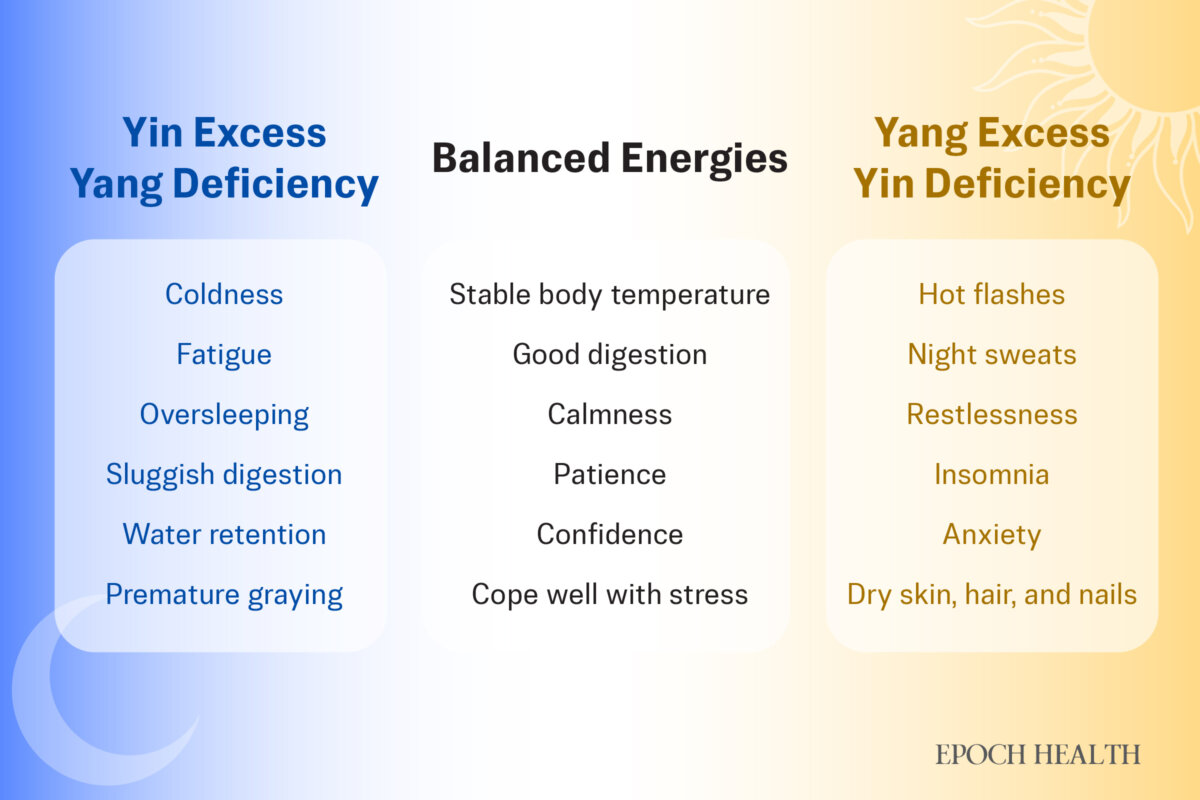
Signs of Yin Deficiency:
When yin becomes deficient, the body’s inherent ability to cool, moisten, and nourish is weakened. The “coolant” has leaked, leaving yang’s heat unopposed. You might experience:
- Hot flashes and night sweats
- Restlessness, insomnia, and anxiety
- Dry skin, hair, and nails
Signs of Yang Deficiency:
When yang becomes deficient, it cannot balance yin’s cooling, slowing effect. The “heater” has broken, leaving you unable to generate warmth and vitality. Common signs include:
- Feeling chronically cold, even in warm environments, fatigue, and oversleeping
- Sluggish digestion, water retention, and loose stools
- Hair thinning and premature graying
TCM identifies the underlying pattern of imbalance and works to restore root harmony, understanding that when balance returns, symptoms naturally resolve.
[series_posts_list][/series_posts_list]
A Pattern, Not a Single Disease
To explain this concept further, let me share a very interesting case of a 48-year-old woman who visited me to discuss anti-aging concerns. She was also experiencing typical menopausal symptoms, such as hot flashes, sleep disturbances, and mood changes.
During perimenopause, a woman’s yin energy—responsible for cooling and moistening—declines more rapidly than her yang energy. The imbalance leads to a relative yang excess and yin deficiency, disrupting the flow of qi (vital energy) and blood throughout the body.
Kidney yin deficiency is the root cause of many signs of aging, including wrinkles, sagging skin, and other menopausal symptoms. In TCM, the key to anti-aging treatment—and menopausal symptoms—lies in correcting the imbalance.
To help the patient, I performed facial rejuvenation acupuncture combined with body acupuncture to improve qi and blood circulation and prescribed Chinese herbal medicine to nourish yin. After a few months of treatment, the woman—who hadn’t menstruated in six months—experienced the return of a regular menstrual cycle. Her anxiety, hot flashes, and other menopausal symptoms completely disappeared, and her facial skin showed remarkable improvement in texture and tone.
Bringing Balance Into Daily Life
TCM promotes adaptive balance, akin to a see-saw where both sides dynamically interact to maintain harmony. The effort should go into consciously balancing activity with rest, stimulation with reflection, and outward engagement with inward calm—adapting oneself as one’s needs shift rather than enforcing a rigid yin-yang divide.
Here’s what I often recommend to my patients:
1. Structure the Day by Natural Rhythms
Mornings are naturally yang, representing active, outward qualities. This makes them ideal for exercise, eating, and preparing for the demanding tasks of the day. Evenings are yin, aligning with restful, reclining routines such as gentle stretching or self-reflection, which promotes quality sleep and mind-and-body detox.
2. Eat Seasonally to Balance the Twin Energies
Pay attention to the rhythms of nature, and adjust your diet according to seasonal changes. The ancient Chinese medical text “Huangdi Neijing” offers the following guidance: “In spring and summer, nourish Yang; in autumn and winter, nourish Yin.”
During the yang season, wake up earlier—as morning light supports the body’s natural yang rise—eat lighter foods and do more exercise. During the yin season, rest earlier, eat nourishing foods, and keep warm.
3. Daily Self-Reflection and Mindful Breaks
To help the body and mind transition smoothly between yang and yin states, I highly recommend including energy-balancing exercises or a period of self-reflection to ease the shift from a stressful working day to a restful evening. Basic energy-balancing exercises from the East include meditation and qigong.
Make a habit of daily self-reflection. Ask yourself: Is my see-saw tilted toward too much activity or too much rest? Am I being excessively irritated or overly indifferent? What small shifts do I need to make to restore personal balance today?
Remember that balancing yin and yang isn’t about perfection or rigid control. Even in the yin-yang symbol, the two energies are in constant adaptive motion, as evidenced by their respective light and dark swirls flowing and transforming into each other. Change itself is the key to harmony.
Our bodies already know how to be healthy. All they need is a little help recalling their way back to balance. In ancient times, longevity meant health, where people sought to live longer by harmonizing with nature (the Dao). However, nowadays, achieving true longevity seems far out of reach, as people pursue quick fixes to maintain their health.
What makes me happy is when my patients understand that extending years without nurturing health isn’t truly beneficial. The goal of TCM is not just to achieve longevity but healthy longevity—a life both longer and richer in wellness and balance.
Views expressed in this article are the opinions of the author and do not necessarily reflect the views of The Epoch Times. Epoch Health welcomes professional discussion and friendly debate. To submit an opinion piece, please follow these guidelines and submit through our form here.