


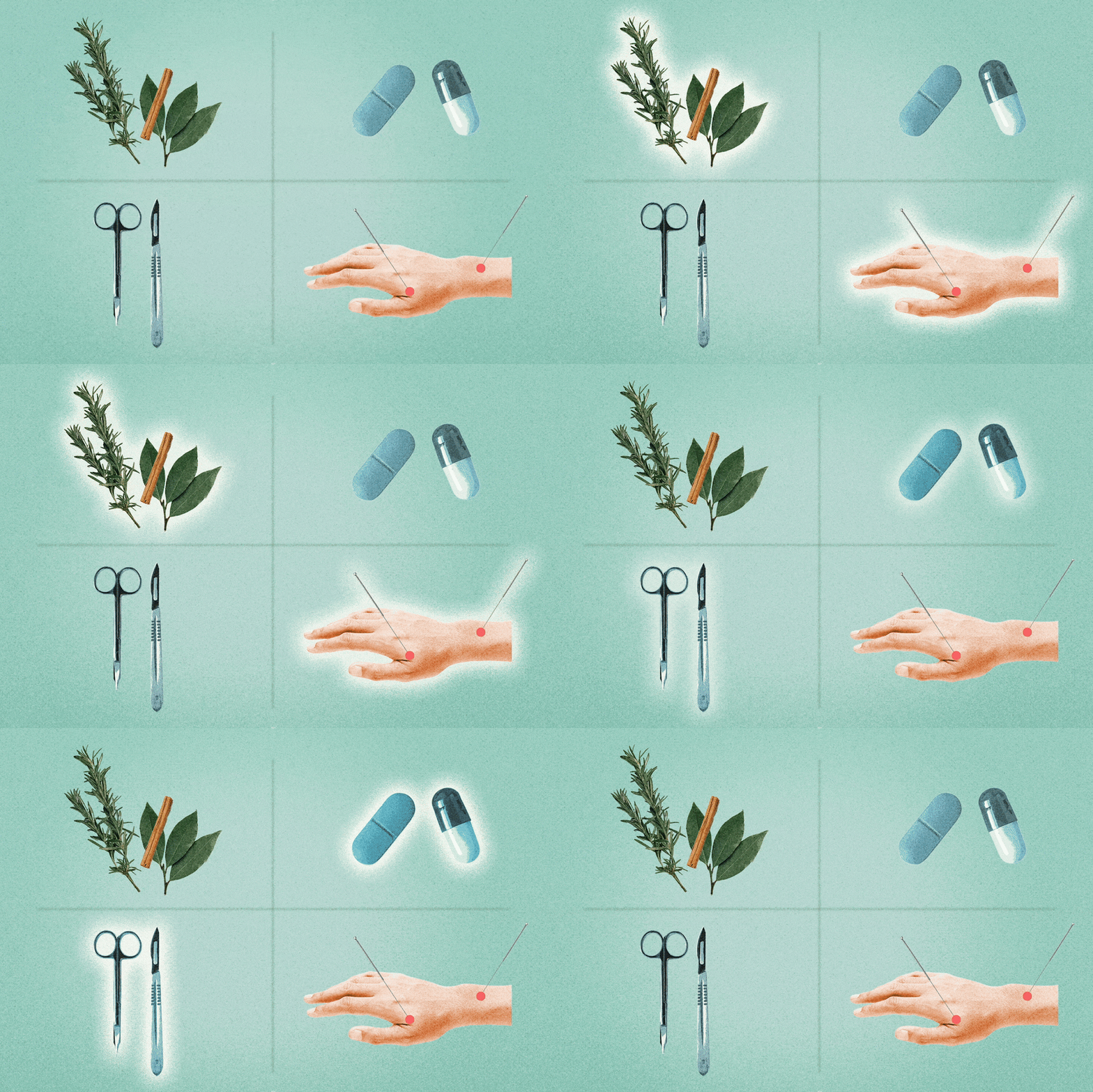
Across the country, patients are building alternative treatments into their own treatment plans.
In 2022, 36.7 percent of adults reported using at least one complementary approach in the previous year, according to a JAMA analysis of National Health Interview Survey data—nearly double the percentage two decades earlier. Alternative forms of care include everything from guided imagery to traditional Chinese medicine.
This shift is rarely a rejection of conventional medicine. Most people who use complementary care continue seeing their regular doctors. More often, it is a response to how the medical system feels: the six-month wait, the 15-minute visit, the symptom that returns.
“The pull is often relational before it is clinical,” Dr. David Rakel, chair of the Department of Family Medicine at the University of Wisconsin–Madison, told The Epoch Times.
Patient surveys show that people want to be recognized as unique human beings with unique stories, and they want to be heard, he said.
In a system built for volume and acute crises, the time required to be heard can be hard to find.
Elsewhere, the pace slows. An acupuncturist asks about stress. A naturopath asks about sleep and diet. There is time for the stories to run long. For some patients, the practitioner’s listening itself feels therapeutic.
As the search expands, so do the choices. In a marketplace crowded with possibilities—some evidence-based, some speculative, some purely commercial—the harder question is, what’s worth trying?
What Progress Looks Like
By the time one patient reached Dr. Victoria Maizes, he had done what his doctors had asked of him.
A viral illness had triggered Guillain-Barré syndrome, an autoimmune attack on his nerves. He received standard treatment. He did not recover. In his early 60s, he spent 23 hours a day in bed and used a wheelchair to move through his house. His pain was constant. He told her he had considered ending his life.
Maizes, the founding executive director of the Andrew Weil Center for Integrative Medicine at the University of Arizona, did not replace his care. She took a detailed history and asked a different question: What might be blocking recovery? She offered several suggestions.
The man agreed to try an elimination diet. Within weeks, he identified unexpected triggers—black pepper among them—that worsened his symptoms. His pain eased. He began sleeping again. When he returned, he walked with a cane and spent most of the day upright.
Another patient, a woman in her early 40s with breast cancer and diabetes, could not tolerate chemotherapy. Severe nausea repeatedly sent her to the hospital, and her oncologist feared she would have to stop.
With acupuncture twice a week and clinical hypnosis, she completed the full course. The integrative therapies did not treat the cancer itself, according to Maizes.
“They made it possible for her to stay in treatment,” she said.
For many integrative physicians, success is measured less by cure than by function.
Dr. Noredia Alile, an integrative pediatrician and founder of My Native Doctor, sees patients who arrive “tired, dismissed, and living in trial-and-error mode.” They have a diagnosis but no plan. Others have been told their labs are normal while their lives are not.
Improvement, she said, means “more good days, fewer crashes.”
A child stuck in a cycle of steroid creams experienced a calming of eczema within weeks and began sleeping through the night. A patient once “on the couch by noon” returned to hiking. Someone who avoided travel boarded a plane without mapping every restroom.
“That’s the shift,” Alile said. “From hopeless to measurable progress.”
For many chronic conditions, meaningful improvement is possible, Maizes said, but it requires a different approach—and real work.
Many alternative approaches ask more of patients: dietary changes, sleep adjustments, stress regulation, or daily follow-through. Integrative care, she said, depends on participation: “Some people want the pill. Others are ready to change.”
What Holds Up
What does the evidence say?
Some complementary therapies withstand scrutiny, particularly for pain. A systematic review and meta-analysis found that acupuncture could reduce migraine frequency compared with sham treatment or usual care, and benefits persisted after treatment. For lower back pain, chiropractic spinal manipulation has been linked to lower odds of receiving an opioid prescription the following year.
Mindfulness programs improve daily function for people living with persistent pain, depression, or anxiety. Nutrition counseling can uncover dietary patterns or nutrient gaps that routine labs might miss.
Evidence thins for more complex conditions—hormonal disorders, post-viral syndromes, autoimmune complaints—for which improvement isn’t a clean cure-or-no-cure outcome.
That is where Brad Rachman, a functional medicine specialist and the medical director of the Rachman Clinic, does much of his work.
He often recommends targeted dietary changes and mind–body practices for patients with hormonal symptoms or neurologic complaints. Practices such as tai chi and meditation, he added, may help quiet the body’s stress response. Patients sleep better and feel steadier.
“These shifts don’t always register dramatically in clinical trials,” he said. “But patients feel the difference.”
For many, improvement is gradual: fewer flares, longer stretches of steady energy, a return to work or exercise. These are measurable changes, even if lab values don’t flip from abnormal to normal.
Recovery is layered, Maizes said.
“Once someone experiences improvement, it changes what they believe is possible,” she said.
Function improves first. Hope follows. Emerging research, she noted, suggests that hope itself may influence immune function—a reminder that recovery is not purely mechanical.
Where Trials Fall Short
The gold standard of modern medicine is the randomized controlled trial: One group gets the treatment, another gets a placebo, and researchers compare outcomes.
Many traditional systems were built differently.
Acupuncture, ayurveda, herbal medicine, and many mind–body practices were developed centuries before clinical trials existed. They grew from repeated observation and from philosophies that treat the body as interconnected rather than a set of isolated diagnoses.
Their goals can differ as well. Instead of aiming to normalize a lab value, they may aim for fewer flares, steadier sleep, or enough stamina to return to work.
“Some things are difficult to study with a classic placebo design,” Maizes said. “How do you create a sham for breath work? People know whether they’re breathing differently.”
That doesn’t place such therapies beyond scrutiny. It does mean they don’t always fit neatly into a double-blind model.
Alile describes evidence as having “multiple legs”: published research when it exists, biological plausibility, safety, and the patient’s experience over time.
If crashes become less frequent or if someone who avoided travel boards a plane again—those changes matter, even if biomarkers don’t shift.
The research landscape is uneven. Drug trials are funded because medications can be patented and sold. No one owns tai chi or journaling. Some approaches remain lightly studied for financial reasons, not necessarily because they fail.
Limited research, however, is not proof of benefit. Nor is an anecdote proof of truth.
“It requires discernment,” Maizes said.
Warning signs include overpromising, testimonials in place of data, and claims of zero risk. Responsible care, she said, acknowledges limits and measures outcomes.
Truth, safety, and transparency, Alile said, are the dividing lines.
None of the physicians interviewed argued for abandoning conventional care. They described integrative medicine not as an alternative to science but as an expansion of it.
How to Decide
When alternatives help, it is often because patients are deliberate. They make one change at a time. They decide what to track—migraine days, sleep, stamina—and wait long enough to see a pattern. They resist stacking therapies before judging the first.
Rakel advises starting with low-risk, affordable options supported by credible evidence. He uses a four-part screen he calls ECHO, which stands for “efficacy, cost, harm, opinion.”
Maizes advises patients to look for formal credentials. Some physicians are board-certified through the American Board of Integrative Medicine or have completed accredited fellowships. Practitioners affiliated with academic medical centers are typically subject to institutional oversight. Credentials don’t guarantee quality, but they signal formal training and accountability.
Ideally, those choices are discussed with a primary care doctor who can interpret evidence and flag drug interactions. However, collaboration isn’t always easy.
Rachman calls such conversations “tricky territory.” Some physicians are open; others are skeptical.
“Defensiveness can say more about the fragility of the practitioner’s ego than the viability of the proposed modality,” he said.
“This is your body. You get to make choices that establish sovereignty and agency over the trajectory of your health.”
Still, choice works best with guardrails.
Sometimes what’s needed isn’t one more therapy. It’s guidance to weigh what’s helping and what isn’t.
Knowing When to Stop
Sometimes the harder decision is to stop.
Care can accumulate quietly: another supplement, another session described as the missing piece. Each step feels reasonable on its own. After three appointments, a fourth feels hard to cancel. After $200 on supplements, quitting feels wasteful. Hope nudges the plan forward. Over time, some patients notice they are busier but not better.
That pattern appears in both conventional and integrative medicine, Rakel said.
“In uncertainty, people trust the ‘expert’ that gives hope, even when piling on interventions and testing doesn’t lead to better outcomes,” he said.
Behavioral research suggests that fear of missing something—the quiet “what if”—can drive additional care.
More is not always better. If a therapy has been given adequate time and there is no clear improvement in symptoms or daily function, it may be time to reassess.
Money enforces this discipline for many families. Americans spend more than $30 billion a year on complementary care, nearly $15 billion of it on practitioner visits. Repeated sessions at $50 to $150 each can add up to thousands, often without insurance coverage.
Costs accumulate the way treatments do: one visit, one bottle, one adjustment at a time.
Rakel advises patients to pay attention to how providers sustain their practices.
“I always ask how they make their money,” he said.
Financial incentives can shape recommendations, even with the best intentions.
What Matters Most
In his practice, Rakel often narrows the conversation to a single question: “What do you want your health for?” The answers are often simple: to hike again, to play golf without wincing, to attend a wedding without calculating the nearest exit.
When that answer becomes clear, the plan sharpens.
Studies of shared decision-making suggest that when patients name what matters most, they may choose fewer tests and fewer appointments that add burden without benefit.
Complementary care is neither a cure-all nor a rebellion against science. It is one more set of tools. Used deliberately and measured honestly, it can help.
Many patients begin by searching for time—for someone who will listen. Time matters, but listening alone is not enough. The goal is not simply to be heard. It’s to be helped.
Maizes’s philosophy is to “change the question from ‘What’s the matter with you?’ to ‘What matters to you?’”
What’s Next: Social media has become a second waiting room for millions of patients. It can offer validation and vital information—or funnel people toward misinformation. The next article explores how to use it wisely.