



When The Epoch Times published a story on the dramatic increase in parents refusing newborn vitamin K shots in March, readers had a comment deluge, including concerns about what is in the injection, what the real odds of a bleeding crisis are, and whether there’s a defensible explanation for babies to have low vitamin K.
Many parents, such as 37-year-old mother-of-three Courtney Jane Gackstetter, have to make decisions about vitamin K moments after giving birth. They receive inadequate information from questions they ask.
Gackstetter told The Epoch Times she quickly said yes to a vitamin K injection for her son 12 years ago and regretted it later when she learned it contained an ingredient to which she’d had a history of severe allergies.
Information remains difficult to find, she said, and sometimes health care workers aren’t equipped with answers. The following are questions from Epoch Times readers, along with the most straightforward answers we could find.
1. Why Do Babies Have Low Vitamin K at Birth?
Mothers pass very little vitamin K to their babies through the placenta, resulting in low levels in all babies.
Vitamin K is produced by gut bacteria, but newborns haven’t yet developed the microbiome needed to produce it. Infants’ microbiomes are only beginning to build at birth.
The newborn microbiome undergoes several transitions in the first three years: initial colonization in the first several days of life, changes as the diet shifts to solid foods, and finally, resemblance to an adult gut microbiome around age 3. Of note, the type of delivery and feeding—breast vs. formula—and whether a baby or mother has taken antibiotics, can also impact microbial development.
Babies’ livers are also insufficiently able to process vitamin K.
Although all babies have low vitamin K levels, what’s concerning is vitamin K deficiency bleeding (VKDB), which could lead to brain damage and even death.
2. Is Vitamin K Deficiency Bleeding Common?
Early and classical VKDB—bleeding disorders that occur in the first day to the first week of life—affect roughly one in 60 to one in 400 newborns who aren’t given vitamin K, with early cases often linked to maternal medications and later cases involving visible bleeding, such as from the umbilical cord or gastrointestinal tract.
Early and classical VKDB are considered serious and occasionally life-threatening, but severe outcomes have not been quantified.
Late-onset VKDB, which can occur as late as 6 months, but more commonly between 2 to 8 weeks, is rarer, occurring in about one in 14,000 to one in 25,000 newborns who aren’t given vitamin K, and can be harder to detect because it is typically caused by internal bleeding in infants who otherwise appear healthy.
Late-onset VKDB is considered more serious because it comes on suddenly with higher mortality rates and chances of long-term brain damage. Retired obstetrician Dr. Stewart James Fischbein used to tell his patients that while late-onset VKDB was about 6 per 100,000, using oral vitamin K drops reduced the risk to two to three births per 100,000, and injectable vitamin K to one per 100,000.
“It’s a six-fold difference, but it’s still almost zero. The numbers are small no matter what,” he told The Epoch Times.
3. What Contributes to Higher Risk of Vitamin K Deficiency?
Infants whose mothers took anticoagulants, certain antibiotics (cephalosporins), or medicines to treat seizures during pregnancy have a higher risk of early VKDB. Prolonged antibiotic use among babies may alter their ability to synthesize vitamin K.
Preterm babies are also believed to be more at risk, as are those who undergo assisted deliveries, which can raise the risk of bleeding under the scalp and even deeper in the skull. Late-onset VKDB has been associated with liver disorders and other diseases that impair fat absorption, which is necessary for vitamin K synthesis.
Classical cases of VKDB are more common among infants with bruising or bleeding, typically from the umbilical cord or circumcision sites.
Though early cord clamping is unrelated to vitamin K because little vitamin K passes from the mother to the placenta, it may deprive a baby of stem cells and blood volume that may be protective in other ways, licensed midwife Blyss Young told The Epoch Times. When a baby is born, roughly one-third of their total blood volume remains in the placenta and umbilical cord—blood that is lost permanently if the cord is clamped within seconds of delivery.
Breastfed babies are more at risk of vitamin K deficiency bleeding because breast milk contains low levels of vitamin K. Even mothers who supplement with vitamin K or eat foods high in vitamin K still have low levels of vitamin K in their milk.
There isn’t much research on what babies with vitamin K deficiency bleeding have in common, so it’s difficult to isolate other potential contributing factors, Young added. “No one’s looking, so how do we know?”
4. When Did Vitamin K Injections for Newborns Begin?
Vitamin K was discovered in the 1930s. Vitamin K intramuscular injections, developed in the 1960s, quickly became the standard of care to prevent unexplained bleeding in newborns.
Most countries recommend vitamin K, though some offer the option of oral regimens given over several treatments, rather than a single injection at birth.
After cases of muscle contracture following intramuscular vitamin K shots in Japan in the 1970s led to malpractice lawsuits, the country largely adopted administering three doses of oral vitamin K instead—a decision now scrutinized as less effective than vitamin K shots. Policy could be shifting in other countries, with the Health Council of the Netherlands now recommending injections after a period of offering oral vitamin K.
The World Health Organization recommends that babies worldwide receive vitamin K prophylaxis, and most countries have policies for injections or oral drops.
5. What Ingredients Are in Vitamin K Injections?
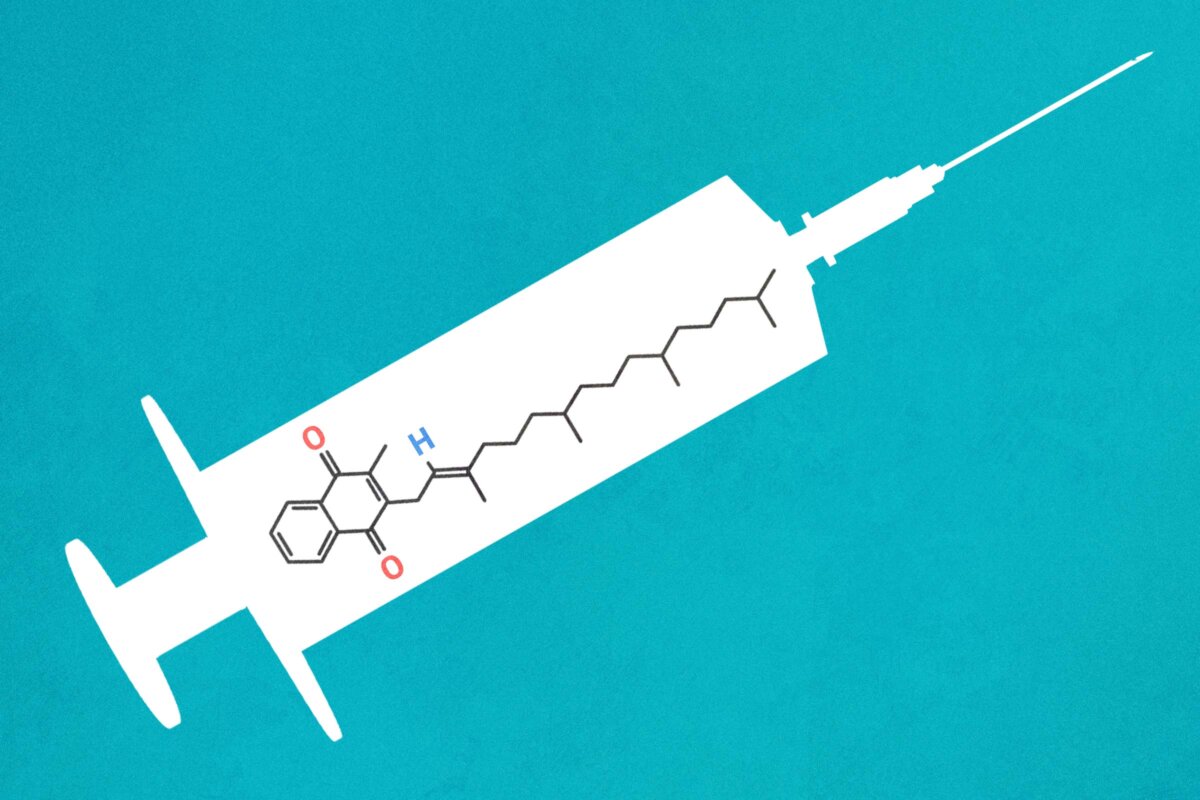
The injection contains phytonadione, a synthetic form of vitamin K, preservatives, along with stabilizing and pH-adjusting ingredients. Preservative-free formulations are available, though they contain similar stabilizing and pH-adjusting ingredients. Amounts of preservatives and additives in both versions are considered generally safe for newborns.
Injections may contain:
- Benzyl Alcohol: a preservative absorbed in the bloodstream, processed by the liver, and excreted through urine.
- Polyoxyethylated Fatty Acid Derivatives: such as polysorbate 80, an emulsifier that keeps ingredients separated and is also absorbed in the bloodstream, broken down into fatty acids, and cleared through urine.
- Dextrose: a glucose that stabilizes the product, and is processed like sugar—used for energy, briefly stored, and cleared from the body.
In rare situations, benzyl alcohol can be toxic to premature babies, who often take other medications containing the preservative in neonatal intensive care units; doctors now monitor and minimize benzyl-alcohol-containing medications, and a benzyl alcohol-free vitamin K product is available for vulnerable babies.
Of note, some oral vitamin K products could contain preservatives and additives.
Stabilizers are the only shared ingredient between the vitamin K shot and vaccines. Differ from vaccines that create an immune response in the body, the purpose of making vitamin K into injection is to slowly release a vitamin into the bloodstream.
Vitamin K is believed to be slowly released from the injection site in the thigh muscle and used over several months.
6. Vitamin K Has a Black Box Warning–How Serious Is That?
Vitamin K has a boxed warning, sometimes called a “black box warning,” about possible severe reactions, including severe allergic reactions such as anaphylaxis or hypersensitivity reactions that can lead to shock, cardiac arrest, and/or respiratory arrest, with intravenous and intramuscular administration.
A review of case reports and surveillance data published in Clinical Applied Thrombosis/Homostasis found that the overall risk is extremely rare, with cases being mostly in adults and involving intravenous vitamin K, which is not recommended for babies.
7. Could My Baby Have a Reaction to the Vitamin K Shot?
There have been cases of anaphylactic shock and Nicolau syndrome, a rare necrosis that can cause pain and deep tissue damage at an injection site, particularly in premature infants who’ve been given a vitamin K shot, according to a review in the International Journal of Molecular Sciences. The majority of reactions have occurred in patients given vitamin K solubilized with polyoxyethylated castor oil—commonly associated with patient medication reactions.
Given that artificial substances are associated with allergic reactions, it’s natural to question the risk of additives, Fischbein said.
8. Is There a Study Comparing Babies Who Get Vitamin K to Those Who Don’t?
Long-term randomized controlled trials comparing children who get vitamin K to those who don’t haven’t been conducted; many experts say such studies would be unethical.
However, Fischbein said that would be beneficial information for parents who want to weigh the potential health harms of an intervention that has no benefit for the vast majority of babies who receive it.
9. Is Oral Vitamin K a Viable Alternative?
One way to avoid the box warning, Young said, is to choose oral vitamin K.
The U.S. Food and Drug Administration hasn’t approved an oral formulation, so parents would have to bring drops to the hospital—mostly purchased at wellness stores and online—and ask their doctor to administer the first dose. Babies receiving vitamin K orally receive an initial dose at birth and two additional doses over six weeks, a practice more prone to human error compared to injections.
Dr. Joel “Gator” Warsh, a functional pediatrician at Integrative Pediatrics and Medicine in California, and a contributor to The Epoch Times, said in a previous interview that oral drops are not as reliable as injections that have decades of safety data.
Though not an official recommendation, a Japanese study of 119 healthy newborn babies found that those who were given 13 doses of vitamin K, one at birth, again on day five, and then weekly for 11 weeks, versus those receiving the three-dose regimen, had higher markers used to measure the effectiveness of vitamin K.
Nonetheless, “that another option is available to families, even though it’s not the standard of care, is good information to know,” Young said of vitamin K oral drops.
10. Could There Be a Benefit to Babies’ Low Vitamin K Levels?
This is a unique question asked by readers.
No benefits have been discovered, but because low vitamin K is a normal part of physiology, Young tends to believe there could be a biological benefit we don’t yet understand.
Babies have an entirely different coagulation system from that of children and adults. All but two of their clotting factors are low, and vitamin K is one of them. If the baby grows healthily, these two factors will quickly accelerate to normal levels, achieving an adult level by about six months.
Newborns also tend to bleed, but due to their specific physiology, they don’t bleed as long, and their blood essentially clots faster than in adults, according to an article in the International Journal of Molecular Sciences.
“Our bodies are very wise,” Young said, adding that one theory is that lower vitamin K causes blood to be able to travel faster to traumas that happen during and shortly after birth.
Many Christians believe that bodily wisdom comes from God, who—according to the Bible—commanded circumcision on the eighth day—a timeline that would line up with the development of a baby’s microbiome’s ability to make vitamin K.
“When God gave the covenant of circumcision, nobody knew anything about blood clotting, not until thousands of years later when man discovered this concept,” Curt Blattman, who has a master’s degree in apologetics, told The Epoch Times. “That to me is a powerful apologetic (defense of faith).”
About the questions on vitamin K shots, Young encouraged parents to bring them to their doctors.
It helps to do your own research rather than regurgitating information from a social media post, Fischbein said, adding that regardless of why a woman makes a choice, doctors have an ethical obligation to avoid coercion. “The woman has the right, innately, to agree or disagree, and we, as practitioners, are supposed to support them in their decision.”