



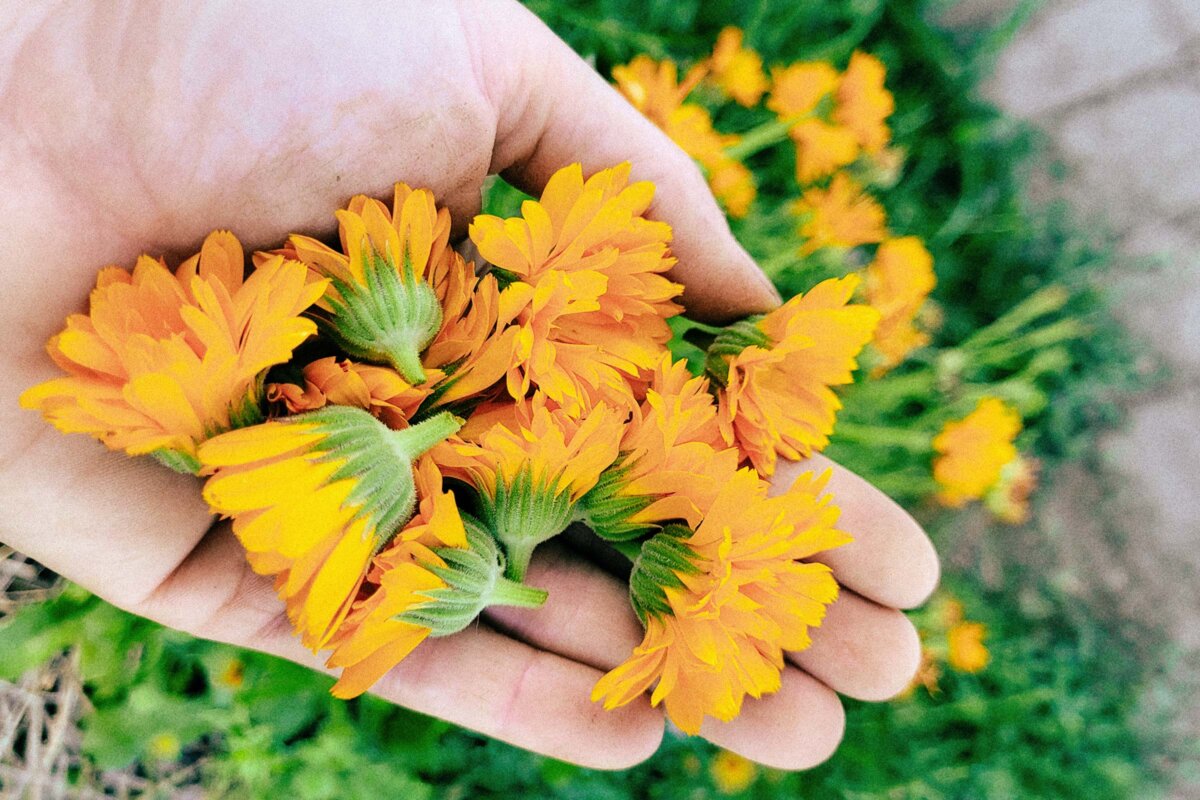
Inconspicuous yet vibrant is how calendula presents itself in my garden. With its bright yellow or orange blossoms, this small flower of the Aster family has a lot going for itself. It is resilient, a pollinator favorite, and packed with health benefits.
Calendula’s anti-inflammatory and tissue-healing properties work both topically as a salve and internally. Used for centuries in Ayurveda, Unani, and homeopathy, calendula contains compounds that may help protect the gut lining and calm irritation linked with leaky gut, gastric ulcers, and intestinal inflammation.
Calendula Nurtures Intestinal Health
Calendula’s vibrant petals are more than a treat for the eyes. Here are the main compounds thought to support digestion.
1. Flavonoids and Polyphenols
Polyphenols and flavonoids are plant compounds that act as antioxidants, protecting human cells from damage and reducing inflammation in the intestines.
2. Triterpenoids
Triterpenoids are special substances that help calendula calm an overly active immune system. They are also very effective at reducing inflammation.
3. Polysaccharides
Polysaccharides are sugars that form into large carbohydrate chains. They store energy and strengthen tissue and cell walls. In the gut, they soothe irritated mucous membranes—the lining of the inner gut.
When tested on animals, calendula showed potential to accelerate healing of acid-induced ulcerative colitis, usefulness against ulcers, and regeneration of the gut lining.
Calendula’s wound-healing qualities support the lining of the lower bowel and strengthen the gut barrier, counteracting leaky gut syndrome.
In all cases, calendula fosters a healthy gut microbiome.
The simplest way to use calendula at home is as a tea made from fresh or dried flowers. You can buy dried calendula, but it is also easy to grow and harvest yourself.
How to Grow and Harvest Calendula Flowers
Calendula is also a straightforward plant to grow, harvest, and use in a home herbal apothecary. Its seeds are easy to save, its flowers can be used fresh or dried, and its bright blooms make it a practical choice for gardens and containers.
Calendula seeds look like small, shriveled-up spiky worms. They are usually shaped like an open ring cut in half with serrated edges.
The seeds form when the flower stops blooming. You can use and spread the seeds only once they are completely dried. However, the plant self-seeds, meaning that it will drop its seeds naturally and regrow from the dropped seed the following year.
 (Alexandra Roach/The Epoch Times)
Calendula flowers can be used fresh or dried. They are edible and make a gorgeous topping on salads or soups, but you usually want to use only the colorful petals, as the green center of the flower has a very bitter flavor.
 (Alexandra Roach/The Epoch Times)
When the flowers are completely dry, you can store them in a sealed, airtight jar in a dark, cool area for up to one year—usually until you harvest next.
How to Make Calendula Tea
Although calendula flowers are bright and sunny, calendula tea has a more earthy, tart, or bitter flavor. I prepare calendula tea from dried flowers.
Tools
-
Cup
-
Strainer
-
Tea kettle
-
Lid or small plate (to cover and steep)
Ingredients
-
2 to 3 teaspoons of dried calendula flowers (entire head or petals)
-
8 ounces filtered water
Total Time: 10 minutes
Servings: 1
Instructions
Step 1: Add the dried calendula flowers directly to your teacup.
Step 2: Boil water and pour it over the flowers.
Step 3: Cover and steep for five minutes. For a stronger infusion, you can let it steep for up to one hour.
Step 4: Strain the flowers and enjoy the tea hot, at room temperature, or as iced tea.
You can enjoy up to three cups of calendula tea daily.
Safety Notes
For those allergic or sensitive to plants of the aster family, calendula tea might cause a skin rash or irritation.
During the first trimester of pregnancy, the use of calendula should be limited to topical skin applications. Refrain from internal use during this time, as calendula is a uterine tonic that hormonally stimulates contractions.
Calendula tea is traditionally known for its gastrointestinal and soothing properties. It can help relieve mild stomach cramps and reduce gut inflammation. In addition to its caffeine-free herbal benefits, the vibrant blooms of calendula bring a sunny, cheerful touch to your container garden.