



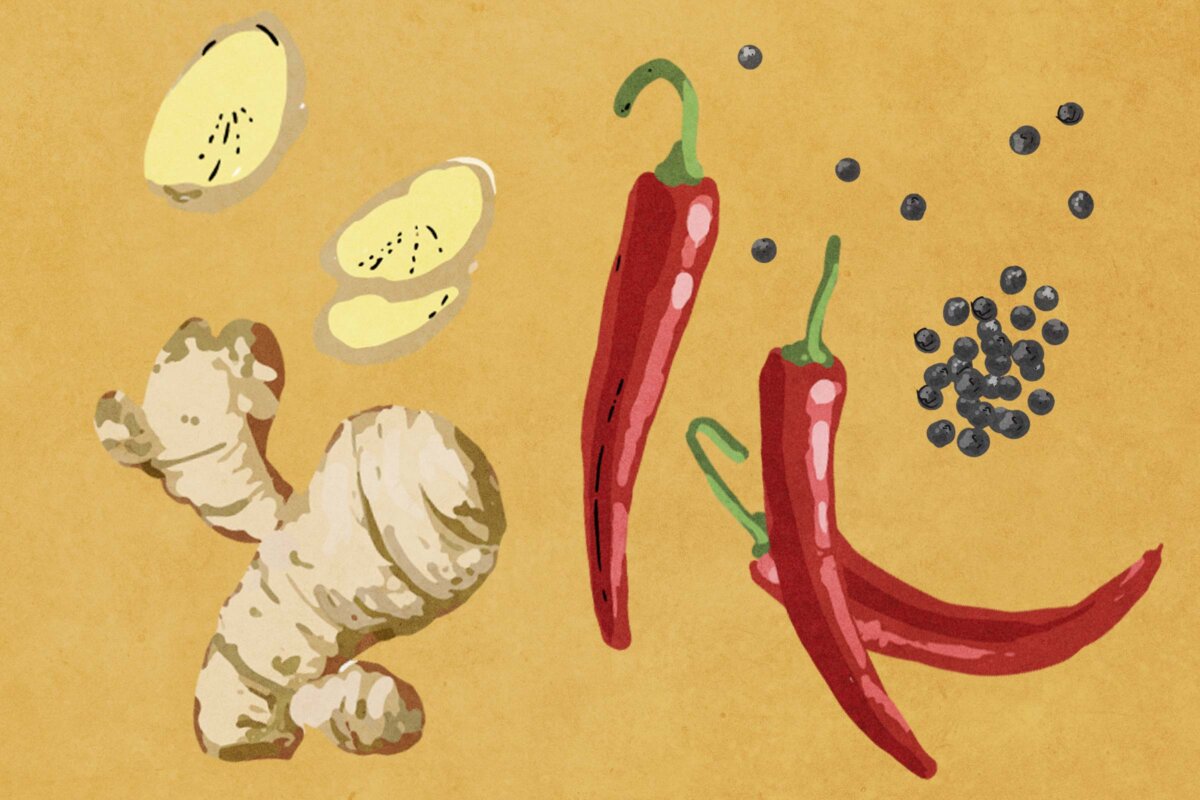
A Western nutritionist will tell you chili peppers work because of capsaicin, a compound that dulls pain and revs up metabolism. A traditional Chinese medicine practitioner will tell you the same chili pepper “expels cold” and moves stagnant energy. Both are describing the same fiery bite, and both are right.
From Mexican salsas to Sichuan hot pots, spicy ingredients have flavored meals for centuries. What’s changed is how seriously both camps now study why they seem to help the body.
Three Active Compounds
Western nutrition science zeroes in on three active compounds: piperine (black pepper), capsaicin (chili peppers), and gingerol (ginger). These molecules are responsible for the heat and aroma that make spices so distinctive, and they also confer a variety of health benefits.
Piperine’s most significant value is its ability to suppress cancer stem cells and block specific liver and intestinal enzymes that normally break down nutrients before they enter the bloodstream.
Capsaicin reduces substance P, a neurotransmitter that carries pain signals to the brain. That’s why it’s a common ingredient in topical creams for arthritis and nerve pain. Eating the substance, however, has no effect compared to topical application.
Capsaicin also stimulates thermogenesis—the body’s process of generating heat—leading to increased calorie burning. This property has made spicy foods popular among those seeking weight management solutions. However, the weight loss effect is modest, and it’s not a substitute for diet or exercise.
Research indicates that capsaicin may help lower blood pressure and cholesterol, reducing cardiovascular risk, and ginger has shown antimicrobial effects that can support immune health in lab studies.
Ginger’s anti-inflammatory compounds may ease muscle soreness and joint pain. It’s also rich in antioxidants that counter oxidative stress, a contributor to aging and chronic disease.
The Benefits of Heat
TCM doesn’t separate food from medicine. Everything you eat is thought to shift your body’s internal balance—its qi (vital energy), blood, and the push-and-pull of yin and yang—two complementary, opposing forces that interact to maintain the universe’s dynamic balance.
Spicy ingredients are classified as “warm” or “hot.” They are said to move circulation and clear out “cold” and “stagnation,” which is why ginger, cinnamon, and Sichuan pepper are traditionally used in winter, or by people who tend to run cold.
“Fresh ginger, scallion, and cinnamon twig can often be used to thwart cold and flu viruses before they have really taken hold in the body,” Sharon Sherman, a licensed acupuncturist and herbalist, told The Epoch Times.
Ginger’s other traditional use—easing nausea—works on digestion more directly, she said.
Flavor itself carries meaning in this system, according to Maz Roginski, a doctor of Chinese medicine and acupuncture. Pungent or spicy flavors are thought to promote sweating; bitter flavors “descend,” which is said to help with heartburn or constipation; bland flavors are thought to absorb excess fluid; and sour flavors are said to generate saliva and other fluids.
Spices are rarely used alone. “The synergistic combination of herbs and spices is at the heart of Chinese herbal medicine,” she said. “We rarely rely on single herbs to address a symptom or imbalance.”
One classic example is ginger and licorice decoction, from the “Shang Han Lun,” a medical text from the Eastern Han dynasty. “Ginger stokes the digestive fire, while the sweetness of licorice balances the stimulating, heating effect and prevents side effects like hiccups, heartburn, or even rashes,” she said.
Moderation is the operating principle. “Signs of excess heat, such as thirst, dry mouth, irritability, or yellow tongue coating, indicate the need to reduce warming spices,” Dr. Reuben Chen, a TCM practitioner and herbalist and chief medical advisor at Sunrider, a wellness and supplement company, told The Epoch Times.
If you’ve overdone it, Chen said, TCM offers cooling remedies: mung bean soup to “clear heat from the blood,” chrysanthemum tea for red eyes and irritability, and peppermint tea to vent heat through the skin.
Where the 2 Systems Converge
“For most people, cooking with spices is a safe and beneficial habit,” Sophia Deahl, a registered dietitian at The Nourished Method, told The Epoch Times. “Spices are one of my favorite ways to add flavor and increase the variety of plant compounds in a diet without relying on excess salt or sugar.”
Culinary amounts used in food are generally considered safe, while supplement doses are much more concentrated, Deahl said.
“For example, people taking blood thinners should talk with their healthcare provider before using high-dose turmeric, ginger, or garlic supplements because they may affect bleeding risk,” she said.
People with liver disease should be careful with concentrated turmeric or cinnamon, and pregnant women should check with a provider before taking any herbal or spice supplement, she said.
Safe, Practical Tips for Incorporating Spices
To source and store spices safely, it is advisable to buy whole spices and grind them at home, which helps minimize the risk of adulteration and fillers commonly found in pre-ground varieties.
Ground spices can be adulterated in two ways—one mostly annoying, one genuinely risky, David Goldman, a visiting researcher with the Faculty of Medicine at the University of Helsinki and fellow of the Academy of Nutrition and Dietetics, told The Epoch Times.
“The common one is plain filler,” Goldman said. Some processors bulk out ground spice with starch, rice flour, chalk, sawdust, ground brick, even sand, along with “spent” spice that has already had its oil extracted and is then sold as though it were fresh, he said. “Mostly, this just robs you of flavor, which is irritating, rather than harmful.”
The risky kind of adulteration is that there can be undisclosed allergens. Goldman noted a study of commercial ground turmeric that found wheat in every single sample it examined, none of it declared on the label. “For someone with celiac disease, that’s a problem hiding in a product they’d never think to question.”
Selecting certified organic brands can also reduce exposure to pesticides and heavy metals such as lead. “Shoppers reach for the brightest yellow on the shelf, so some processors add lead chromate, an industrial pigment, to turmeric,” Goldman said. He noted a 2024 study that examined 356 turmeric samples from India, Pakistan, Sri Lanka, and Nepal and found lead in 14 percent of them.
“In the worst markets, the levels were high enough that a child eating that turmeric regularly could end up with ten times the blood lead the CDC [Centers for Disease Control and Prevention] treats as a threshold for concern,” he said.
Proper storage is essential. Keep spices in airtight glass containers, away from heat, moisture, and direct sunlight to preserve their potency. Also, check expiration dates and discard spices that have lost their distinct aroma, as this indicates their active health compounds have degraded.
Increase Spice Intake Slowly
Start with small amounts, such as pinch-sized doses, to allow your gut microbiome to gradually adapt to new bioactive compounds.
It’s also beneficial to cook spices in a healthy fat such as olive oil, which helps activate fat-soluble nutrients and reduces gastric irritants present in the raw state.
For enhanced absorption, always pair turmeric with black pepper, as this combination can increase curcumin absorption by up to 2,000 percent.
To reduce sodium intake, incorporate flavorful spices such as cumin, smoked paprika, and garlic powder as alternatives to table salt.
Understanding the risks associated with common spices is also important. Limit cassia cinnamon and opt for Ceylon cinnamon if you use it daily to avoid potential liver toxicity linked to coumarin.
Eat nutmeg in moderation, keeping intake under 1/4 teaspoon per day, since larger amounts contain myristicin, which can cause toxicity.
If you are managing blood sugar levels, monitor them closely when combining therapeutic amounts of fenugreek or cinnamon, especially if you are on diabetes medications.
Finally, avoid taking high-dose garlic, ginger, or ginkgo concentrates at least two weeks before surgery, as they can increase bleeding risks.