



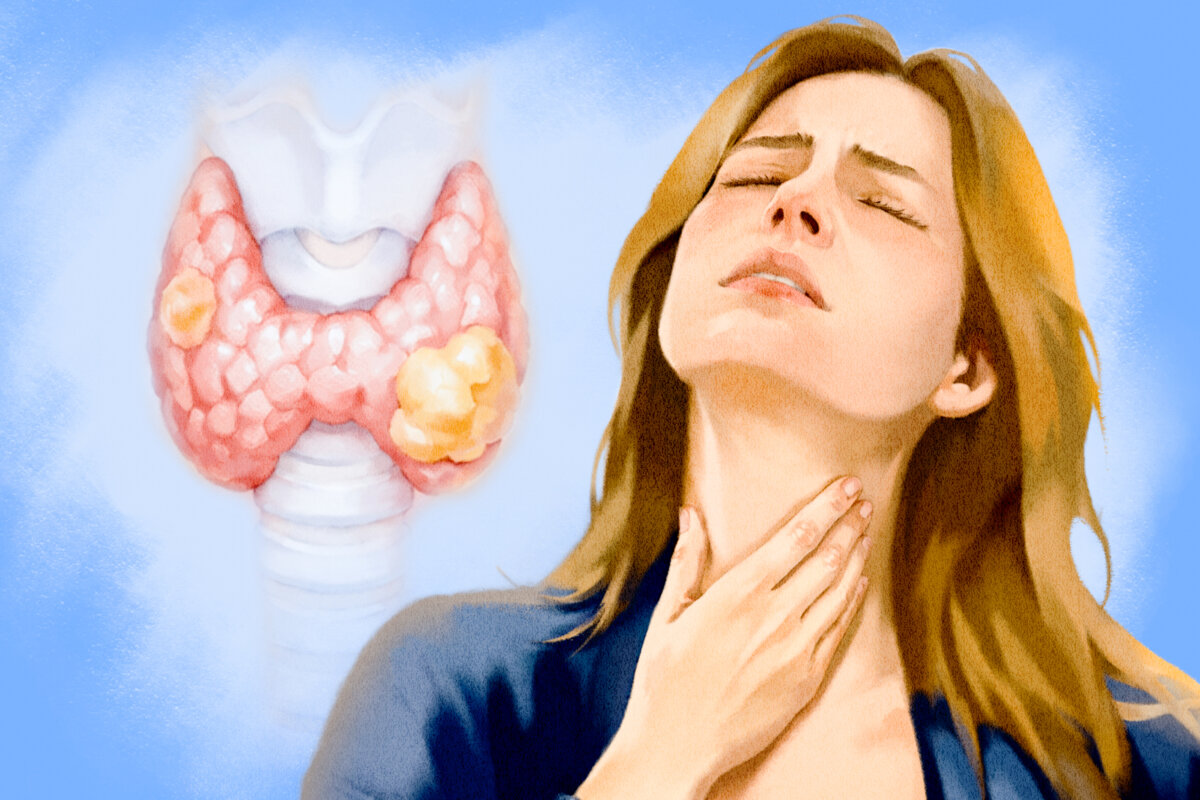
The thyroid is a small, butterfly-shaped gland in the neck that plays an outsized role in regulating metabolism, energy, growth, and many of the body’s essential functions. Trouble ensues when its cells turn cancerous.
Thyroid cancer often develops without obvious symptoms in its earliest stages. It is a diverse group of cancers with very different behaviors, treatments, and outcomes.
 (Illustration by Ran/ The Epoch Times)
When thyroid cancer does cause symptoms, they include:
-
A lump or nodule at the front of the neck that may grow quickly
-
One or more enlarged lumps in the side of the neck
-
Swelling or enlargement of the neck
-
Persistent pain in the front of the neck, sometimes extending toward the ears
-
Ongoing hoarseness or other voice changes
-
Difficulty swallowing and breathing
In more advanced disease, additional symptoms may appear:
-
Loss of appetite
-
Unintentional weight loss
-
A persistent cough
-
Coughing up blood
-
Severe diarrhea and flushing due to high levels of calcitonin
[shortcut_anchor id=”anchor_1789831560179″ label=”Types and Causes”]What Are the Different Types of Thyroid Cancer and Their Causes? [/shortcut_anchor]The thyroid sits just below the larynx (voice box) and in front of the trachea (windpipe). It absorbs iodine from food and uses it to produce two thyroid hormones—thyroxine (T4) and triiodothyronine (T3)—that help control how the body uses energy. These hormones influence metabolism, heart rate, body temperature, digestion, and muscle function.
The thyroid contains two main types of cells: follicular cells, which use iodine to make thyroid hormones, and C (parafollicular) cells that produce calcitonin, a hormone that helps regulate calcium.
The thyroid also interacts with other hormone systems and plays an important role in maintaining normal bodily functions.
Thyroid cancer includes four major types. Most thyroid cancers originate from follicular cells.
-
Papillary: This is the most common type of thyroid cancer, accounting for around 80 percent of all cases. It typically grows slowly in one lobe of the thyroid. Even when it spreads to nearby lymph nodes, it is usually highly treatable and rarely fatal. Some variants grow or spread more aggressively and may require more intensive treatment.
-
Follicular: This is the second most common type of thyroid cancer. It is more common in regions with low iodine intake. Unlike papillary cancer, it rarely spreads to nearby lymph nodes but can travel through the bloodstream to distant organs such as the lungs and bones. Although its prognosis is generally slightly less favorable than that of papillary thyroid cancer, outcomes are still very good for most patients. Oncocytic carcinoma of the thyroid, formerly known as Hürthle cell cancer, is traditionally classified as a variant of follicular thyroid cancer, although it is now increasingly recognized as a distinct form.
-
Medullary: This type accounts for less than 5 percent of thyroid cancers and develops from the thyroid’s C cells rather than follicular cells. It can be more difficult to detect and treat than the more common thyroid cancers, as it may spread early and does not respond to radioactive iodine.
-
Anaplastic (undifferentiated): This is a rare and highly aggressive form of thyroid cancer, accounting for about 2 percent of cases. It is believed to often develop from a pre-existing papillary or follicular thyroid cancer whose cells have changed so much that they no longer resemble normal thyroid cells. This cancer is difficult to treat and has a poorer prognosis than other types. It is also called undifferentiated thyroid cancer because its cells have lost the specialized characteristics of normal thyroid cells, thus contributing to its highly aggressive behavior.
Rarely, sarcomas and lymphomas can develop in the thyroid gland. These are uncommon and require different treatments than the cancers above.
Genetic Changes
Most thyroid cancers arise from gene changes acquired during a person’s lifetime, although not every cancer has an identifiable mutation. Only a small share are caused by mutations inherited from a parent.
Thyroid cancers have different genetic changes depending on their type: papillary cancers often involve BRAF mutations, follicular cancers commonly involve RAS mutations, medullary cancers are strongly associated with RET mutations, and anaplastic cancers may arise from other thyroid cancers and acquire additional mutations, particularly in TP53, that contribute to their aggressive growth and spread.
Risk Factors
The risk factors for each type of thyroid cancer vary.
-
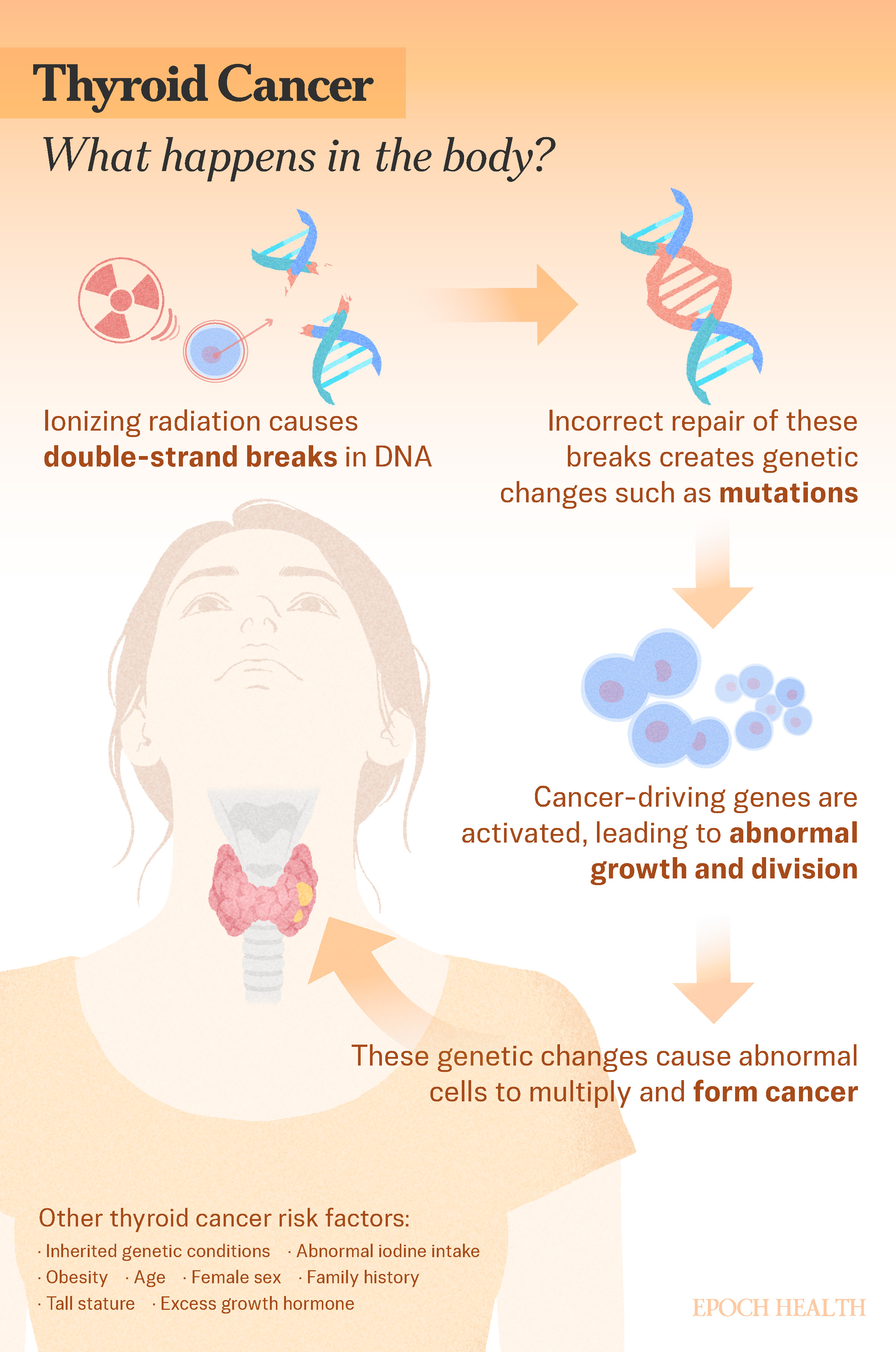
Radiation exposure: Exposure to ionizing radiation, particularly during childhood, is one of the strongest established environmental risk factors for papillary thyroid cancer. The thyroid gland is particularly sensitive to radiation, especially during childhood, because radiation damages DNA and can trigger genetic changes in thyroid cells. Ionizing radiation can damage DNA, particularly by causing double-strand breaks. When these breaks are repaired incorrectly, they can produce genetic changes such as gene fusions or mutations. Some of these changes can activate cancer-driving genes, leading to abnormal activation of the MAPK pathway, which is a cell-signaling system that controls cell growth and division. As a result, the MAPK pathway begins to promote cancer. Abnormal cells accumulate and potentially acquire additional genetic changes that contribute to the development of thyroid cancer. Before the 1960s, children sometimes received low-dose radiation for conditions such as acne, scalp ringworm, and enlarged tonsils or adenoids. The risk of developing thyroid cancer is higher with larger radiation doses and younger age at the time of radiation treatment. X-rays and CT scans expose patients to low doses of ionizing radiation. Any associated thyroid cancer risk is thought to be small and is more relevant with exposure at younger ages or repeated examinations. Medically necessary imaging should not be avoided, although unnecessary radiation exposure should be minimized.
-
A high or low iodine intake: A high-iodine diet may increase the risk of papillary thyroid cancer, for unknown reasons. Low iodine intake may lead to increased cases of thyroid cancers, especially in locations where iodized salt is not commonly used. One theory suggests that iodine deficiency resulting from low iodine intake may increase thyroid cancer risk by raising thyroid-stimulating hormone (TSH) levels, which stimulates thyroid-cell growth and may increase the likelihood of genetic changes that contribute to cancer.
-
Obesity: This condition is associated with a higher risk of papillary, follicular, and anaplastic thyroid cancers. Researchers have proposed several possible explanations for this association, including insulin resistance, altered TSH and growth-factor signaling, changes in hormones produced by fat tissue, and chronic inflammation. These pathways could influence thyroid-cell growth and the tumor environment, but none has been conclusively shown to explain the association between obesity and thyroid cancer in humans.
-
Inherited genetic conditions: Different gene mutations cause different types of thyroid cancer.
-
Papillary: Conditions such as familial adenomatous polyposis (an inherited condition caused by gene mutations that leads to the development of hundreds or even thousands of polyps in the colon and rectum) can increase the risk of thyroid cancer.
-
Follicular: Conditions caused by inherited gene mutations, such as Werner syndrome (a genetic disorder that causes signs of accelerated aging to start appearing in adolescence or early adulthood) or Cowden syndrome (an inherited disorder that causes noncancerous tumor-like growths called hamartomas), can increase the risk.
-
Medullary: Approximately 25 percent of medullary thyroid cancers are hereditary and caused by a germline RET mutation. Genetic counseling and RET testing are generally recommended for anyone diagnosed with medullary thyroid cancer.
-
-
Age: Thyroid cancer is most often diagnosed in women in their 40s and 50s and in men in their 60s and 70s.
-
Female sex: Thyroid cancer is the most common cancer in women under 30 and the second most common in women aged 30 to 45. Hormonal factors may play a role. A 2021 study suggests the gap in thyroid cancer risk between women and men may be largely due to greater detection of small papillary thyroid cancers rather than a true difference in underlying cancer risk.
-
Benign thyroid conditions: Some non-cancerous thyroid conditions may increase the risk, including thyroid nodules, enlarged thyroids, and thyroiditis (inflammation of the thyroid).
-
Being tall: A meta-analysis of 15 prospective cohort studies involving 6.7 million people found that relative risk rose by about 16 percent for every 5 centimeters of additional height.
-
Excess growth hormone: A 2023 meta-analysis of 19 observational studies found that thyroid cancer was diagnosed substantially more often in people with acromegaly than in comparison populations.
[shortcut_anchor id=”anchor_1789831578930″ label=”Diagnosis”]How Is Thyroid Cancer Diagnosed?[/shortcut_anchor]There is no standard routine screening test for thyroid cancer. Cancers without symptoms are often found incidentally—during a physical neck examination, surgery for another condition such as neck injury, or an ultrasound done for another reason such as carotid artery disease, a condition in which plaque builds up in the major neck arteries that supply blood to the brain. Routine screening is not recommended for most people, because many thyroid cancers are slow-growing and unlikely to cause harm. While screening can lead to false positives, overdiagnosis, and unnecessary treatment, it may be considered for those at higher risk.
Initial Evaluation
If a neck lump, symptom, incidental imaging finding, or high-risk medical history raises concern, the initial evaluation may include a neck examination, thyroid ultrasound, and thyroid-function testing.
-
Physical examination: Your doctor checks your neck for thyroid nodules or enlargement.
-
Ultrasound: Helps determine whether thyroid nodules are solid or fluid-filled, assess their number and size, and check nearby lymph nodes for signs of spread.
-
Blood tests: These tests measure thyroid hormone levels and may identify markers linked to thyroid cancer or thyroid dysfunction. A complete blood panel may include thyroid function tests such as TSH and free T4. These tests assess how well the thyroid is functioning but usually cannot determine whether a thyroid nodule is cancerous. Calcitonin and carcinoembryonic antigen may be measured when medullary thyroid cancer is suspected or after it has been diagnosed.
Diagnostic Tests
If screening, symptoms, or a neck lump raises concerns, further testing may include:
-
Imaging tests
-
Radioiodine scan: Uses a small amount of radioactive iodine and a special camera to identify thyroid tissue and help determine whether thyroid cancer has spread. Some thyroid cancers do not absorb radioactive iodine.
-
CT scan: Uses X-rays to create detailed images that can show the size and location of thyroid cancer and whether it has spread. Usually done after ultrasound, since iodine-based contrast dye can interfere with a later radioiodine scan.
-
MRI: Uses magnets and radio waves instead of radiation to create detailed images of the thyroid, nearby lymph nodes, and other soft tissues. It may also be used to check whether thyroid cancer has spread to other parts of the body.
-
PET scan: May be useful when thyroid cancer does not absorb radioactive iodine, as it can help detect whether the cancer has spread to other parts of the body.
-
Chest X-ray: Creates an image of the chest and checks whether thyroid cancer has spread to the lungs.
-
-
Biopsy: Confirms whether thyroid cancer is present by examining tissue from a suspicious area for cancer cells. Only about 12 percent of thyroid nodules that undergo a biopsy are found to be cancerous.
-
Blood tests: Check whether the thyroid is functioning normally and help guide decisions about further testing. They can also be used to monitor certain thyroid cancers. Some of these tests may be used for screening, too.
-
Calcitonin: Blood tests of calcitonin levels can help detect medullary thyroid cancer. Calcitonin may also be monitored after treatment to check for recurrence.
-
Carcinoembryonic antigen (CEA): People with medullary thyroid cancer may have elevated CEA levels, which are a tumor marker.
-
Hormones: Thyroid-stimulating hormone (TSH), triiodothyronine (T3), and thyroxine (T4) tests measure how actively the thyroid is functioning. TSH helps regulate the amount of T4 and T3 thyroid hormones in the blood. However, their levels are usually normal in people with thyroid cancer.
-
-
Vocal cord exam (laryngoscopy): The doctor examines the voice box using mirrors or a thin, lighted scope.
[shortcut_anchor id=”anchor_1789831590813″ label=”Stages”]What Are the Stages of Thyroid Cancer?[/shortcut_anchor]Staging—based on tumor size, location, and spread—helps doctors plan treatment and estimate prognosis. Thyroid cancer uses the tumor–nodes–metastasis (TNM) system, with criteria that vary by cancer type and, for papillary/follicular cancer, by age.
-
Papillary and follicular thyroid cancer in patients younger than 55: In Stage I, the tumor has not spread to distant parts of the body, while Stage II means the cancer has spread to distant areas.
-
Papillary and follicular thyroid cancer in patients 55 years plus: In Stage I, cancer is confined to the thyroid, with the tumor being 4 centimeters or smaller. In Stage II, the tumor may have spread to nearby lymph nodes or neck muscles. In Stage III, the cancer has spread beyond the thyroid into nearby structures, such as the trachea, esophagus, larynx, or nearby nerves. In Stage IV, the cancer has spread extensively beyond the thyroid.
-
Medullary thyroid cancer: In Stage I, the tumor is 2 centimeters or smaller and confined to the thyroid. In Stage II, the tumor is larger than 2 centimeters or has grown into nearby neck muscles. Stage III indicates spread to nearby central neck lymph nodes, while Stage IV represents more extensive spread beyond the thyroid.
-
Anaplastic thyroid cancer: It is always Stage IV because it tends to grow rapidly and is often advanced when diagnosed.
[shortcut_anchor id=”anchor_1789831634629″ label=”Treatments”]What Are the Treatments for Thyroid Cancer?[/shortcut_anchor]Thyroid cancer is also classified as low or high risk. Low-risk cancers are usually small and limited to the thyroid, while high-risk cancers have spread beyond the thyroid or are growing quickly. This risk level helps guide treatment decisions.
1. Active Surveillance
Some very small, low-risk papillary thyroid cancers can be monitored with regular exams and tests instead of immediate treatment. Treatment can begin if the cancer grows or starts causing symptoms. Active surveillance is not routinely used with follicular thyroid cancer, because confirming this cancer and assessing its invasive features generally requires surgical examination of the tumor.
2. Surgery
Surgery is typically the main treatment for papillary and most medullary thyroid cancers, as well as a first-line treatment for follicular thyroid cancer. There are several types of surgery:
-
Total thyroidectomy: Removes the entire thyroid and is the most common surgery for papillary thyroid cancer, the first surgery performed for medullary thyroid cancer, and also commonly used for follicular thyroid cancer.
-
Lobectomy: Removes one thyroid lobe and may be appropriate for some low-risk papillary thyroid cancers that are confined to the thyroid and are 1 to 4 centimeters in size.
-
Completion thyroidectomy: Removes the remaining thyroid tissue after a lobectomy confirms follicular thyroid cancer.
-
Neck dissection: Removes affected lymph nodes and surrounding lymphatic tissue in the neck. For medullary thyroid cancer, a central neck dissection is often performed at the same time of thyroidectomy because of the high risk of lymph-node spread.
Surgery is rarely used to treat anaplastic thyroid cancer, as this type is often advanced and cannot be completely removed when diagnosed. However, surgery may be considered in select cases or used to relieve symptoms, and may be given before or after other treatments.
3. Radiation Therapy
Radiation therapy uses high-energy radiation to destroy cancer cells and may be used after surgery or to treat cancer that has spread. There are several types, including:
-
Radioactive iodine (RAI) therapy: A form of internal radiation used for thyroid cancers that absorb radioactive iodine, including some cancers that remain after surgery or have spread.
-
External radiation therapy: May be used to treat cancer that has spread to distant sites and does not respond to RAI. It is commonly used for anaplastic thyroid cancer to control tumor growth in the thyroid and neck. In treating this type of thyroid cancer, it may be given alongside chemotherapy (chemoradiation) and delivered once daily or in smaller doses twice daily (hyperfractionation).
-
Proton therapy: A precision form of external-beam radiation using protons instead of X-rays, which can better spare nearby healthy tissues, making it useful for select thyroid cancers near critical structures.
4. Hormone Therapy
After total thyroidectomy, lifelong levothyroxine is generally needed to replace the hormones the thyroid would normally produce. In patients with persistent or higher-risk differentiated thyroid cancer, the dose may also be adjusted to suppress TSH. The degree and duration of suppression are individualized because excessive suppression can affect the heart and bones.
5. Targeted Therapy
Drugs blocking molecules driving cancer growth are used for recurrent or metastatic disease when RAI no longer works. There are multikinase inhibitors (daily pills blocking cell growth and blood vessel formation) and RET inhibitors (for cancers with RET gene changes).
6. Chemotherapy
Chemotherapy may be used when targeted therapy is ineffective in treating metastatic medullary thyroid cancer. Since chemotherapy has limited effectiveness in this type of cancer, it is generally used as palliative treatment to help control symptoms.
7. Traditional Chinese Medicine
Traditional Chinese medicine may be used alongside conventional thyroid cancer treatment to manage treatment-related symptoms and potentially support immune function and reduce some side effects, although it should not replace evidence-based cancer therapies. Herbal products may cause adverse effects or interact with cancer medications and should be discussed with the oncology team.
-
Compound Blister Beetle (Fufangbanmao) capsules: The main ingredients of this herbal medicine include blister beetle, ginseng, Astragalus, and several others. A 2023 study of 118 thyroid cancer patients assigned the participants to two groups: an experimental group receiving combination treatment of CAF chemotherapy and Fufangbanmao, and a CAF-only group. As per the findings, the objective response rate, representing the proportion of patients who achieved a complete or partial response, was 76 percent in the CAF-only group and 92 percent in the experimental group. The disease control rate, which additionally includes patients with stable disease, was 83 percent in the CAF-only group and 97 percent in the experimental group. The combination group also experienced fewer treatment-related toxicities compared with the CAF-only group. This small study does not establish the treatment’s effectiveness or safety. Blister beetle products may also contain toxic cantharidin. They should not be used outside specialist medical supervision or as a substitute for standard cancer treatment.
-
Qi-Supporting and Cancer-Fighting (Fuzheng Yiqi Kang-ai) decoction: This is composed of 20 herbal ingredients, including Astragalus root, Atractylodes root, Poria cocos, and lily bulb. One retrospective, single-center study reported better short-term disease-control rates among patients with anaplastic thyroid cancer who received a multi-herb decoction with radiation than among those who received radiation alone. Because treatment was not randomized and survival benefit was not established, these findings are preliminary and require confirmation in rigorous controlled trials.
[shortcut_anchor id=”anchor_1789831706629″ label=”Natural and Lifestyle Approaches”]What Are the Natural and Lifestyle Approaches to Thyroid Cancer?[/shortcut_anchor]There’s no thyroid-cancer-specific diet, and a generally balanced diet is recommended—with one notable exception.
1. Short-Term Low-Iodine Diet
Patients with papillary or follicular thyroid cancer may be prescribed a temporary low-iodine diet before radioactive iodine treatment. This diet reduces iodine intake so thyroid cancer cells are more likely to absorb radioactive iodine, allowing doctors to treat cancer cells more effectively.
The American Thyroid Association recommends limiting iodine intake to 50 micrograms or less per day during a low-iodine diet. Patients need to avoid iodized salt, seafood and seaweed, dairy products, egg yolks, soy products, and some commercially prepared bakery products that may contain iodine.
2. Cancer Recurrence Prevention
The likelihood of recurrence varies widely according to the thyroid cancer subtype, stage, pathology, treatment, and response to therapy. Continued risk-based follow-up is therefore important even after treatment. Maintaining a healthy lifestyle may help reduce the risk of thyroid cancer recurrence or developing another cancer. Key steps include maintaining a healthy weight, staying physically active, limiting processed red meats and sugary drinks, avoiding smoking, and limiting alcohol.
3. Mindfulness-Based Program
A 2019 study of 120 patients with papillary or follicular thyroid cancers receiving radioactive iodine treatment found that an 8-week mindfulness-based stress reduction program significantly improved emotional well-being and fatigue, while reducing anxiety and depression. These benefits were seen shortly after treatment and were still present three months later.
4. Combination Exercise Program
A 2018 study found that a 12-week home-based exercise program combining aerobic, resistance, and flexibility exercises helped thyroid cancer patients taking thyroid hormone replacement after thyroidectomy. Compared with the control group, patients who exercised experienced less fatigue and anxiety and increased natural killer cell activity, suggesting that home-based exercise may benefit both psychological well-being and immune function after thyroid cancer treatment.
[shortcut_anchor id=”anchor_1789831723546″ label=”Prevention”]How Can I Prevent Thyroid Cancer?[/shortcut_anchor]Most people who develop thyroid cancer have no known risk factors such as radiation exposure or obesity, which makes many cases difficult to prevent.
For those who inherit gene changes that increase their risk of medullary thyroid cancer, early genetic testing can identify at-risk family members, and preventive thyroid removal may be recommended.
If you don’t carry such gene mutations, you can reduce your risk by:
-
Limiting radiation exposure: Avoid unnecessary X-rays and discuss alternatives with your healthcare provider when appropriate.
-
Checking your neck regularly: Be familiar with the front of your neck and report any new lumps or nodules to your healthcare provider.
-
Considering chamomile tea: Limited observational evidence suggests that drinking herbal teas, particularly chamomile tea, may be associated with a lower risk of thyroid cancer.
[shortcut_anchor id=”anchor_1789831731579″ label=”Complications”]What Are the Complications of Thyroid Cancer?[/shortcut_anchor]Thyroid cancer’s potential complications include:
-
Difficulty swallowing or breathing: A growing thyroid tumor can compress or invade the esophagus or trachea.
-
Voice changes: Cancer invading the nerves or structures controlling the vocal cords can cause hoarseness, voice changes, or difficulty speaking. Surgery can also injure the recurrent laryngeal nerves.
-
Distant metastasis: Advanced disease can cause complications depending on where it spreads.
There may also be several treatment-related complications, including:
-
Low calcium levels if the parathyroid glands are affected during surgery
-
Hypothyroidism requiring lifelong levothyroxine after total thyroidectomy
-
Salivary or tear-gland problems following radioactive iodine therapy