


I was interviewing the last of three people who told me they had died, when I noticed they were all saying the same thing.
Their accounts of the other side differed in nearly every detail. One had been guided through an unearthly realm by a young woman on a butterfly’s wing. Another had communicated with a man who had died years before. The third was met by angels in an operating room. What they had in common was that while recounting their experiences, they had the same gentleness in their eyes and a poised confidence about the nature of death and the meaning of life.
They all carried a sense of mission that, decades later, had not faded.
I’ve been making a documentary, “Final Hours,” about people who have come back from clinical death, known as near-death experiences (NDEs). By the third interview, I was interested less in what they saw and more in what they brought back.
This is what they brought back.
The Neurosurgeon Who Didn’t Believe
Dr. Eben Alexander III was given up for adoption when he was 11 days old. His adoptive father was one of the most respected neurosurgeons of his generation, and Alexander followed him into the same field, eventually teaching neurosurgery at Harvard Medical School for 15 years. He was a confident materialist, believing that “the brain produces the mind—period.”
However, in November 2008, he was admitted to the emergency room, seizing from a rare bacterial meningitis—an infection in his brain. By the end of the week, his doctors put his survival chance at 2 percent, with zero percent chance of recovery. They were recommending that the family take him off the ventilator.
Yet he miraculously recovered.
I sat with him on a brisk February morning at his home in Virginia, listening as he recounted the experience. He is in his 70s now and, while speaking, moves fluidly between medical neuroscience and spirituality in the same sentence.
What he remembers from the seven days his brain was offline is the spine of the documentary, and I will leave most of it there. Yet he came out of the coma with an account that he—as a working neurosurgeon—could not reconcile. His entire neocortex was offline; there was no instrument left to produce a dream.
Upon return, he realized that the materialist worldview he was teaching at Harvard was a smaller story than the one he had stumbled into.
“Be careful of your beliefs,” he told me.
The neurosurgeon who used to teach that consciousness ends at the skull now teaches the opposite. He shares with people that human life is not purely materialistic—that life is unlimited, even after death.
The Teenager Who Died Full of Regret
Just days before my trip to Virginia, on a humid afternoon in central Florida, I sat in a gym across from a young man whose heart had stopped on the operating table during what was supposed to be a basic elbow surgery.
Bubba Herrick was 19, a right-handed pitcher, on a fast track to the major leagues. The day before his surgery, a nurse asked whether he had any allergies that might complicate the procedure. He had never been under, so he said no, and he walked out with a pit in his stomach he couldn’t explain.
The next morning, he had a reaction to the anesthesia and died on the operating table.
What he describes from the other side begins with a life review. He saw every single moment of his life play out, including obvious moments: the first time he picked up a baseball, an A on a test. Yet he also saw things he had not expected. He saw every time he could have said “I love you” and didn’t, and he saw every time he could have said “I’m sorry” and didn’t.
“I died full of regret,” he told me.
However, over on the other side, he was approached by a figure who told him he could receive a second chance, with one condition: “The next time you die, you have to be ready for it.”
Herrick is in his early 20s now. He carries himself with a bovine gentleness that usually only comes with age—or by peeking at the great beyond. The first thing he did, once he could put what had happened to him into words, was call everyone on his phone he felt he had wronged.
“I made sure to right all the wrongs that I felt I needed to,” he told me.
A Message From the Light
My journey to interview the third person was itself a test. I drove to Houston in a storm that turned the freeway into a long gray corridor of brake lights and standing water. By the time the crew and I reached the set, the rain had thinned, and Tricia Barker arrived ready.
In 1995, at 21, the then-English major at the University of Texas (UT) was hit head-on in Austin by a driver who jumped a yellow light.
Her back broke in three places. The first surgeon on call refused to come in because she had no health insurance. The surgeon who eventually agreed had been on duty for 40 hours and had to take a nap first. The consent form offered to the student noted a 17 percent chance of death. With no other choice, she signed the documents.
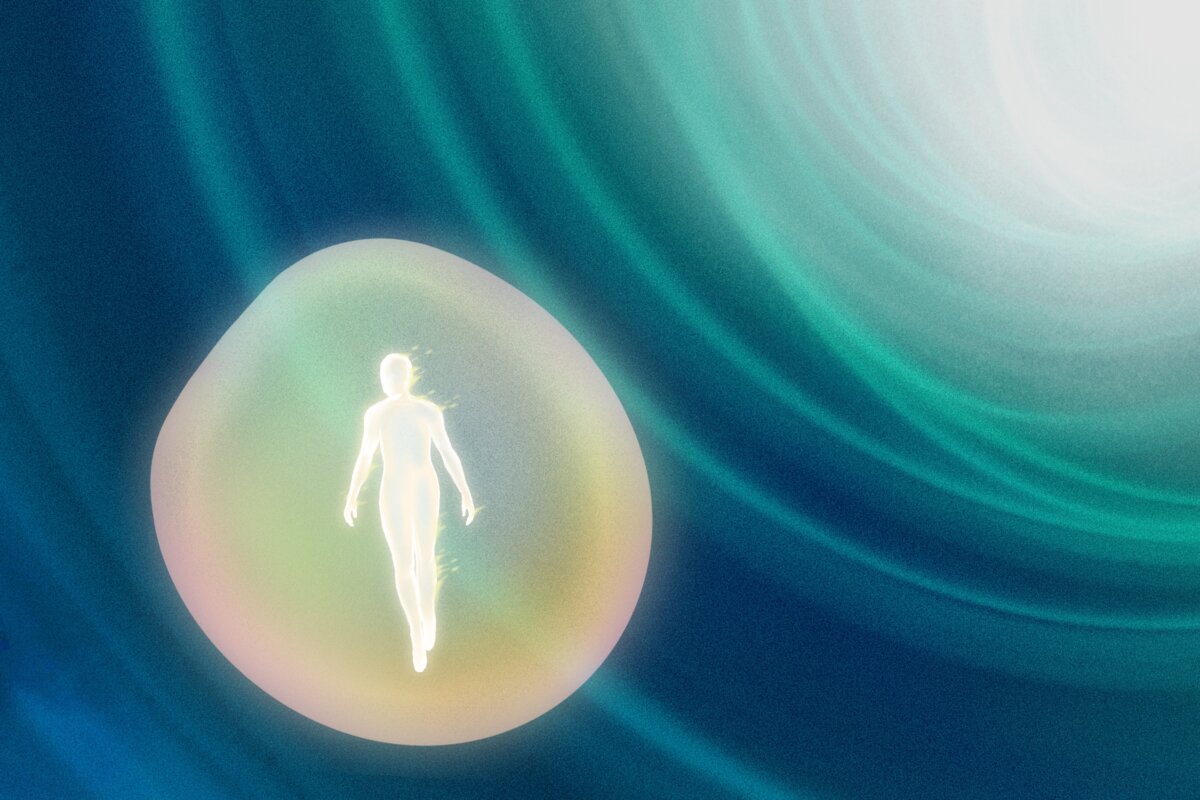
On the operating table, she counted down from 100, waiting for the anesthesia to hit, when suddenly her consciousness left her body. She watched the surgery from above the table and noticed the surgeons were not alone in the room. Angels worked around them and through them. Later, she rose higher, past the hospital, into a starscape, where she met what she calls a divine intelligence. There was a voice. It instructed her plainly.
“You’re going back, and you’re going to teach,” it said.
Before the accident, Barker was an agnostic college student from a broken home, a few years out from a suicide attempt.
After the accident, she returned to UT, completed her degree, and became a teacher.
Thirty years later, she is still teaching.
What she brought back, she said, was a job description, a mission, and a value system.
“I was a product of this culture,” she said. “I thought money and success and a house and a car, you know, all these things were all that mattered. Then I had seen what really matters is how you treat people.
“You can’t take dogma with you into that realm. You can’t take hatred into that realm. You can’t even take being right. All you can take—the only energy that is light enough to go with you—is love.”
1 Question, 1 Answer
At the end of each of these interviews, I asked a question I had asked at the first one and could not stop asking by the third. I looked the person across from me directly in the eye and asked, “Are you afraid of death?”
Their answers came so quickly you could mistake them for reactions.
“Absolutely not,” they unanimously said.
Their lack of fear was striking to me. Their calmness was a reflection of a deeper kind, a realization that death is far from the end.
These three had all reorganized their adult lives around things they brought back. For Alexander, it was teaching that we are spiritual beings in a spiritual universe. For Herrick, it was learning to live so that the next death, whenever it comes, finds him with nothing left unsaid. For Barker, it was guiding her students in a classroom.
A Message About This Life
I also talked to experts who study this phenomenon scientifically.
I visited Dr. Jeffrey Long’s home in Kentucky. He is a practicing radiation oncologist and researcher who runs the largest publicly accessible database of near-death experiences in the world. He has been doing this for more than 30 years. I asked him whether what I had been observing on my three trips was present in his data.
He answered it the way a researcher would, with numbers.
In 2024, he published the largest study of NDE aftereffects on record, comparing 834 near-death experiencers against a control group of people who had brushes with death without an NDE. The differences, he told me, were far from subtle. The experiencer group reported, overwhelmingly and consistently, increased compassion, a heightened sense of meaning, and decreased fear of death.
“Ultimately,” Long told me near the end of our conversation, “the message they bring back, again and again across cultures, is the same. I would say it is the most profoundly important message that is even conceivable for all of humanity.”
What is that message?
“Our lives have purpose,” Janice Holden, past president of the International Association for Near-Death Studies, told me.
“We’re meant to treat each other with as much compassion and caring and generosity as we can … and to use the opportunity of life as an opportunity for spiritual development.”