




At 65, “Marianne” found herself standing in the grocery aisle, staring at the prices. Living alone on a fixed income, she wanted to eat healthy but didn’t know where to start. “I walk through the store and try to make healthy choices, but everything costs so much,” she told The Epoch Times. “It’s hard to maintain a nutritious diet on a budget these days.”
Marianne’s story is not unique. Across the United States, the rising cost of food is generating major problems. Grocery prices have spiked by 23.6 percent since 2020, with one in four adults reporting food insecurity in 2024. Persistent high costs can make it difficult for many households, especially those on fixed incomes, to maintain a healthy diet.
Eating well on a fixed income can be a strategy. With the right planning and perspective, nutritious food can fit into almost any budget.
The solution isn’t what most people expect, Laura Banks, an integrative nutrition health coach, told The Epoch Times.
“When it comes to meal planning, a lot of people just want to jump straight in and start writing down meal ideas,” she said. “But there are very important steps that need to come before that so that you save yourself money, time, and frustration in the long run.”
6 Tips to Stretch Your Grocery Budget
You might be spending more at the grocery store than you realize. These six tips can make it easier to plan and save.
1. Check Your Schedule First
Most people start meal planning by picking recipes, then realize halfway through the week that they don’t have time to cook them. The first step isn’t choosing meals—it’s scheduling, Banks said.
“The first thing you must do is look at your calendar to see what is going on in the upcoming week that will impact meal times,” she said. “Then look through what you already have in your refrigerator, freezer, and pantry.”
This small step creates structure. Knowing when you’ll be home late or what ingredients are already on hand prevents food waste and last-minute takeout ordering. For example, if there’s soccer practice on Tuesday night, you might plan a quick stir-fry or tacos that come together in under 20 minutes. A quieter Sunday afternoon, on the other hand, is a perfect time to roast vegetables or cook a big batch of rice to use throughout the week.
2. See What You Already Have
The average American family throws away about $3,000 worth of food each year, according to the Environmental Protection Agency. Forgotten produce, expired leftovers, and bulk buys gone bad all add up.
Using what you already own is one of the easiest ways to save. A single bag of frozen vegetables can stretch into three dinners. Toss them into fried rice one night, mix them into a quick pasta with olive oil and garlic the next, or add them to soup at the end of the week. A half-bag of brown rice can make burritos, grain bowls, or stir-fry with leftover chicken and eggs.
Using what’s already in your kitchen keeps your costs down and prevents the waste that costs families hundreds annually.
3. Become a ‘Hidden Costs’ Detective
Ultra-processed foods appear cheaper because they last longer and require little effort to prepare, but their hidden costs are steep. A 2024 meta-analysis published in The BMJ confirmed that diets high in ultra-processed foods are associated with a greater risk of chronic illness. A 2024 review published in Frontiers in Nutrition found that ultra-processed foods are associated with increased risk of obesity, heart disease, and early mortality.
Aderet Dana Hoch, a registered dietitian, said much of the confusion happens before food even reaches the cart.
“Marketing influences poor spending choices,” she told The Epoch Times. “You may buy something labeled ‘health food’ or ‘organic,’ but the unit price or nutrition doesn’t justify it.”
The fix is to look past packaging. Compare unit prices, check ingredients, and focus on recognizable, whole foods. Simple staples such as beans, oats, eggs, and frozen vegetables deliver far more nutrition per dollar than most packaged “health” foods.
4. Be Selective About Buying ‘Organic’
If you want to add organic items without breaking your budget, start by focusing on the produce most likely to carry pesticide residues. Soft or leafy fruits and vegetables, such as strawberries and spinach, are higher risk. Research shows that produce with thicker skins, such as avocados, bananas, and oranges, provides a natural barrier that limits pesticide exposure into the pulp.
According to the Environmental Working Group’s annual analysis, produce such as peaches, nectarines, grapes, cherries, and apples often appear on its Dirty Dozen list because they show the highest levels of detectable pesticide residues. Washing produce thoroughly under running water reduces surface chemicals regardless of whether items are organic or conventional.
According to registered dietitian nutritionist Yvette Hill, you don’t have to buy everything organic. “Try finding them in frozen or canned options. Frozen or canned organics can be cheaper and will last longer,” she told The Epoch Times.
Stock up when organic pantry items go on sale, and consider farmers’ markets or co-ops, where prices can be lower than those at major grocery stores. Freezing discounted organic produce extends both shelf life and savings.
5. Simplify Meal Prep
The image of perfectly portioned containers lined up in a fridge can make meal prep feel intimidating. “It doesn’t have to be all or nothing,” Banks said.
“It can feel super overwhelming and time-consuming to meal plan and prep on a weekly basis.”
Start with small, manageable steps. Wash and dry greens as soon as you get home from the store so they’re ready for quick salads. Cook a batch of grains or roast a tray of vegetables to mix into meals during the week. Even packing snacks to take with you or slicing fruit ahead of time makes healthy eating easier.
Whether you spend a Sunday afternoon cooking or simply double your portions for leftovers, consistency matters more than perfection. The goal is to make it realistic enough to maintain.
6. Prep Perishables Promptly
Even the best plans fail if food spoils before it’s cooked. Darin Detwiler, a food safety expert and professor of food policy and corporate social responsibility at Northeastern University, said that food safety and waste are connected.
“A preventable foodborne illness can result in doctor visits, missed work, or hospitalizations that are far more costly than a few minutes of careful preparation,” he told The Epoch Times.
Detwiler recommends refrigerating leftovers within two hours, thawing frozen foods safely in the refrigerator, and cooking perishables promptly. “If I’m worried about whether a food is safe, I cook it,” he said. Cooking what you buy promptly keeps you healthy and prevents the money you spend on food from ending up in the trash.
Safety Tip: Label leftovers with dates, freeze what you can’t eat within three days, and always cook thawed meat within 24 hours.
A Week of Budget-Friendly Meals
A practical five-day family dinner plan can help save money. Each of the recipes below repeats ingredients to reduce waste and keep costs low—proof that eating well can be affordable without sacrificing variety. The price is about $90 to $100 for the week, or roughly $4 to $5 per serving.
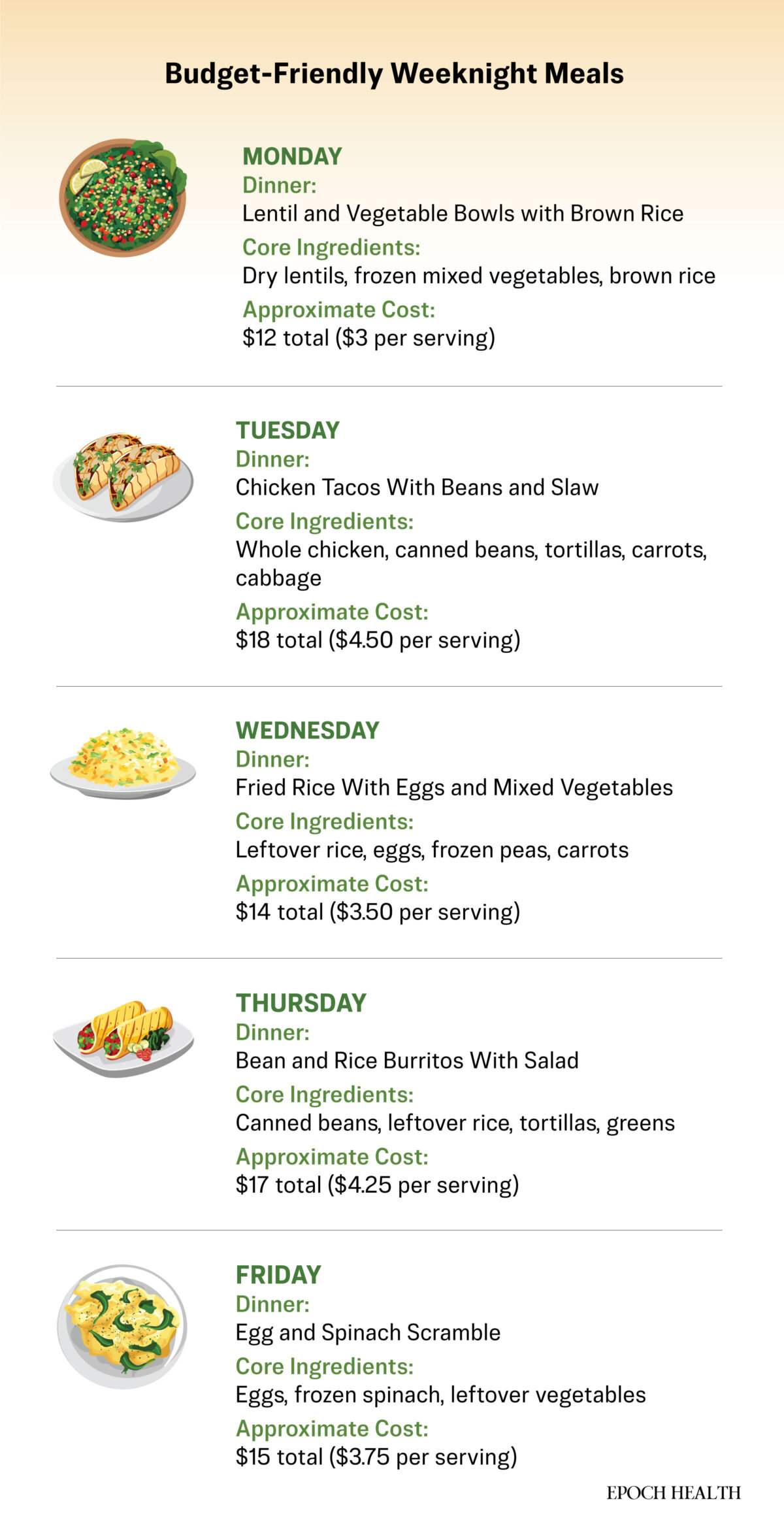
Eating for 1
For single eaters such as Marianne, a scaled-down version of the same meal plan can still work. Preparing smaller batches or freezing portions of rice and vegetables turns bulk shopping into smart savings. However, since single shoppers still have to buy full-size ingredients, such as a whole carton of eggs or a full bag of tortillas, their per-serving costs are naturally higher.
Planning can make a real difference. A whole chicken, which costs far less per pound than a single breast, becomes a budget-friendly choice when it is broken into portions and used across several meals. With preparation, single shoppers can freeze what they don’t want right away and repeat ingredients over multiple meals to bring their costs down. As a general rule, however, they will end up buying ingredients in smaller portions that will raise their per-meal costs.
Smart Shopping Strategies to Save Hundreds
- Compare Unit Prices Instead of Packaging: A store-brand bag of frozen broccoli for $2 yields four servings compared with $3.50 for the same amount fresh. Over time, those savings add up.
- Use Your Freezer Like a Savings Account: When you find discounts on meat, bread, or produce, freeze labeled portions. It turns temporary deals into long-term resources and protects against food waste. Label leftovers, cook perishables promptly, and freeze what you can’t eat within three days. Every wasted item is money lost.
- Simplify Your Staples: Keep versatile, inexpensive foods, such as whole grains and frozen vegetables, on hand. These basics form the backbone of countless meals, saving both time and money. A 2024 study found that households relying on simple, nutrient-dense staples tended to maintain better diet quality at lower cost.
- Batch Cook and Repurpose: Make one large ingredient the base for several meals. A pot of beans can become soup, burritos, or salads. A tray of roasted vegetables can stretch across three dinners. Small efficiencies multiply.
- Use Technology Wisely: Store apps, digital coupons, and loyalty programs reduce grocery bills without much effort. Some now track price trends for staples such as rice and eggs, making it easier to plan purchases.
- Eat Seasonally: Buying produce in season, such as strawberries in summer and squash in winter, can reduce prices by up to 30 percent. Seasonal foods are fresher, more flavorful, and often more nutritious.
Bottom Line
Eating well on a budget begins with a mindset. It’s about planning ahead, staying consistent, and making the most of what’s already in reach. Each small habit, from checking your calendar to cooking in batches and freezing leftovers, turns into a way to eat better and stick to a budget.
Within a month of planning and using what she already had at home, Marianne noticed she was saving nearly $40 a week on groceries and wasting far less food. What started as a small effort quickly became a routine she could maintain.
With steady practice, healthy eating can become a normal, cost-effective part of your week. It’s proof that nourishment and affordability can coexist. Healthy eating doesn’t require spending more—it just takes spending smarter.