



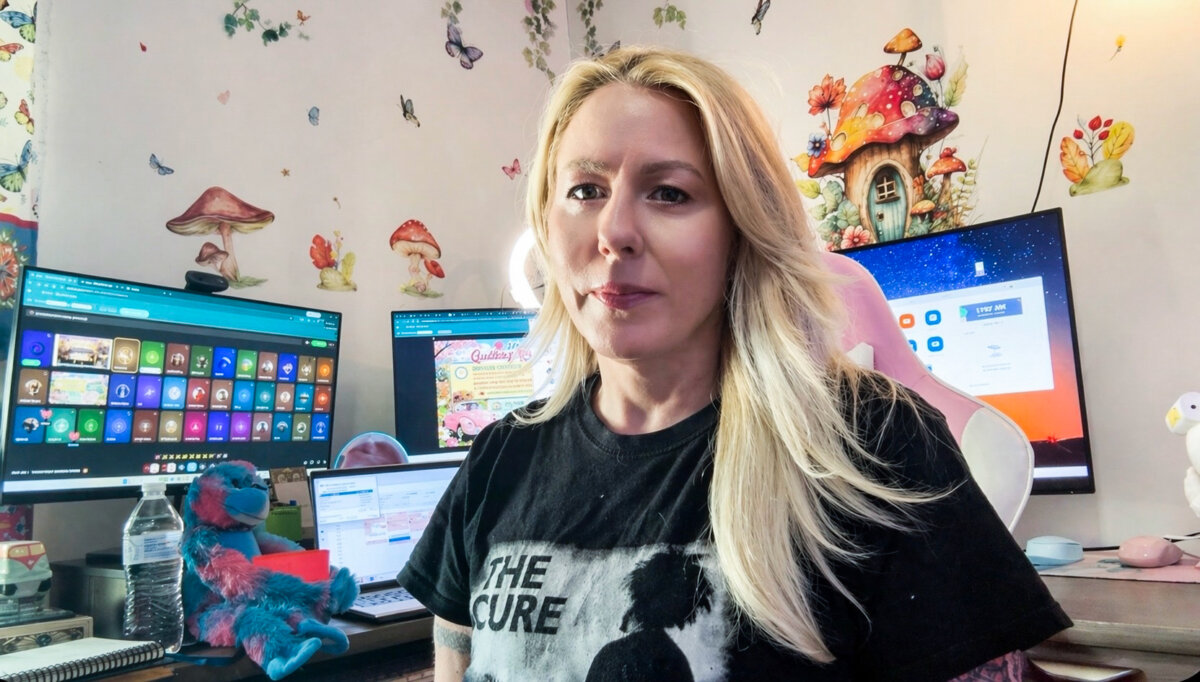
After Decima Davis started taking kratom, a tropical plant often billed as a healthy pick-me-up, she could not stop.
Whenever she tried to pry herself loose from kratom’s grip, her torment only intensified.
“Every morning, I’d wake up drenched in sweat, already in agony, knowing relief was just two minutes away at the local gas station [that sold kratom],” Davis, 51, of Mississippi, told The Epoch Times.
“I spent my mornings throwing up, desperately redosing just to be functional enough for work. That desperation is what led to three overdoses and grand mal seizures.
“I reached a point where I couldn’t even look in the mirror; I didn’t recognize the person looking back. I felt completely gone, just a hollow shell of myself living a daily nightmare.
“It was a relentless, soul-crushing cycle.”
After many failed efforts, something finally clicked for Davis after she and two fellow kratom addicts formed the online community Quitting Kratom Support—There Is A Way Out. Since its inception in 2017, the peer-guided group has drawn upward of 15,000 unique online visitors, said Davis, its president.
“The group replaced my isolation with accountability,” she said. “In the past, I was surrounded by negative messages and self-loathing, but this community drowned that out.
“We use a ‘collective tools’ approach—people bring what they’ve learned from various programs and share it. Peer support is backed by the ‘helper therapy principle,’ which suggests that when we help others, we heal ourselves.”
Now, at least three times per day, dozens of people quietly tap into a reservoir of hope at KratomQuitters.com. In the past two months, online attendance has grown by 17 percent, Davis said.
Many group members, including Davis, credit the online community with saving their lives.
“We want people to know: Hope is out there; there’s help,” Davis said, noting that she and a handful of other volunteers—all unpaid—keep the group running. They often absorb website costs and other expenses themselves, defrayed by some contributions.
Davis said being around others “who actually understand the specific pull of kratom” is key.
“Being surrounded by people who truly want to see me win changed my internal narrative from ‘I’m a failure’ to ‘I am part of a family that cares about my well-being and loves me,’” she said.
“This community is the family I chose. It didn’t just help me manage the withdrawals; it gave me my soul back.”
Increased interest in groups such as Davis’s parallels the rise of kratom use in the United States, along with higher numbers of reported adverse effects among users—and additional legal restrictions.
Last year, a Journal of Psychoactive Drugs survey found that about 9 percent of Americans were using kratom. That is a ninefold increase over the 1 percent that an American Journal of Preventive Medicine survey estimated in 2019.
Although several foreign countries banned kratom years ago, officials across the United States are grappling with how to regulate the opioid-like substance. Some praise kratom as helpful, but others denounce it as addictive and harmful.
So far, at least eight U.S. states and the District of Columbia have banned kratom. Ohio and Florida banned concentrated versions called 7-OH last year and more than a dozen states enacted other restrictions, according to End Kratom Addiction, a nonprofit organization.
However, kratom remains unregulated at the federal level. In 2016, the Drug Enforcement Administration withdrew a proposed ban following backlash. Advocates asserted that kratom should remain legal to help manage pain, anxiety, or opioid withdrawal.
As regulators continue investigating, the Food and Drug Administration (FDA) held a May 18 “listening session” with Davis’s peer support leaders and the group’s board members, according to an email provided to The Epoch Times.
The group’s treasurer and another cofounder, Natalie Melvin, 37, of Kentucky, told The Epoch Times that the FDA gleaned knowledge the group has collected.
“We have been on the ground … hearing people’s stories and their experiences every single day … all day, every day,” she said. “I don’t think there’s a lot of places out there that have the knowledge and the data that we have, just from personal experience.”
Besides anecdotal information, the group also shared the results of an April survey of 148 of its members. Among respondents, 55 percent who became addicted said they believed that they were taking a “safe” substance that was not addictive, and nearly 36 percent reported experiencing seizures or heart palpitations that they attributed to kratom.
“I think the most important thing is just that kratom addicts’ voices are finally being heard,” Melvin said, noting that they have often been drowned out by kratom advocates.
The support group’s meetings “grow bigger and bigger because more people are finding [it], and more people are needing help,” she said.
“We’re just people who have been through it, helping the next person the same way we were helped when we first came in,” Melvin said. “There’s something different about that—it’s real, it’s relatable, and people feel it.”
Now a paramedic, Melvin formerly used the substance to help her “get through the day” in a job that was physically demanding.
But the bad effects soon overshadowed the seemingly good ones.
“I would wake up every day just with this dark cloud over me. … It was affecting everything,” she said. “It was like I had no life left in me.”
Now, she and Davis have each been kratom-free for about three years.
Melvin’s message to others: “There’s help out there for you, and life can be beautiful—sober.”
Increasing Concerns
Kratom and kratom-extract products come in various types, but capsules, powders, and small liquid bottles are among the most popular. They are typically sold at gas stations and vape shops.
These products, derived from a plant in the coffee family that has sedative and stimulant properties, are mostly imported from the plant’s native land of Southeast Asia. However, some kratom is grown in Florida and Hawaii, where tropical climates create favorable growing conditions.
The Centers for Disease Control and Prevention flagged kratom as “a public health concern” earlier this year.
It noted a 1,200 percent increase in “kratom-related” reports to poison control centers: 3,434 in 2025 versus 258 in 2015. Further, the agency stated that “the recent shift from traditional leaf preparations to high-potency alkaloid extracts has raised safety concerns.”
The most serious outcomes—including 79 percent of the 233 “kratom-associated deaths” reported over the same 10-year period—resulted from combining kratom with at least one other substance.
The World Health Organization said, “Some countries ban kratom or limit its use for human consumption.”
The Association of Southeast Asian Nations “bans kratom in herbal medicine or dietary supplements, but allows cultivation of the tree,” according to a report from 2021, the most recent available.
Last year, the FDA warned the public not to use 7-OH kratom concentrates, calling them “novel potent opioid products that have not been proven safe or effective for any use.”
The American Kratom Association, in an April “consumer alert,” said 7-OH products “bear little resemblance to natural kratom leaf.”
Those products are “fundamentally different,” as they are “chemically manipulated, highly concentrated compounds that pose significantly greater safety risks to consumers,” the association said.
That is why the group advocates for rules such as those that Minnesota recently approved, restricting kratom purchases to people aged 21 and older. The association called that move “a meaningful step toward thoughtful, science-based regulation and away from misinformation-driven prohibition” in an email to news outlets, including The Epoch Times.
The association calls 7-OH “dangerous,” while arguing that unadulterated kratom leaf products ought to remain legal for adults.
However, Davis said her group emphasized to the FDA that “it’s not just 7-OH that’s causing problems.”
She estimated that more than half of Quitting Kratom Support’s participants became addicted to kratom leaf powder; Davis falls into that group herself.
The Power of Peers
Davis said her kratom powder habit used to cost about $30 per day, but some addicts report spending $100 per day for the more costly liquid concentrates.
She made multiple failed attempts to quit over a nine-year period. Finally, Davis’s commitment stuck, thanks to the support group, which spawned in-person friendships with some members.
Research suggests that peer counselors “are a promising intervention” that may help substance abuse addicts obtain treatment and remain sober, according to a 2025 article published in Frontiers in Public Health. Although 22 million Americans “have resolved a past substance use concern,” many others have trouble finding the right type of help, the article states.
Dean Francis—a Virginian who founded End Kratom Addiction amid his son’s battle with the substance—said peer support groups “are filling a huge void for tens of thousands of people.”
“They desperately need each other to climb out of this dark pit,” he told The Epoch Times. Hilary Tesluck, a cofounder of Quitting Kratom Support—There Is A Way Out, now works for Francis’s organization.
Francis noted that another online group, Kratom Anonymous, also has been helpful for many people; its website provides multiple links to resources for people struggling with kratom addiction.
Davis allowed The Epoch Times to observe a peer counseling session on the condition that participants’ identities remain confidential. Likewise, attendees agreed to maintain each other’s privacy.
Several dozen people participated in the late April online gathering, and most participants used avatars rather than showing their faces during the live session.
Davis and about a half-dozen other group members became certified peer counselors through their respective states’ programs. The moderator of this meeting lacked that certification, but is among about 50 peer support leaders that the group has trained, using its own processes.
Throughout the session, he offered calm reassurances while guiding conversations. Each person was allotted three minutes to talk, until the group’s one-hour time limit expired.
A new community member, who was participating from a foreign country, described being drawn back to kratom despite knowing that his “life gets worse in every way” while he is using it.
The moderator replied, “I’m so glad that you found us; you’re definitely in the right place.”
Responding to the foreigner’s comment about kratom’s availability in the United States, the moderator said: “That’s one of the problems I think a lot of us have found with it. … It’s hard to get away from it; it’s everywhere.”
Some participants noted that they saw kratom on store shelves even in states that prohibit its sale.
A man who said he quit kratom use about six months ago encouraged the foreigner, saying, “You are not alone,” and noting that addicts from that same country had joined past sessions.
Gratitude for New Lease on Life
A woman from the Midwest rued the day when she walked into a cafe where an employee introduced her to “this lovely tea,” she said, sarcastically, referring to a kratom-infused beverage.
The woman said she was pleased to learn that authorities in her state were shutting down the business.
“I’m grateful for a lot of things—grateful for all of you,” the woman told the group.
She said she has learned to appreciate life’s little pleasures and small victories anew as the recovery process continues, such as “just being comfortable” in her own bed, “learning to make better decisions,” and giving herself grace.
Another attendee said: “I’m finally just starting to get back into the things that kratom took from me when I was on it. For me, it was just a progressive loss of everything: Money, hobbies, self-respect, ambitions, everything.”
Another attendee agreed, saying, “You don’t realize how incrementally it takes things from you until you’re in the thick of it.”
Another participant said: “Hearing your stories always gives me strength. … As I get more and more distance away from it, I just feel better and better.”
That user, from the eastern United States, said she used to have “all these secret ‘squirrel stashes’ of kratom capsules.” She said she felt renewed freedom because she had finally flushed her last stash down the toilet.
“I didn’t want it in the house,” she said. “I didn’t want it near me. I didn’t want [it] to even be something that I considered as an option.”
Davis later said sometimes people “live-flush” their last remaining kratom doses during the video chats.
When one attendee said she felt like her problems were minimal compared with those of others in the group, the moderator told her: “Please keep sharing. Your problems are worth sharing. The daily struggle, the tedium, the overwhelm—these are all contributing factors and why we use [kratom].”
The moderator told the group, “We need to share praise for her, for being able to walk past the kratom advertisements without going in and buying some [during a recent trip].”
Complacency was a theme of the conversation. One woman commented, “I’m still too scared to be complacent.”
She vowed to maintain her sobriety because she did not like the person she became while she was using kratom.
Unknowingly ‘Inviting Addiction’
After the meeting, Davis told The Epoch Times that such statements are typical.
However, no one on this day mentioned a common side effect.
“We call it ‘kratom rage,’” Davis said.
She said some users report that they are always angry when they are using.
“We’ve all kind of calmed down once we quit,” she said.
Outside of the moderated discussion, the group’s online “lobby” stays open 24 hours per day; a group on the encrypted messaging app Signal alerts people when a visitor has shown up and may need support.
Special subgroups have formed, too. One is for kratom-addicted musicians, including singers who often say the substance changed the sound of their voices.
Although some group members have a history of illicit drug use, Davis said, “We have so many teachers, therapists, doctors, lawyers, firefighters.”
These professionals were “misled” to believe that they were trying a harmless, natural mood booster or pain reliever, she said, noting, “They had no idea they would be inviting addiction into their lives.”
Davis said it uplifts everyone when they see new people join the discussions, often while they are still using kratom. Then, after those newbies decide to quit, it is even more gratifying to see them accumulate days—then weeks, months, and years—of sobriety.
Watching that process “is incredible to witness,” Davis said.
“When they see us living clean, it shows them it can be done, and witnessing their progress reinforces my own journey,” she wrote in a text message.
“Seeing the ‘glow up’ in our members, seeing people move from the same hopeless, scared place I was in to a life of empowerment, is why I do this.
“I’m no longer that person crying in the mirror; I’m someone with a mission … and a PURPOSE to be here.”