




Two researchers with the National Institutes of Health (NIH) have been charged after allegedly smuggling viral pathogens into the United States and then lying to investigators, prosecutors announced on June 2.
Vincent Munster and Claude Kwe, employed by the NIH’s National Institute of Allergy and Infectious Diseases and working at the high-level laboratory in Montana, traveled in January from the Republic of the Congo—where there was an outbreak of monkeypox—and landed at the airport in Detroit.
Customs officials saw the men traveling with a large black plastic case, according to charging documents. The men told officers that diagnostic and testing equipment was inside. An investigation revealed that the case contained 113 vials.
Testing completed on 20 of the vials showed that 17 of them contained inactivated monkeypox virus, one contained chickenpox virus, and two contained human DNA, the FBI said.
Monkeypox virus is on the federal list of biological agents and toxins “determined to have the potential to pose a severe threat to both human and animal health, to plant health, or to animal and plant products.” People transporting agents and toxins on the list have to carry paperwork, including documents showing that the agents or toxins have been inactivated.
An FBI agent said Munster, 53, was informed that he needed to present required documentation and replied: “It’s all in my laptop, but you won’t need them. I do this all the time.”
That documentation was never produced, authorities said, and NIH officials confirmed that there were no records indicating that Munster or Kwe notified the agency ahead of time about transporting the material, as required by the agency.
Federal prosecutors in Michigan charged Munster, a citizen of the Netherlands, and Kwe, a Cameroonian national, with conspiring to smuggle monkeypox into the United States and lying to law enforcement.
“These NIH experts apparently broke our laws by smuggling viral pathogens on a packed commercial airplane from an outbreak in the Republic of Congo,” U.S. Attorney for the Eastern District of Michigan Jerome Gorgon Jr. said in a statement. “Let that sink in.”
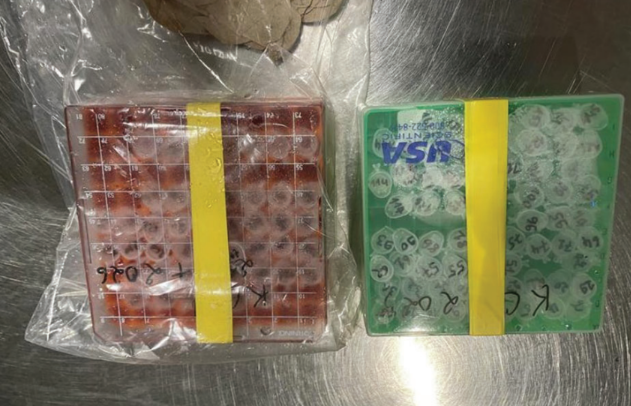 Vials found in a black case being transported by National Institutes of Health researchers. (FBI via The Epoch Times)
The inspector general of the Department of Health and Human Services (HHS), the NIH’s parent agency, was involved in the probe.
“The arrest of these individuals on serious federal charges sends a clear and unmistakable message that no one—including HHS employees who have an obligation to safeguard our federal programs—is above the law,” Marcus Sykes, special agent in charge of the HHS office of the inspector general, said in a statement. “Any deliberate effort to conceal and smuggle biological materials into the United States without proper authorization is a breach of the public’s trust and could have placed the public at risk.”
The charges could land Munster and Kwe up to five years in prison.
Munster, the chief of the Virus Ecology Section at the Rocky Mountain Laboratory in Hamilton, Montana, who was listed on a proposal for risky research to be conducted at a Chinese lab where COVID-19 first appeared, did not respond to a request for comment. Kwe could not be reached.
Munster’s most recent post on LinkedIn, posted earlier this year, shared an article that explained that his section was focused on “better understanding the parameters of mpox transmission,” translating its work in the Republic of the Congo “towards experimental laboratory approaches.” Monkeypox is sometimes referred to as mpox.
Munster and Kwe, who prosecutors said was a research fellow in Munster’s section, coauthored an article published in April that described monkeypox as a “global threat” and noted that there have been multiple cases associated with travel reported since 2024, including seven in the United States. In 2024, the researchers published an analysis of genetic sequencing from monkeypox in Congo.
Neither Munster nor Kwe was listed in the HHS employee directory as of June 3, although an NIH webpage on June 3 still said Munster is the chief of the Virus Ecology Section.
An NIH spokesperson told The Epoch Times in an email that the agency’s leaders were made aware in January of an incident involving NIH staffers at the airport in Detroit.
“NIH leadership immediately activated established agency protocols to safeguard related laboratory facilities, research materials, and biological samples. These actions included securing relevant laboratory spaces, restricting access to affected areas, and conducting a comprehensive audit and inventory assessment to verify that all materials were appropriately accounted for, documented, and maintained in accordance with all relevant biosafety policies, requirements, and procedures,” the spokesperson said.
The matter is currently under investigation, and the agency is cooperating with law enforcement and other authorities, according to the NIH.