



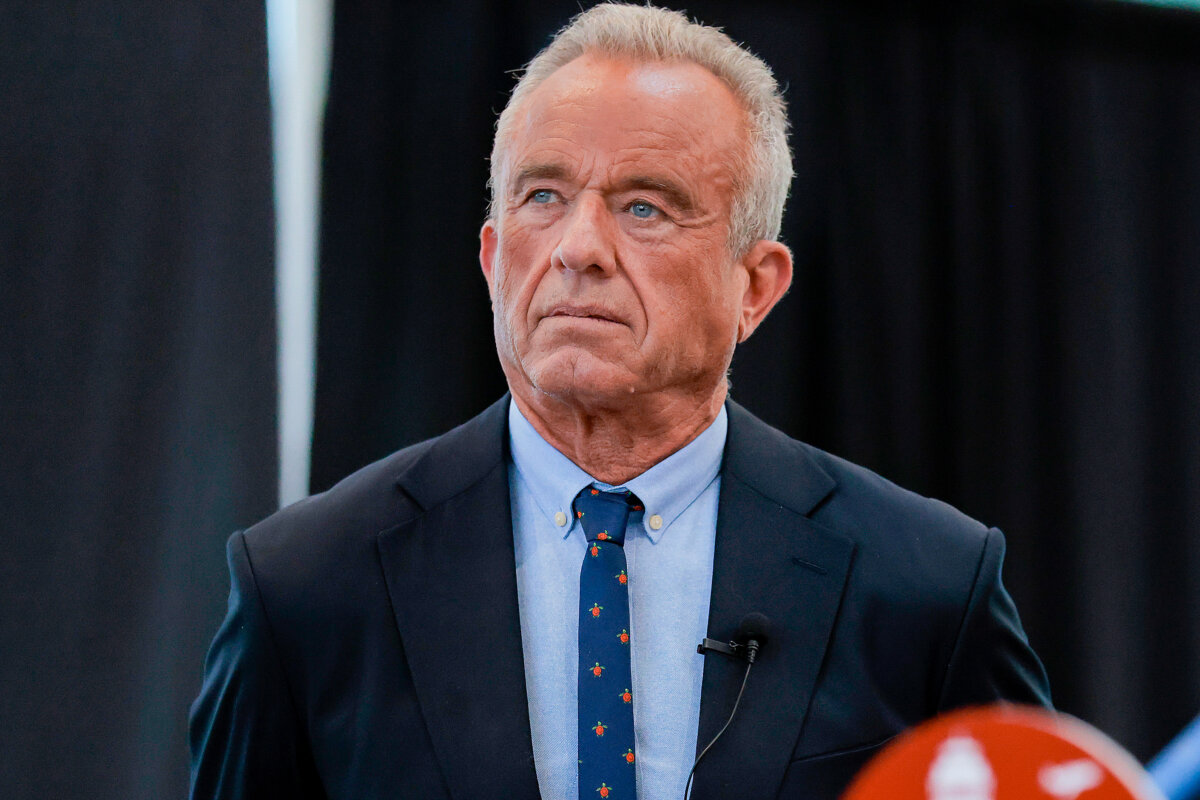
Health Secretary Robert F. Kennedy Jr. has appointed new members to a national committee on autism, his department announced on Jan. 28.
Kennedy said in a statement that he selected the new members of the Interagency Autism Coordinating Committee (IACC) in response to President Donald Trump directing officials to modernize autism research.
“We are doing that by appointing the most qualified experts—leaders with decades of experience studying, researching, and treating autism,” Kennedy said. “These public servants will pursue rigorous science and deliver the answers Americans deserve.”
Autism rates have been rising in the United States. They were pegged at one in 31 children in the latest federal update, up from one in 150 children in 2002.
The IACC is a federal advisory committee that coordinates federal efforts related to autism, monitors research on autism, and provides advice to the health secretary.
The committee is required to have some members who are not employees of the federal government. At least three need to be people with autism diagnoses. A minimum of three others must be parents or legal guardians of individuals with autism, and at least three others have to represent organizations involved in autism research, advocacy, or service.
“I am honored to be asked to serve on the Interagency Autism Coordinating Committee with so many clinicians, researchers, and advocates with whom I have had the pleasure to work in the past,” Elizabeth Bonker, one of the new members and executive director of the group Communication 4 ALL, told The Epoch Times in an email.
“As a nonspeaker with autism who types to communicate, I will focus on research and services for the millions of nonspeakers whose voices are rarely heard. With expanded access to typed communication, more nonspeakers will have the opportunity to live happy, productive lives.”
Dr. Daniel Rossignol, a doctor who has studied autism biomarkers and treatments and another new member, told The Epoch Times via email he values the committee’s role in promoting autism research.
“As a parent of two children with autism, I also recognize how essential it is that research priorities translate into meaningful improvements in care, services, and long-term outcomes. I look forward to contributing a perspective that bridges evidence, policy, and lived experience,” he said.
Health officials said that the terms of previous members of the committee ended and were not renewed.
At least some of the 21 new members have said that vaccines can cause autism, a disorder that has symptoms ranging from distress over loud noises to an inability to communicate verbally.
One new member, Toby Rogers, a fellow at the Brownstone Institute for Social and Economic Research, said in a 2025 blog post that vaccines are among the “immune activation event[s]” that can cause autism.
Another, Ginger Taylor, a former therapist, says on her X profile that there are “240 papers linking vaccines and autism,” citing a website that lists studies such as a 2013 paper that said certain people with an underlying mitochondrial defect “may be highly susceptible to mitochondrial specific toxins like the vaccine preservative thimerosal.”
Taylor wrote in a blog post that when she submitted her resume for the committee position, she made it “vaccine heavy.” She wrote, “The fact that the Department of Health and Human Services Secretary has chosen someone like me, being as apologetically vocal as I am about my vaccine stance, encourages me that the Trump administration is very serious about tackling our issues.”
A third new member, Tracy Slepcevic, who wrote the book Warrior Mom: A Mother’s Journey In Healing Her Son with Autism, has said that her son is “vaccine-damaged.”
A fourth, Honey Rinicella, executive director of the Medical Academy of Pediatrics and Special Needs, has alleged her son’s autism was caused or made worse by vaccination.
A fifth, Dr. Elizabeth Mumper, said in a 2013 paper that reports from parents about autism appearing or regressing following vaccination were “increasingly difficult to ignore.”
Some other groups, such as the American Academy of Pediatrics, say that autism is not caused by vaccines.
The Centers for Disease Control and Prevention previously held that position. However, in a 2025 update, it said, “The claim ‘vaccines do not cause autism’ is not an evidence-based claim because studies have not ruled out the possibility that infant vaccines cause autism.”
Kennedy has said that people who say vaccines do not cause autism are lying, that studies on the matter have not been properly done, and that the Trump administration is conducting those studies.
“This committee does not reflect the breadth of the autism community,” the Autism Science Foundation, which has been critical of Kennedy, said in a statement. “It disproportionately represents a very small subset of families who believe vaccines cause autism, while excluding the overwhelming majority of autistic individuals, families, and advocates who support evidence-based science.”
Mary Holland, CEO of Children’s Health Defense, a group founded by Kennedy, said in a statement that “it is wonderful news that there are now people on this committee who are truly motivated to solve many of the existential autism issues, including prevention, treatment, education, employment opportunities, long-term care and housing.”
The committee last met on Jan. 14, according to its website. It has no future meetings scheduled.