



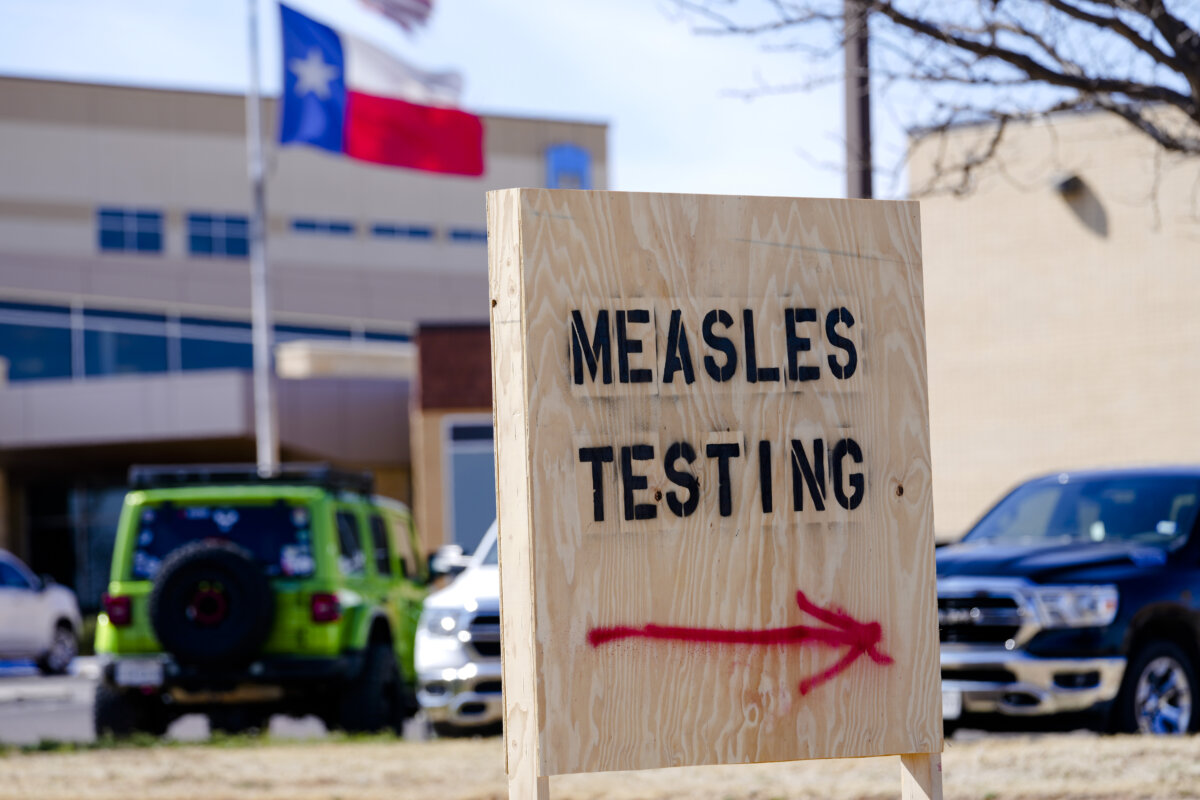
The West Texas measles outbreak, the largest the United States has seen in more than two decades, is officially over, according to the Texas Department of State Health Services (DSHS) on Aug. 18.
The department stated that 42 days had passed with no new reported cases. Health officials use this benchmark because measles has a 21-day maximum incubation period—the longest it can take between exposure to the virus and the onset of symptoms, so two full incubation cycles without new cases indicates that the outbreak has been contained.
“We arrived at this point through a comprehensive outbreak response that included testing, vaccination, disease monitoring and educating the public about measles through awareness campaigns,” DSHS Commissioner Jennifer A. Shuford said in a statement.
“I want to highlight the tireless work of the public health professionals across the state who contributed to the containment of one of the most contagious viruses,” she said. “I also want to recognize the many health care professionals who identified and treated cases of a virus that most providers had never seen in person before this outbreak.”
The outbreak began in late January in Seminole, a city in highly rural and sparsely populated Gaines County at the New Mexico border. It had spread to more than 10 counties, as well as three other U.S. states—Kansas, New Mexico, and Oklahoma—and into Mexico.
By the last update on Aug. 12, officials had confirmed 762 cases in Texas, with 99 hospitalizations and two deaths, both in school-aged children who were unvaccinated and had no underlying conditions.
Children made up more than two-thirds of the Texas cases. This included 225 younger than age 5 and 286 between 5 and 17.
State health officials said 718 cases involved unvaccinated individuals, while 23 had been partially vaccinated with one dose, and 21 were fully vaccinated.
Officials cautioned that the end of the outbreak does not mean measles is no longer a threat. With ongoing outbreaks elsewhere in North America and around the world, they warned it is likely that Texas will see additional cases later this year.
“Health care providers should continue to be vigilant and test for measles if their patient has symptoms compatible with the virus,” the DSHS stated.
Measles is caused by an airborne virus that spreads easily via coughing and sneezing. Symptoms typically include high fever, cough, runny nose, and a distinctive rash that begins on the face before spreading across the body.
In severe cases, measles can cause serious neurologic or respiratory complications. According to the Centers for Disease Control and Prevention, death from complications of measles occurs in one to three of every 1,000 cases in the country.
More than two decades after the disease was declared eliminated in the United States—a status indicating that there had been no continuous spreading of the disease for 12 months—measles cases are undergoing a resurgence. Data from the CDC suggest that more measles cases were reported in the first three months of 2024 than in all of 2023.
Texas and federal health officials have consistently said that vaccination is the best way to prevent getting sick with measles. The vaccination process includes two doses of a measles-containing vaccine, which is primarily administered as the combination measles-mumps-rubella (MMR) vaccine.