



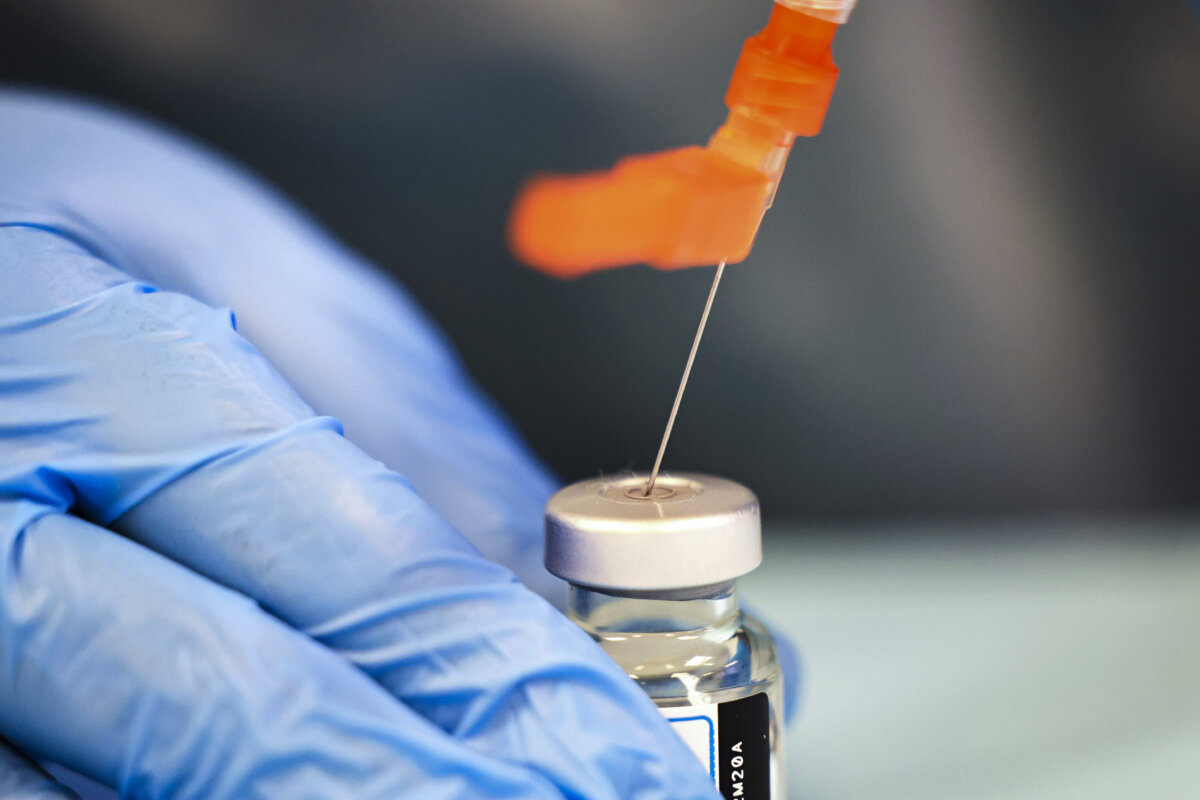
The nation’s largest association of pediatricians and the Department of Health and Human Services (HHS) are at odds over recommendations for COVID-19 vaccines for children.
The American Academy of Pediatrics (AAP) released new COVID-19 vaccine recommendations earlier this week, diverging from the Centers for Disease Control and Prevention immunization schedule for children.
After the release, HHS Secretary Robert F. Kennedy Jr., whose agency oversees the Centers for Disease Control and Prevention, called on the academy to disclose any conflicts of interest.
Here’s what we know about the situation.
The Vaccine Schedule
The AAP said on Aug. 19 that all children aged 6 months to 23 months should receive a COVID-19 vaccine.
The recommendation is at odds with the official CDC schedule, which calls only for vaccinating children with at least one condition, such as obesity, that the CDC says places them at higher risk of severe COVID-19 outcomes. The American Academy of Pediatrics and other groups challenged the CDC schedule in court.
The academy also says children of other ages should receive a COVID-19 vaccine if they are unvaccinated, reside in congregate settings (i.e., a place where unrelated people live in close quarters and share at least one common area), are at high risk of severe COVID-19, or live with people who are at high risk.
“The AAP also recommends the vaccine be available for children ages 2–18 who do not fall into these risk groups, but whose parent or guardian desires them to have the protection of the vaccine,” the academy stated.
It cited several papers published in its journal Pediatrics or by the CDC that examined the safety of earlier versions of COVID-19 vaccines. The single study on effectiveness was published by the CDC in 2023 and estimated 80 percent protection shortly after vaccination against emergency department and urgent care visits.
Federal regulators recently approved updated versions of the shots for some people, based largely on immunogenicity data.
HHS has cited other papers in outlining its opposition to COVID-19 vaccines. Additional papers and data have indicated that vaccine effectiveness wanes.
Kennedy’s Appeal
After the AAP released its new recommendations on Aug. 19, Kennedy said on X later the same day that the Trump administration believes in free speech and that the academy “has a right to make its case to the American people.”
At the same time, he called on the academy to “disclose conflicts of interest, including its corporate entanglements and those of its journal—Pediatrics—so that Americans may ask whether the AAP’s recommendations reflect public health interest or are, perhaps, just a pay-to-play scheme to promote commercial ambitions of AAP’s Big Pharma benefactors.”
The academy lists Pfizer and Moderna, which manufacture two of the three COVID-19 vaccines available in the United States, among its corporate donors. Each company provides at least $50,000 annually to the academy’s children’s fund, earning an invitation to a summit at the national headquarters in Illinois, according to the academy’s website.
Four of the members of the academy’s Committee on Infectious Diseases, which approved the COVID-19 vaccine recommendations, have received payments from Pfizer and Moderna, according to a review of payment records.
The AAP said in a policy statement, set to be published by its journal Pediatrics, that the authors of the recommendations “have indicated they have no potential conflicts of interest to disclose.”
It also said: “All authors have filed conflict of interest statements with the American Academy of Pediatrics. Any conflicts have been resolved through a process approved by the board of directors.”
The academy did not respond to requests for comment on any disclosures that were filed or the process it used to resolve any that were filed.
A conflict of interest “is a set of circumstances that creates a risk that professional judgment or actions regarding a primary interest will be unduly influenced by a secondary interest,” according to a National Academy of Sciences report. Primary interests include an obligation to patients, and secondary interests include financial gain and a desire for professional advancement.
Records
A review of conflicts of interest disclosures for the committee members showed that four out of 16 worked on research funded at least in part by Pfizer, Moderna, or both. One member was also paid directly.
Dr. Robert Frenck Jr., of Cincinnati Children’s Hospital Medical Center, and a member of the academy’s panel, for example, has received $35,698 from Pfizer since 2018, including $27,765 in 2023 for consulting and other services, according to OpenPaymentsData.CMS.gov, a government-run system that lists payment records provided by doctors, companies, and hospitals.
Pfizer also has paid $10.9 million to institutions for studies of which Frenck is the principal investigator, which falls under a category that is labeled in the database as associated research funding. The research payments include $10,780 in 2024.
“This type of funding does not necessarily indicate that the covered recipient received direct funds from the reporting entity. The principal investigator may have varying degrees of involvement with the research project/study,” the system states.
Frenck disclosed receiving money to perform clinical trials for Pfizer and Moderna in a paper published in April by The Journal of Infectious Diseases.
Dr. Jason Campbell, a professor of pediatrics at the University of Maryland School of Medicine, and another committee member, received $1,351 in 2023 from Moderna for travel, lodging, and food. Campbell also worked on research that received a total of $584,473 from the companies over the years, including $234,417 in 2024.
In a paper published by The Journal of Infectious Diseases in March, Campbell said he has “received institutional support from Moderna, Inc, Pfizer, Inc.,” and other pharmaceutical companies.
Studies with which Dr. Kristina Bryant—a third committee member and an associate medical director for the Louisville, Kentucky, Department of Public Health and Wellness—was involved received $10,088 in funding from Pfizer in 2023 and $117,471 in total since 2018, according to the payment database.
In a 2021 paper, Bryant said she was a clinical investigator for several trials funded by Pfizer, including for its COVID-19 vaccines.
A fourth member, Dr. Pia Pannaraj of the University of California–San Diego’s School of Medicine, worked on studies that received $12,100 from Pfizer, including $3,300 in 2023.
Two other members have payments listed in 2020 or earlier.
In addition, Pfizer has paid more than $5 million to institutions for studies of which Dr. Elizabeth Barnett, an ex officio member and a professor at the Boston University Chobanian & Avedisian School of Medicine, is a principal investigator, including $321,086 in 2024, according to the database.
The doctors did not return requests for comment.
“These clear conflicts of interest should be disclosed and the AAP should utilize experts who have no conflicts of interest in crafting their recommendations,” Dr. Aaron Kheriaty, director of the Ethics and Public Policy Center’s Bioethics and American Democracy Program, told The Epoch Times in an email.
Authors Required to Disclose
Experts have said that conflicts of interest of any kind diminish trust in the independence of doctors, which can lead to less successful public health interventions such as vaccination campaigns. The conflicts can also influence votes and other actions.
Authors of papers accepted by Pediatrics are required to fill out conflict of interest forms created by the International Committee of Medical Journal Editors.
The forms ask for consulting fees and other payments from the past 36 months. The title page for manuscripts also must include disclosures, the Pediatrics website states.
“This includes any potential conflicts of interest, any relevant financial relationships, and any other relationships or activities that could be perceived to have influenced the work,” it says.
Some experts have said that research funding is generally less concerning than direct payments because it is not associated with personal income.
Kheriaty told The Epoch Times that he does not necessarily agree.
“While direct payments may appear to me more obvious, for academics, grants to fund their research also contribute to paying their salaries, sometimes in a remarkably direct way,” he said. “So both are sources of income and likely exert similar pressures.”
A spokesperson for the HHS told The Epoch Times in an email, “We call on the AAP to strengthen conflict-of-interest safeguards and keep its publications free from financial influence, ensuring every recommendation reflects only the best interests of America’s children.”