



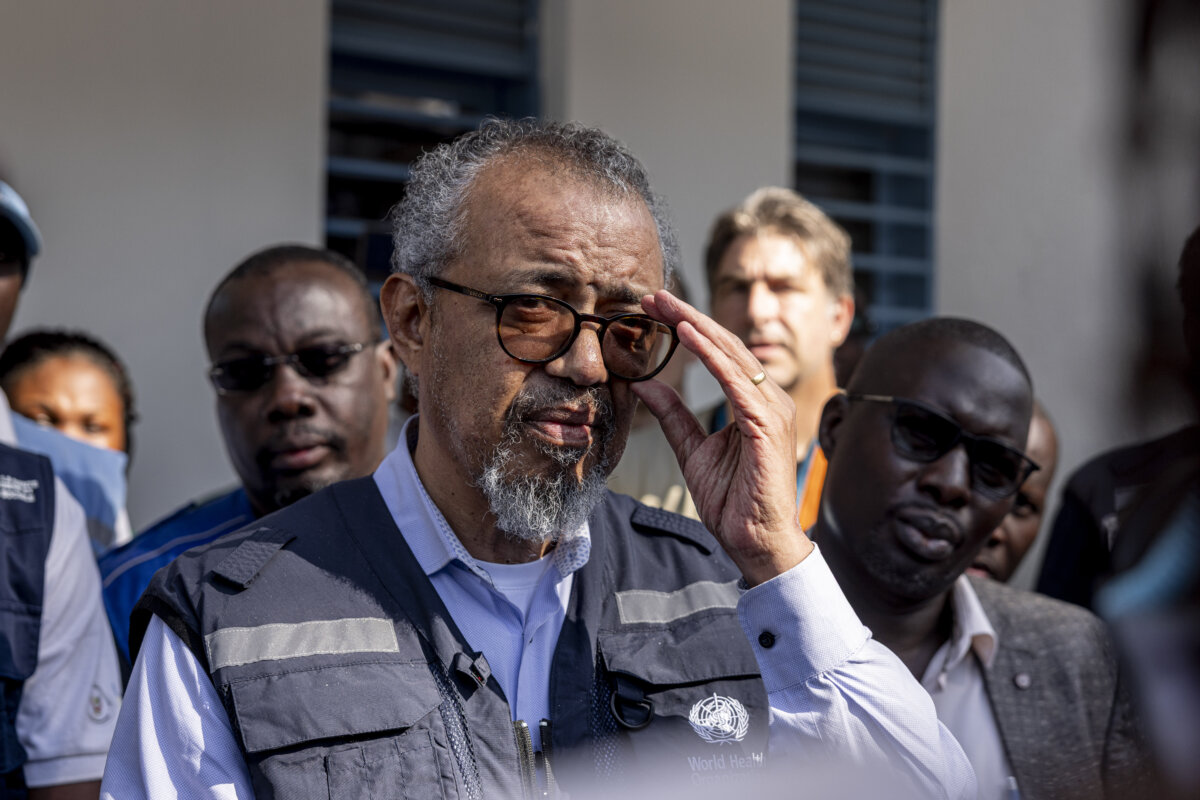
The response to the Ebola outbreak in Africa is catching up to where it needs to be, the head of the World Health Organization (WHO) said June 3.
“The outbreak had a big head start, and we’re still behind, but under the leadership of the government of [Congo], we’re catching up,” Tedros Adhanom Ghebreyesus, WHO’s director-general, told reporters in Switzerland.
Congo’s Ministry of Health said earlier Wednesday it has confirmed 344 cases, including 60 deaths, with another 116 suspected cases. The number of suspected cases has dropped significantly in recent days.
The outbreak is believed to have started in Congo earlier in 2026. Only Congo and neighboring Uganda have reported confirmed cases.
Detection of the outbreak was delayed due to multiple factors, officials have said, including early testing not being able to identify the Bundibugyo virus, the virus behind the outbreak.
Authorities have since ramped up testing, isolation of confirmed and suspected patients, and tracing the contacts of patients as part of an effort to curb the health crisis.
Ghebreyesus said there are still several challenges, including that only about 45 percent of contacts have been contacted, and a persistent lag remains in testing capacity in Ituri Province, the outbreak epicenter.
“We also need to scale up readiness, including surveillance, laboratory diagnostics, and access to health services in neighboring provinces and countries,” he said.
WHO personnel have been working with aid and health groups, local doctors, and officials in Congo’s northeast to identify cases, have them treated, and distribute medical gear.
WHO’s costs for the first three months of the outbreak are estimated at $115 million, of which only 35 percent has been received, Chikwe Ihekweazu, another WHO official, told reporters. “And considering the scale of the outbreak, we estimate we will need a lot more for the duration of the response.”
US Updates
The U.S. State Department said in a new advisory that it has established a way for American citizens in Congo, South Sudan, or Uganda to request assistance.
If people are not at high risk of Ebola exposure, then U.S. officials may offer assistance such as a loan, the department said. If people are at high risk of exposure, but asymptomatic, then State Department workers may arrange transportation for those Americans to a quarantine facility in Kenya. And if people are symptomatic or have tested positive for Ebola, then staff “may arrange specialized aeromedical evacuation to a designated safe location for appropriate treatment,” the department said.
One American doctor, his family, and a colleague were taken to Europe for medical care earlier in the outbreak.
The planned facility in Kenya is on hold for now, under order from a judge there.
“We are aware of the court action filed in Kenya and are actively working with the Kenyan government to resolve any objections and communicate our shared objectives to the Kenyan people,” the U.S. Embassy in Kenya said on Tuesday. It said that the facility “is part of a holistic response to prevent spread of the disease and lessen health risks for the region as a whole; it does not pose risk to nearby communities.”
U.S. Secretary of State Marco Rubio has stated that the United States will not let Ebola enter the country, and the government has taken other steps, such as prohibiting non-U.S. citizens who have recently been in Congo from coming to the United States, to try to prevent Ebola from being introduced there.