



A previous article, “Excessive Phosphorus in Food and Medicine: A Growing Concern,” delved into problems the chemical element P causes as an additive in our food products and medications.
Although we need phosphorus as a major building block for cells and tissues, DNA, RNA, bones, and teeth—too much of a good thing can be detrimental. In our bodies, the trouble manifests in the kidneys, which are the main eliminatory organs for excess phosphate.
In this article we will explore the influences phosphorus has on our environment, which in turn further impacts human health.
To make this connection, we need to understand our comparability to plants—at least when it comes to the absorption and use of phosphorus. The element with the atomic number 15 on the periodic table is a key plant nutrient. Plant cells require it to promote cell division and stimulate the development of the growing tip. Phosphorus transfers energy, nutrients, and genetic characteristics, and helps with photosynthesis and the transformation of starches and sugars.
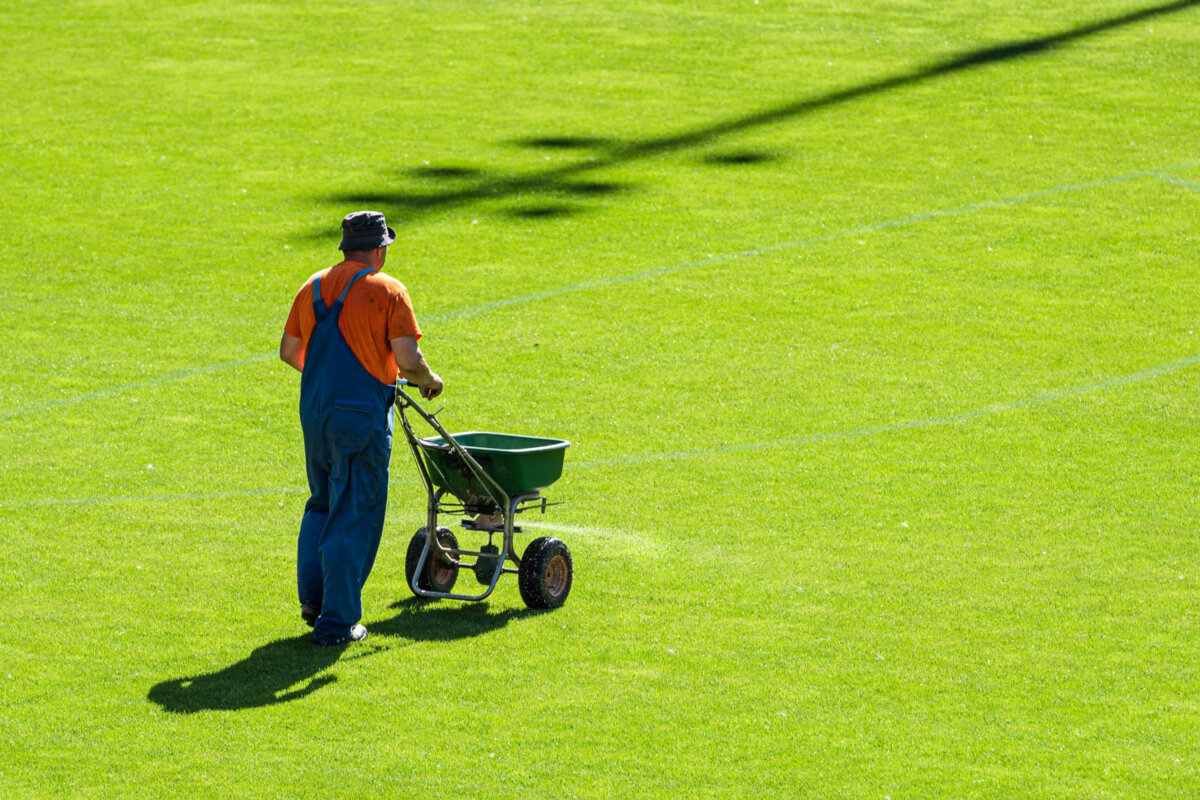
Consequently, the lawn and garden industry instructs us to fertilize well in order to enjoy luscious grass and beautiful flower and vegetable beds. Herein lies the first predicament.
Correctly Feeding Your Home Garden
A quick online search of “most common fertilizer for home gardens” results in advice such as that from the Texas A&M AgriLife Extension Service: “Most gardeners should use a complete fertilizer with twice as much phosphorus as nitrogen or potassium. An example would be 10-20-10 or 12-24-12. These fertilizers usually are easy to find.”
Indeed, they are easy to find—too easy, for those of us living in the 39 states where home gardeners are allowed to freely purchase phosphorus fertilizer. If you live in the remaining 11 states (Illinois, Maine, Maryland, Michigan, Minnesota, New Jersey, New York, Vermont, Virginia, Washington, and Wisconsin), be informed that the sale of phosphorus fertilizer is banned for your garden unless you prove with a soil test that your piece of earth lacks the element—but more on the topic “soil test” later.
Nutrient Amendments for Your Lawn
While many of us no longer grow gardens for food, most homeowners are proud of the lush, green grass framing their houses. A beautiful lawn functions as a figurehead for the entire estate, seen by passersby and visitors alike. Therefore, many do not shy away from extra costs in lawn care and fertilizers.
All-purpose fertilizers frequently sold at garden centers come with three numbers. You will see something like 5-5-5 or 10-10-10, which means that you get an equal amount of nitrogen, phosphorus, and potassium.
Turf grasses, on the other hand, especially when established, do not need a high amount of phosphorus. Purdue Extension offers a downloadable PDF called “Facts about Phosphorus and Lawns.” It explains that mature turf is best cared for with special lawn fertilizers low in phosphorus. But why the concern?
Excess Phosphorus Runoff and Leaching
Unlike nitrogen or carbon, phosphorus does not develop gases. When the soil has reached its fill of the element, excess phosphorus moves with water. This happens via three pathways:
- Surface runoff
- Leaching
- Subsurface flow
Imagine that heavy rain falls on your garden and lawn. You applied nutrient supplements like manure or compost (organic) or fertilizer (inorganic) just a few days before. Unfortunately, you did not perform a soil test and are unaware that your soil is saturated with phosphorus and won’t be able to hold more—where will it move to?
Eutrophication–Blooming Alga as a Health Hazard
Algal blooms are natural events. According to the National Ocean Service, early European settlers described such occasions as early as the 1500s in Florida, when explorers told of the toxic red water that killed marine wildlife and fish.
However, modern-day industries and agricultural practices contribute to an increase in these HABs (harmful algal blooms).
One such memorable algal bloom occurred in 2016 in Florida’s Lake Okeechobee. Another “unprecedented cyanobacterial bloom” took place one year later in September of 2017 in Michigan’s Lake Erie—there is a long list, and in recent years, incidents have increased. San Francisco Bay was affected in July 2022, Florida officials had to issue a health hazard alert in November 2023, and even one of my own children got sick from swimming in a small lake in Western Massachusetts.
-

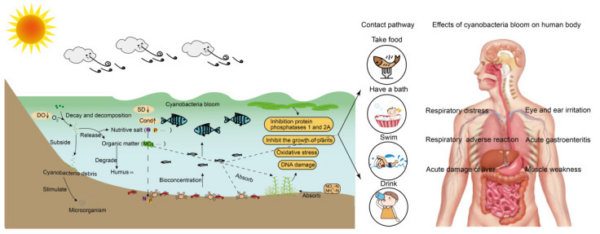
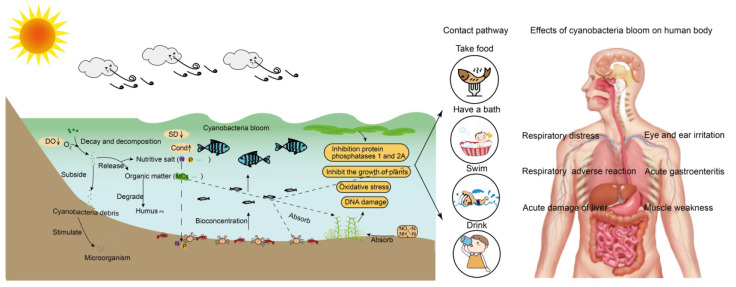
The true hazard comes from a plethora of organisms that thrive in fresh or salt water. The National Institute of Environmental Health Sciences informs about algal blooms on its website and lists the following health effects depending on the type of organism:
- Gastrointestinal (nausea, vomiting)
- Neurological (a floating sensation or muscle weakness)
- Abdominal tenderness, pain, or acute liver failure
- Muscle cramps, seizures, paralysis
- Respiratory problems, especially for asthmatics
- Headaches and bulging eyes
A 2022 review published in the journal Toxins reports on the dangers of cyanobacterial blooms and warns that “toxins and carcinogens released from cyanobacteria can be enriched through the food chain/web, endangering human health” via food intake, drinking, or recreational activities in contaminated water.
The New York State Department of Health informs readers with an online FAQ fact sheet with details on “Harmful Green-Blue Algae.” The Centers for Disease Control and Prevention warns individuals to be aware that algal toxins collect most in the internal organs of fish, shellfish, and crustaceans and to not eat fish from contaminated rivers or lakes.
Loss of recreational zones for swimming, water-skiing, boating, or jet-skiing due to algal blooms is another major issue—consider breathing in the toxic blooms when they mix with tiny water droplets or spray, which can be inhaled while enjoying a day out on the lake.
In addition, the onslaught of nutrient overload creates “dead zones” in lakes and other freshwater causing death to fish and aquatic animals. Entire ecosystems are vulnerable to the attack of tiny organisms.
Soil Tests–A Responsible Obligation
-
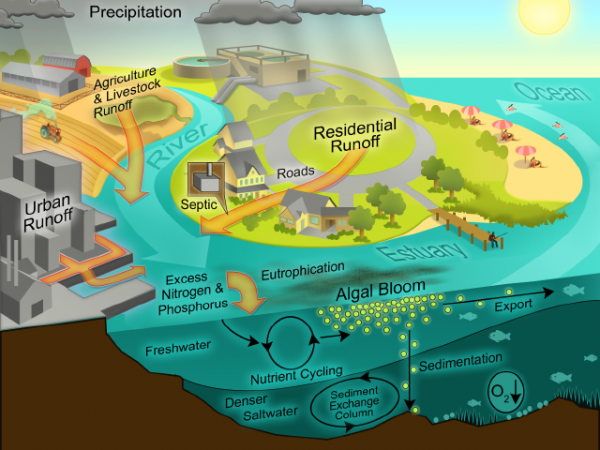
The image above is a valuable visual to summarize the areas of runoff. Clearly, the problem is not solely caused by heavily fertilized farmers’ fields (to be honest, the agricultural sector is less and less the culprit—less fertilizer means lowered expenses for farmers), but by residential runoff from neighborhood streets, gardens, and lawns.
A reasonable responsibility is to execute a soil test. Most local cooperative extension service offices offer soil tests with detailed instructions at a low cost, or in some counties even for free. “A soil test is a chemical analysis of your soil,” informs the University of Kentucky extension service and will examine “plant nutrients such as phosphorus (P), potassium (K), calcium (Ca), magnesium (Mg), and zinc (Zn).”
Soil test results are usually returned after a few weeks and inform the gardener or homeowner in detail what nutrient amendments they need for the care of their specific piece of land. This not only saves unnecessary expenses, but ensures that flower gardens, fruits and vegetables, and lawns are ideally managed and produce at their best.
A Surprise Culprit–Our Fluffy Pets
Our canine companions might not come first to mind when thinking about phosphorus runoff. However, pet numbers have steadily increased over the past years, and their excrements must go somewhere. Unfortunately, not all pet owners follow signage to pick up after their dog.
The Plant and Soil Sciences Department of the University of Kentucky completed a unique, and at first glance possibly peculiar program. Under the title “No P on My Lawn” they added a dog excrement component to phosphorus research they were conducting. Since Kentucky “ranks 3rd in the nation for the number of dogs per capita (45.9% of Kentucky households have 1.9 dogs),” it seems a worthy addition.
The results showed that one dog produces about 275 waste-solids per year, which translates into 85 pounds per dog per year. This means that canines contributed 4.0 million pounds of phosphorus in Kentucky per year. With 99.9 percent of P inorganic form, dog manure was the highest contributor to available phosphorus compared to other manures and composts.
Wow! Will this convince you to pick up after your pet?
Water Quality, Drinking Water
Excess phosphorus not only enters lakes, rivers, streams, and other bodies of water but also the sewage systems and water treatment plants. In some areas, stormwater drainage canals are not connected to the sewage system, which means that anything running down the curb flows directly into the nearest river.
On the other hand, combined sewers are connected to treatment plant systems, which can become overwhelmed, especially in severe weather events—their overflow leading to the nearest “ditch, stream, river, or lake, [and therefore,] prevents the rupturing of pipes, backing up of sewage into basements, and/or flooding of streets,” reports Ohio’s Environmental Protection Agency.
A 2023 study researched cyanobacteria and their implication on “water ecosystems but also for the availability of treated water” in a river and lake in Poland. The seasonal algal bloom affected water quality, and researchers confirmed the correlation between “physical and chemical indicators of water quality,” including excess nutrients like phosphorus and nitrogen.
The Environmental Protection Agency offers a 12-page downloadable fact sheet titled “Cyanobacteria and Cyanotoxins: Information for Drinking Water Systems” for anyone interested in learning in detail about this bacterial hazard and its related health risks.
Think Twice About Household Cleaners
In 2010, 17 states banned dish detergent with added phosphorus (Illinois, Indiana, Maryland, Massachusetts, Michigan, Minnesota, Montana, New Hampshire, New York, Ohio, Oregon, Pennsylvania, Utah, Vermont, Virginia, Washington, and Wisconsin). Nevertheless, phosphate-enhanced soaps are still popular for use in kitchens and laundry rooms because of their qualities to remove grease and oil, as well as soften water.
An article published in Data Brief revisits global phosphorus release due to detergents and provides an interesting outlook on a future with phosphate-free cleaners. The scenarios outlined include the effects of eco-friendly dish-washing and laundry agents based on how many countries introduce P-free detergents by the year 2050.
Much less theoretical is a downloadable pdf the NYC Environmental Protection Agency offers about “Phosphorus Concerns with Detergent Use,” which points to health hazards connected to the use of such cleaners: “nausea, diarrhea, and skin irritations.” England’s River Kennet Organization also posts practical advice under the title: “A clean home needn’t mean a dirty river,” which is applicable wherever you live on this planet.
Surely, you might have more questions after reading these two articles about the “Phosphorus-Dilemma.” I hope I was able to provide some insight and inspire a personal curiosity of how to best create a balanced phosphorus environment in and around you—thereby improving your overall health and well-being and that of the planet.