



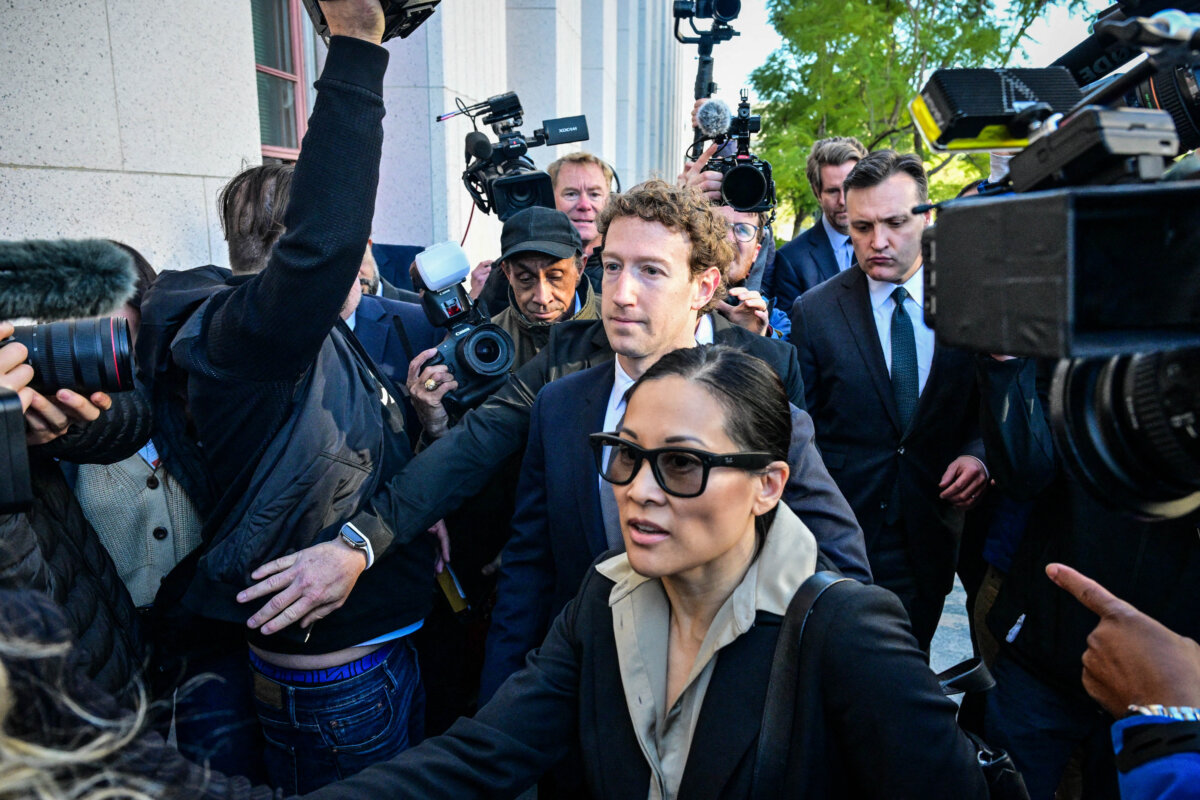
LOS ANGELES—In the third week of a historical jury trial considering whether social media companies have engineered their platforms to addict young people despite knowing the potential harms, attorneys sparred over what a young plaintiff’s therapy records might reveal about her social media use and mental health.
So far, the jury has heard theoretical arguments and seen forensic evidence, in the form of internal documents, largely centered on what the companies knew and when, and whether their actions, or lack thereof, constitute a “willful and conscious disregard for safety.”
On Feb. 25, testimony from a licensed family therapist inched closer to the personal story at the heart of the case—and highlighted a gray area underlying its core claims.
That story belongs to a 20-year-old California woman identified in court records as “K.G.M.” or “Kaley G.M.,” who says she began using social media apps as a child, became addicted to them, and as a result suffered serious harms—including body dysmorphia, depression, and suicidal ideation.
In this bellwether trial, which will determine how thousands of related personal injury cases play out, K.G.M. has been a stand-in for a generation that came of age in the digital era—and for an unprecedented youth mental health crisis that grew alongside it.
But even as some experts say instances of social media addiction are skyrocketing among young people, the phenomenon is new enough that consensus about its meaning and implications is far from clear, diagnosis and treatment are not standardized, and a sense of its scope remains out of focus.
Dr. Anna Lembke, a psychiatrist and medical director of addiction medicine at Stanford University School of Medicine, testified as an expert witness for the plaintiff that about 40 percent of patients at the school’s adolescent recovery clinic—which historically treats mostly alcohol and drug abuse—are now presenting with social media addiction.
“There is a wealth of peer-reviewed literature and other publications from authoritative bodies validating that people can get addicted to social media,” Lembke said.
A 2025 Columbia University study published in the Journal of the American Medical Association reported high or “increasingly addicted” use of social media among 40 percent of nearly 4,300 children who were surveyed over four years, starting at age 8.
Both high and increasingly addictive use patterns, researchers noted, were associated with worse mental health and suicidal behaviors.
A growing body of literature, according to Lembke, supports claims that addictive, excessive, or problematic use of social media can increase or cause depression; that it can worsen negative comparison among adolescents and negatively affect body image, especially among girls; and that excessive use can lead to self-harm and suicidal ideation and displace sleep, among other impacts.
The brains of children and teens in particular, Lembke said, are more malleable, developing in the years from childhood to age 25 the neurological “scaffolding” they will have for the rest of their lives. Impacts on brain development from addictive drugs and behaviors, including problematic use of defendants’ social media platforms, can have profound consequences.
Instagram and parent company Meta, YouTube and parent company Google, TikTok and its parent company ByteDance, as well as Snapchat and parent company Snap Inc. are named as defendants in K.G.M.’s case; Snap and TikTok settled privately days before the trial began, but they remain in related cases.
Meta CEO Mark Zuckerberg, Instagram head Adam Mosseri, and YouTube vice president of engineering Cristos Goodrow have all told the court that their platforms are not designed to be addictive—and more broadly, that they do not believe that clinical social media addiction exists.
Victoria Burke, a licensed family therapist in California, initially diagnosed K.G.M. with generalized anxiety disorder at age 13, but after noting that her patient’s anxiety was largely focused on social acceptance and perceived physical flaws, she narrowed her diagnosis to social phobia and body dysmorphic disorder.
According to Burke, who was still a trainee when she treated K.G.M. for about six months in 2019, the plaintiff described using her smartphone to self-soothe and avoid social interactions at school. Creating digital art on social media, K.G.M. told her, was one of the few ways she felt “seen.”
Burke observed that K.G.M.’s sense of self was closely tied to her social media use and that she experienced distress and loneliness when it was taken away.
“It could really make or break her mood coming into a session,” Burke said.
Under cross-examination, Burke acknowledged that although she has seen social media cause functional impairment in clients’ lives—a critical diagnostic criterion for mental disorders—she has never concluded that any of her adolescent clients were addicted to social media.
This is mainly because social media addiction is not recognized as an official disorder.
“There is currently no social media addiction diagnosis in our [diagnostic manual],” she said.
However, she noted that there are other ways to capture the phenomenon—it may show up as obsessive-compulsive disorder, social phobia, or trauma, for example.
The Diagnostic and Statistical Manual of Mental Disorders (DSM), now in its fifth edition, is published by the American Psychiatric Association and was last updated in 2022. It is the authoritative guide—a clinician’s bible.
When deposed in May 2025, Burke said she had not formed any opinion about whether social media contributed to any of K.G.M.’s mental health issues.
“My opinion today is different,” she told the court on Feb. 25.
“I believe that it was a contributing factor,” she said. “I do not believe it was causation.”
Her trepidation about word choice, she explained, stems from the fact that she is limited to clinical observation in the absence of an official diagnosis.
“I’m not going to come to a conclusion or say I know everything; I’m going to say this is what I’m observing, this is my clinical insight. … Someone else may have different clinical insight,” she said.
Andrew Stanner, an attorney for Meta, suggested that family issues, educational difficulties, and bullying that K.G.M. experienced, as recounted in sessions with Burke, were responsible for her mental health issues.
He framed her use of social media as a positive experience, saying that social media platforms were rare places where she could connect with others and gain recognition for original edited music videos she posted.
“It was supportive in some ways,” Burke said of K.G.M.’s social media use. “I saw both benefits and areas where it was getting in the way.”
That was seven years ago. Her understanding of the impacts of social media among adolescent users, she suggested, has evolved.
When asked whether she had any idea how much time K.G.M. spent on Instagram, Burke said she did not.
“I didn’t assess for it,” she said. “I would assess for that now.”
Mark Lanier, attorney for the plaintiff, argued that the fact that social media addiction is not an official disorder in the DSM does not mean that people are not addicted to social media.
“There was a time in that book when bipolar disorder wasn’t listed,” he said. “That doesn’t mean there weren’t people who were bipolar, it just hadn’t made it into the handbook.
“Sometimes it just takes a while for the DSM to catch up.”
Correction: A previous version of this article gave an incorrect name for the plaintiff Kaley, also known as “K.G.M.” The Epoch Times regrets the error.