



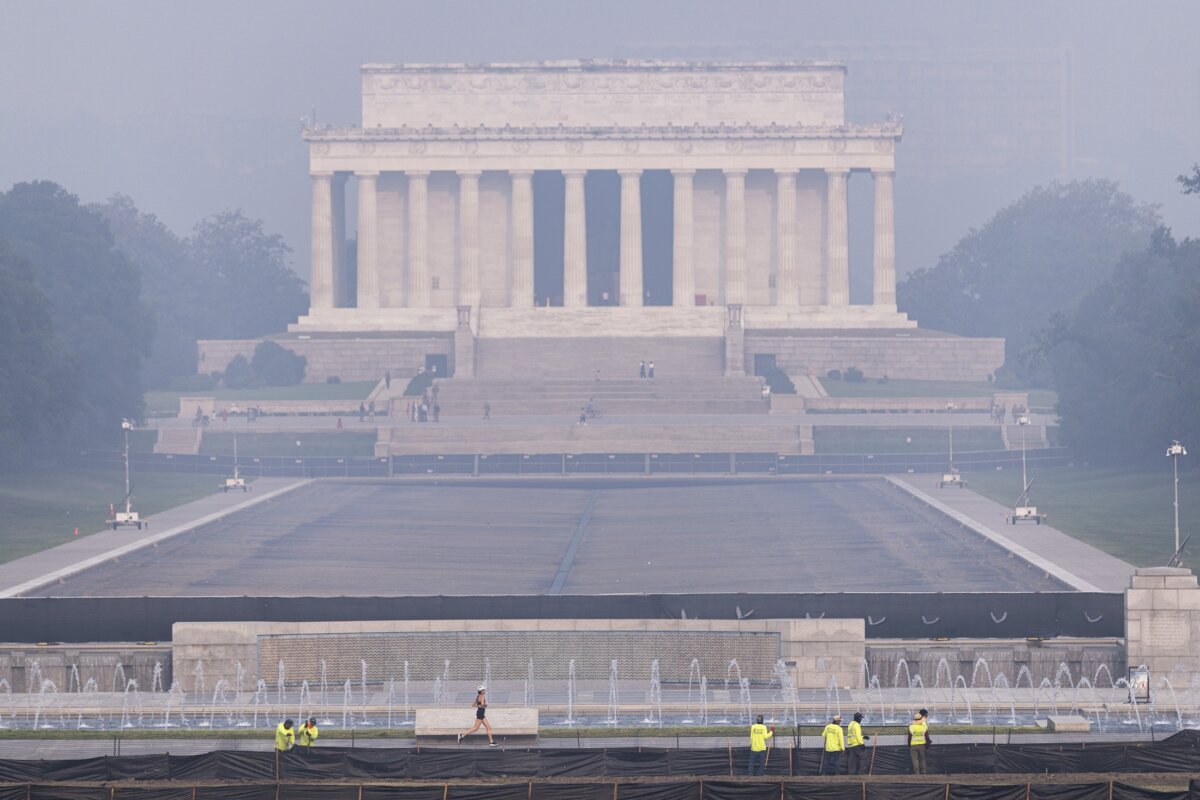
Alerts and warnings for around a dozen states were in effect July 17 as smoke from wildfires in Canada resulted in reduced air quality.
Officials across the northern Midwest and northeast warned residents of air quality issues, with some advising people to avoid the outdoors.
“At-risk populations should stay indoors and keep your windows closed to keep yourself safe,” Maryland Gov. Wes Moore said in a statement.
“Please make sure to check in on your family, neighbors, and loved ones.”
Maryland issued a code red air quality alert because of smoke from Canadian wildfires.
The air quality there, nearby states, and the upper Midwest was unhealthy, very unhealthy, or hazardous, according to IQAir.
Indiana, Michigan, and Ohio were among the other states warning people about lower-than-normal air quality.
Dozens of fires are burning in Ontario, according to a Canadian government website. Some of the fires were described as not yet being under control.
The province is capable of handling the situation, Canada’s defense minister, David McGuinty, said during a Friday briefing.
“If it gets to a level where they require a more direct and immediate support from the Canadian Armed Forces, like always, the women and men of the Canadian Armed Forces will be there.”
The National Weather Service in the United States said in a bulletin that “air quality … remains a concern this weekend as northwesterly flow continues to usher in smoke from Canadian wildfires toward the northeastern quarter of the nation.”
Some of the warnings are in place through Monday.
“Heavy smoke is lingering for the northern half of Indiana currently divided by a stationary front,” the Indiana Department of Environmental Management said in a statement.
“The front will lift north later Friday, providing a brief break in levels before a system late Saturday will bring another round of smoke.
“High pressure in place Sunday and Monday will recirculate the smoke over most of the state with the primary concern remaining the northern half of Indiana.”
Stuart Batterman, professor emeritus of environmental health science and of global public health at the University of Michigan School of Public Health, said in a statement that unhealthy air from smoke can cause health issues such as eye irritation, coughing, and exacerbation of heart problems.
“You can reduce or eliminate the risks from heat waves and air pollution episodes by staying cool and hydrated, filtering your air at home using your air conditioner, HVAC system, or air purifier, and using a N95 mask when outdoors,” he said.
“A combination of these strategies can be most effective.”