



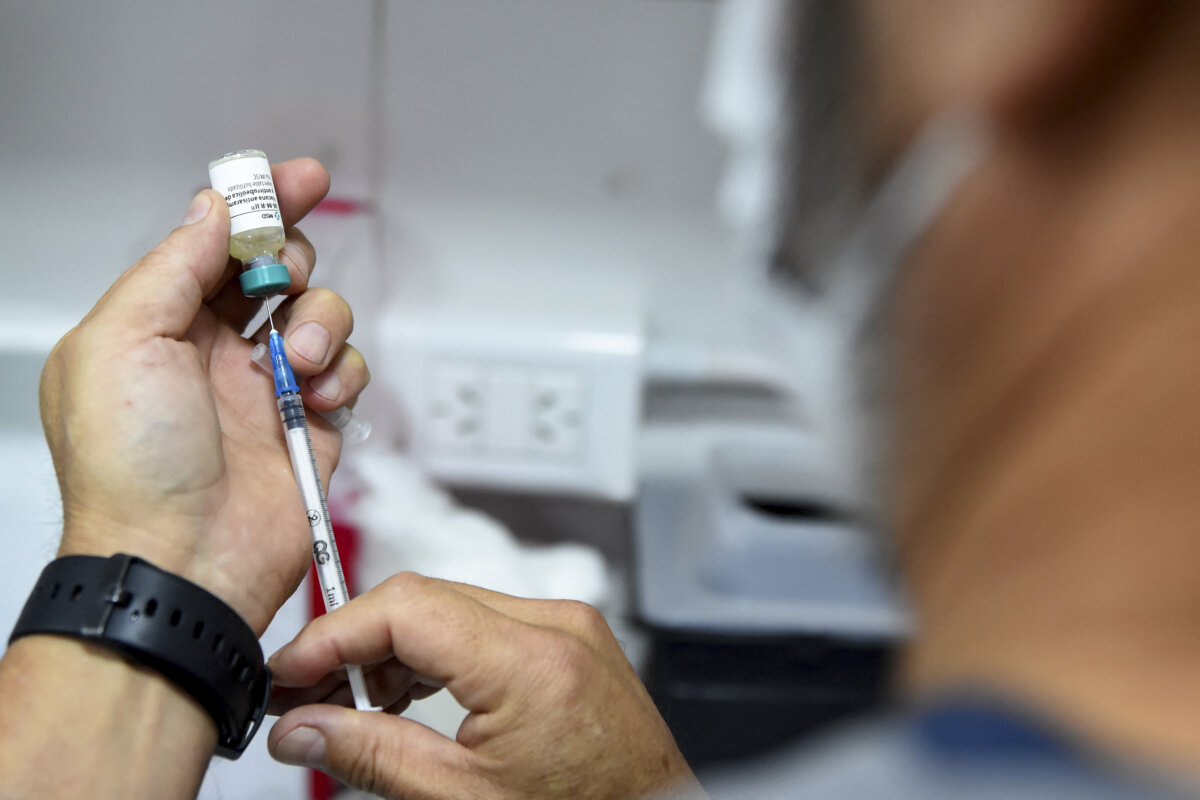
Health Secretary Robert F. Kennedy Jr. said on Sept. 17 that the true risks from vaccines are not known, in part because the government lacks a robust safety monitoring system.
“We have no idea what the risk profile is for these products, and that means we can’t really make the kind of risk-benefit analysis that my agency is supposed to do,” Kennedy said at a conference in Washington.
His Department of Health and Human Services includes the Centers for Disease Control and Prevention and the Food and Drug Administration.
“Unfortunately, we’ve had a dearth of science for 30 years, and that is regulatory malpractice,” he added later.
“They weren’t doing the studies to find out what the risks were of these products, and so we don’t know. And we are finding that out now.
“We’re documenting it scientifically, and then we will take appropriate action.”
He pointed to the regulatory insert for the hepatitis B vaccine, which shows it was tested across three clinical studies in only 147 children who were monitored for just five days.
A regulatory official said in 2025 that would not be sufficient for approval, although an outside review that included post-approval studies said the shot is safe regardless of timing.
Kennedy was speaking at a conference held by Children’s Health Defense, an organization he founded and chaired until 2023.
Multiple speakers expressed strong opposition to vaccines, including Mark Gorton, a one-time donor to Kennedy who leads the Make America Healthy Again (MAHA) Institute.
Gorton, who spoke just before Kennedy, called vaccines “a public health nightmare.”
Gorton cited studies, such as an unpublished study that found unvaccinated children were less likely to develop chronic health conditions, and a paper from Children’s Health Defense scientists that has been withdrawn.
Kennedy, who often spoke negatively about vaccines before he joined the government, has tempered some of his language after becoming health secretary, repeatedly promoting, for instance, the measles vaccine as effective in preventing that disease.
He has also taken steps to enact priorities such as removing the mercury-based preservative thimerosal from vaccines in the United States and around the world, and rolling back certain vaccine guidance.
Health officials in January, with his support, said they were keeping in place guidance for some routine vaccines, but narrowing recommendations for others, including shots against hepatitis B and COVID-19.
The update was blocked by a federal judge. An appeal is ongoing.
Kennedy spoke for more than an hour on Wednesday. He told attendees that President Donald Trump has directed him to strengthen research on childhood vaccines, improve transparency, and make it easier for parents.
“Let me be clear: You have a strong and steadfast friend at the White House,” he said.
Kennedy also referenced critics who say he has not done enough since becoming the Trump administration’s top health official.
“In government, a bunch of things have to happen before something else happens, or you get sued, and it’s a very laborious system, and there’s a lot of inertia built in,” he said.
“If we were able to overcome it, we would have changed things on day one, but those would have been short-lived, and I would have been out of a job because I have to manage my agency competently according to the law and according to procedures.”