




The National Disability Insurance Scheme (NDIS) risks becoming unaffordable due to the rising cost burden of mental health conditions such as autism and attention deficit hyperactivity disorder (ADHD).
That’s according to a report from the Centre for Independent Studies, which recommends evaluating outcomes to better measure the system’s efficiency.
“Support programs such as the Better Access initiative and the National Disability Insurance Scheme have dramatically expanded access to therapy, medication, and support. Yet, for all this investment, the nation’s mental health has conspicuously failed to improve.
“Suicide rates have barely budged. Psychiatric drug use is at record levels. And each year, the number of Australians classified as mentally ill continues to rise,” says the report, titled “Drowning in a Sea of Diagnoses” and written by Emeritus Professor Steven Schwartz.
Autism, for instance, costs the NDIS more than $10 billion of its $48.5 billion annual budget, and now accounts for 43 percent of the total number of people supported through the scheme.
A record 62,500 people diagnosed with autism were added last year—a rate of growth that is fiscally unsustainable, Schwartz argues.
The Diagnostic-Industrial-Government Complex
He compares the situation to reported cases of repetitive strain injury (RSI) that peaked in the 1980s and then virtually disappeared.
“When diagnosis became a pathway to validation and compensation, case numbers rose sharply. When those incentives changed, the epidemic faded,” he notes. “A similar trend is now evident in mental health.”
An interconnected network of people and entities depends on a steady supply of cases, Schwartz argues.
This includes clinicians who must operate within funding frameworks to allow their patients access to help; schools, universities, and employers who rely on diagnoses to justify special consideration; pharmaceutical companies that profit from treatment; and governments that respond with more programs, inquiries, and spending.
Or, as Schwartz puts it in an accompanying essay, “diagnosis has become the gateway to incentives.”
“Together, these various actors form a diagnostic-industrial-government complex: a self-reinforcing system in which each participant depends on diagnostic expansion to justify their role,” he explains.
The findings align with an earlier speech by One Nation Senator Pauline Hanson who said one family told her they were offered an $80,000 program from the NDIS—which they did not need—because their son was on the autism spectrum.
“I am pleased the family saw this as a rort and declined,” Hanson told the Senate on March 31.
“I’ve heard similar stories from others whilst also hearing that participants with significant or severe disabilities are not having their more urgent needs met. The NDIS was not originally intended for people with mild autism, but now more than $10 billion per year goes to participants with autism.”
The senator also claimed parents were “shopping for doctors” who will give an autism diagnosis so their children can get on the NDIS.
Suffering Still a Concern, But Approach Must Change
Schwartz is careful not to minimise genuine suffering, noting that “eating disorders can be fatal. Depression can destroy relationships and lead to self-harm. Severe psychotic disorders can require lifelong support.
“The issue is not whether people suffer, but whether medicalising their suffering has helped them to recover and live better lives.”
Yet that hasn’t stopped governments from spending more money on it.
According to the Australian Institute of Health and Welfare (AIHW), total government spending on mental health services increased from $9 billion in 2013/14 to $13.2 billion in 2022/23, a rise of almost 50 percent in real terms in only seven years.
Added to that is the increasing burden on the Pharmaceutical Benefits Scheme (PBS).
In 2023, almost one in five Australians filled a prescription for a psychiatric drug—a 5 percent increase over the previous year. That year, publicly subsidised mental health medication cost the government $691 million.
And, the report points out, total spending on mental health extends beyond treatment to include long-term income and support entitlements.
Overdiagnosis Causing Harm to Patients
Overdiagnosis paradoxically risks harming both sufferers of long-term and serious mental health issues and those experiencing temporary and milder difficulties.
The former group, who need intensive and often lifelong professional care, must now compete for scarce resources with a much larger group of people with less pressing needs.
And that second group faces the possibility of having long-term professional intervention convert their temporary hardship into chronic dependency.
The report points out that the “mental health epidemic” often highlighted by some politicians and media doesn’t include severe conditions such as schizophrenia and bipolar disorders, which both affect the same proportion of the population today as they did a century ago.
“Today’s mental health crisis results from a large influx of less severe disorders (binge eating, hoarding, and hundreds of others). These are commonly referred to as psychosocial disorders,” it says.
“To cope with the volume of new diagnoses, mental health funding has doubled and then doubled again, yet the number of people receiving psychosocial diagnoses continues to rise.
“It’s a paradox; the more money Australia spends on treating mental health, the worse our nation’s mental health seems to become.”
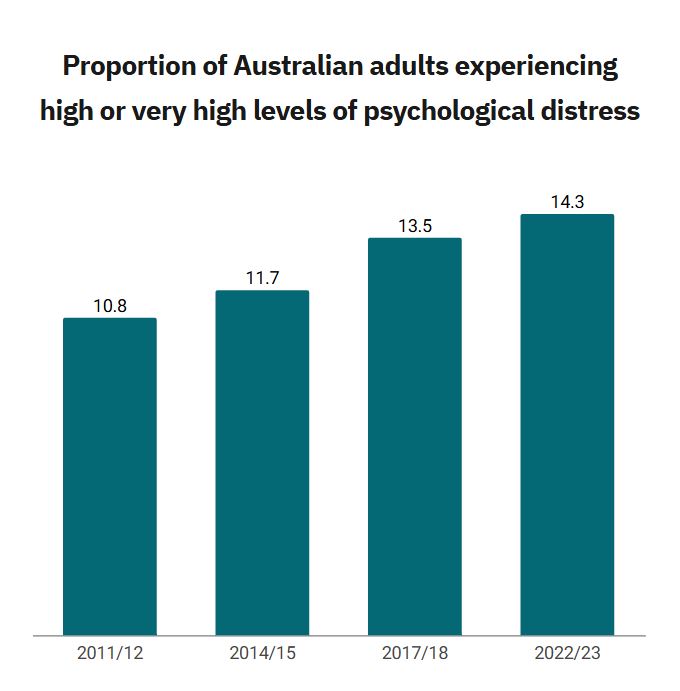
The National Health Survey reports that the proportion of adults reporting high or very high psychological distress increased from around 11 percent in 2011/12 to almost 15 percent by 2022/23.
And among young people, the increase is even more pronounced: For those aged 16 to 24, the prevalence of diagnosed mental disorders increased from around 26 percent in 2007 to 39 percent in 2020/21.
Suggested Courses of Action
With the number of new diagnoses showing no decline, the report recommends five changes to the way mental health is managed to control demand on the health system.
First, it recommends allocating support based on people’s abilities rather than on criteria for a psychosocial condition.
Second, people with mild to moderate difficulties should receive low-intensity interventions first—such as counselling, peer support, and digital tools—with escalation to specialist care only if needed.
Third, contextual causes should be addressed before medicalising them.
“Many difficulties labelled as psychosocial disorders are better addressed through the provision of decent housing, employment, and civic infrastructure than through clinical intervention,” the report says,
Fourth, doctors and other service providers should receive outcome-based payments for helping people return to work, education, or independent living, rather than fee-for-service payments that incentivise ongoing treatment.
“Success should be measured by how many people exit the system, not by how many enter it,” Schwartz says.
Fifth, collect data on factors such as functional recovery, duration of care, and whether resources are reaching those with the greatest needs, rather than things like spending and the number of sessions delivered.
“A humane system does not shrink compassion; it sharpens it by distinguishing those who truly need lifelong care from those who need understanding, structure, and the opportunity to recover.”
Crystal-Rose Jones contributed to this story.