



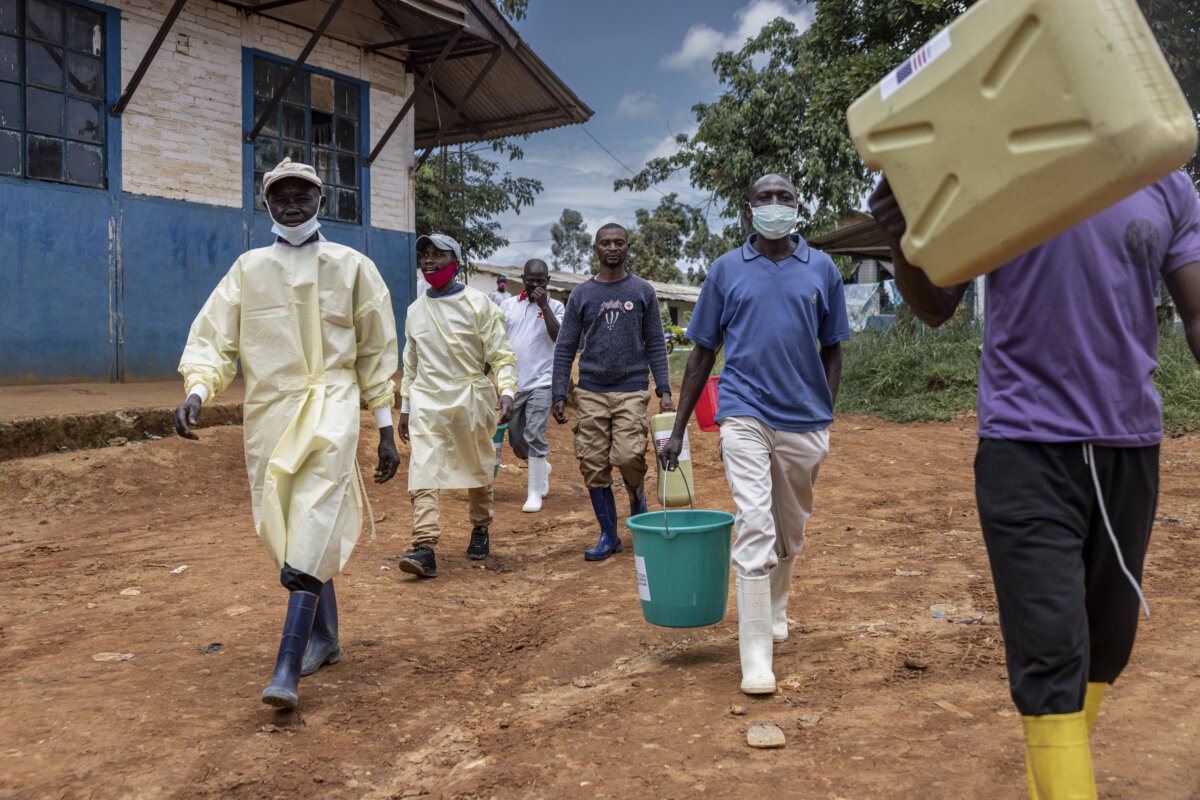
The Ebola outbreak is quickly moving, World Health Organization (WHO) officials said on May 22.
The outbreak, centered in Congo, is “spreading rapidly,” WHO Director-General Tedros Adhanom Ghebreyesus told a briefing.
Eighty-two cases and seven deaths have been confirmed, according to Ghebreyesus. Additionally, there are almost 750 suspected cases and 177 suspected deaths.
That is up from 51 confirmed cases, almost 600 confirmed cases, and 139 suspected deaths reported by the WHO on May 20.
The WHO previously pegged the risk from the outbreak as high nationally and regionally, and low globally.
The risk is assessed as the same regionally and globally as before, but is now very high nationally, officials said Friday.
The assessment is based on the potential risk for human health, the risk of an event spreading, and the available health infrastructure capacity.
The risk of the outbreak spreading has gone from moderate to very high in recent days in part because of insufficient control in the conflict-ridden provinces where most cases have been recorded, WHO officials said. Aid groups estimate more than 2 million people in Ituri and South Kivu provinces have been displaced due to conflict, and nearly as many have lost access to health care.
“What all of these mean is that … even if people are sick, they may be suspect cases, they cannot access health services and therefore they cannot be detected, they cannot be diagnosed,” Dr. Teresa Zakaria, head of WHO’s humanitarian and disaster action unit, told the briefing.
Early Ebola symptoms can resemble symptoms caused by other diseases such as malaria. Officials have said the current outbreak started at least several weeks before it was confirmed earlier in May.
“What we are seeing now may reflect an early transmission that is only being identified retrospectively,” Dr. Mohamed Yakub Janabi, WHO’s regional director for Africa, told reporters.
“An increase in cases does not mean response is failing. Actually it so often reflects that the response is intensifying, uncovering the true scale of the outbreak,” he added.
“So the bottom line here is the rise in cases is driven by a combination of early undetected spread and a stronger surveillance. So as we scale up our detection and response, we expect to see more cases initially before the curve begins to go down.”
Dr. Anne Ancia, who is in Congo as the WHO’s representative, said that making sure Ebola patients go to health care facilities and isolating contacts for 21 days “is the only way that we will be able to disrupt the transmission.” Some 1,400 contacts are being traced currently.
Dr. Abdi Mahamud, WHO’s director of health emergency alert and response operations, said the percentage of Ebola tests returning positive has gone down from 67.6 percent on May 15, when the outbreak was first confirmed, to 49 percent.
He urged other countries to provide funding and support to officials and organizations working on the outbreak, rather than impose travel restrictions.
Neighboring Uganda has barred flights from Congo, Rwanda has closed its border with Congo, and the United States has prohibited non-U.S. passport holders who have recently been to Congo, Uganda, or South Sudan from entering the United States.
U.S. officials said the step was taken to prevent Ebola from entering the country.
Treatment Update
No vaccines or treatments currently exist for the Bundibugyo virus, which is causing the Ebola outbreak and has only caused two others before, one in Uganda in 2007 and one in Congo in 2012.
A WHO advisory group this week recommended testing two monoclonal antibodies, one from Regeneron and one from Mapp Biopharmaceutical, in clinical trials against the virus, as well as looking at an antiviral called obeldesivir for post-exposure prophylaxis.
A trial is being developed with the Africa Centers for Disease Control and Prevention and the Collaborative Open Research Consortium, Ghebreyesus said.
A spokesperson for Regeneron told The Epoch Times in an email the company recently donated 500 doses of an antibody cocktail that is approved for treatment of the Zaire virus, which causes Ebola, to WHO, and that one of the cocktail’s components, maftivimab, performed well against Bundibugyo in laboratory testing.
“We are in close coordination with the WHO and U.S. government in regard to the current outbreak,” the spokesperson said.
“Today the WHO shared that they have prioritized maftivimab for clinical investigation, and we are working on next steps in terms of supply/delivery to the region.”
Remdesivir, made by Gilead Sciences, is also a potential antiviral treatment for Ebola caused by Bundibugyo, Dr. Sylvie Briand, WHO’s chief scientist, told reporters on Friday.
The main criteria for repurposing treatments developed for other uses are safety and efficacy, Briand said.