



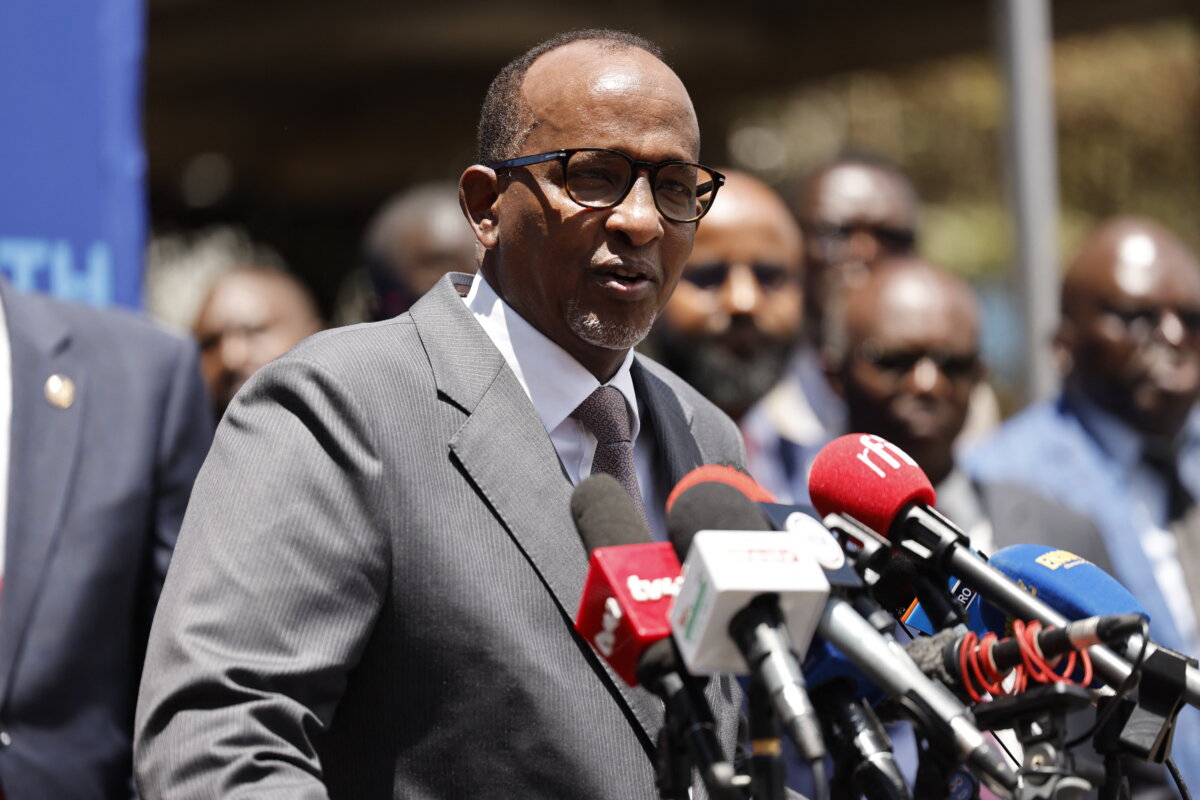
Ebola has spread to Kenya, authorities there said on Oct. 6.
A Kenyan man who has been living in Congo for seven years and fell ill about a month ago was found to have Ebola caused by the Bundibugyo virus, officials told a briefing.
The man traveled in a vehicle to Kampala, Uganda, before boarding a flight to Nairobi on Saturday, authorities said. After arriving at 1:10 p.m. local time, he was screened and taken to a hospital in the city where he was quickly isolated.
The patient showed symptoms such as fever, sore throat, and bleeding. He died on Monday.
The death is the first from Ebola in Kenya’s history.
Officials are making arrangements for a safe burial.
Twenty-eight people, including relatives and healthcare workers, came into contact with the person before the death, Health Minister Aden Duale said. Another 27 individuals flew on the same plane as the man.
Ebola’s typical incubation period is two to 21 days, so contacts will be isolated for 21 days, Dr. Patrick Amoth, Kenya’s director general for health, said at the briefing.
Anybody who tests negative at that time will be released.
Kenyan officials said they already had heightened screening in place for incoming flights from Congo and asked travelers to be truthful when answering questions during the screening so any additional cases can be identified and treated quickly.
More than 650,000 people entering the country have been screened so far, according to Duale.
Of the 267 samples tested thus far, only one test, from the man who died, returned positive.
Officials said they’re working with the World Health Organization, the Africa Centers for Disease Control and Prevention, and other entities. They said the situation is under control.
“I wish to reassure the public not to panic, as all systems are in place to mitigate the spread of the disease,” Duale said in a statement.
People should frequently wash their hands and avoid close contact with sick individuals who have recently come from any countries where Ebola is actively transmitting, he added.
People who experience symptoms should go to a medical facility for treatment, and healthcare workers should be vigilant and maintain procedures aimed at preventing infection.
An outbreak caused by the Bundibugyo virus has been ongoing in Congo for months. In their last update, authorities there reported 8,544 cumulative confirmed cases, 824 patients currently hospitalized, and 4,114 deaths.
It’s the second-largest Ebola outbreak in world history.
Historically, outbreaks caused by the Bundibugyo virus kill 30 to 40 percent of confirmed patients, according to the U.S. Centers for Disease Control and Prevention.
The outbreak has mostly been contained in Congo, apart from previous cases in Uganda and a handful of patients who flew to European countries. Uganda discharged its last Ebola patient in July.