



Fruit drinks conjure images of health and refreshed vitality. But many lurking dangers lie behind the sunny labels of store-bought fruit punches and juices. They certainly seem innocent compared to soda’s unambiguous syrupy hit.
But these cocktails of health risks—from hidden sugars to hazardous ingredients—fail when it comes to providing better nutrition.
100 Percent Fruit Juice vs. Eating Fruit
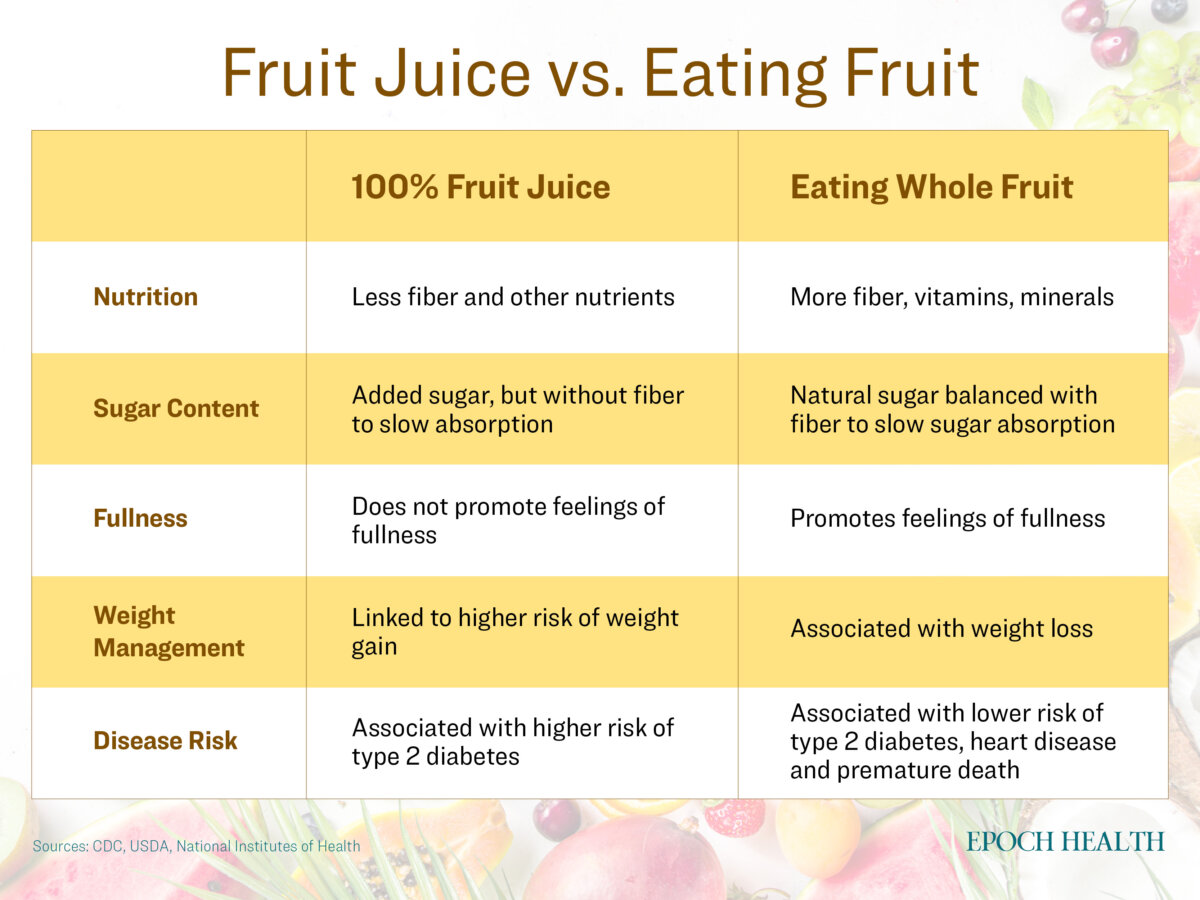
Drinking 100 percent fruit juice pales nutritionally compared to eating whole fruit, though it is healthier than fruit juices with added sugar, according to Dr. Michael Greger, author of “How Not to Age: The Scientific Approach to Getting Healthier as You Get Older,” told The Epoch Times.
Moreover, “consumption of whole fruit is associated with significantly lower risk of premature death,” he added.
Research involving over 187,000 participants between 1984 and 2009 shows that greater whole-fruit intake correlates with lower Type 2 diabetes risk, yet higher fruit juice intake links to greater diabetes risk.
Though most fruits contain sugars, they are naturally occurring simple sugars. The natural sugars in fruits, combined with their fiber content and other nutrients, can contribute to a feeling of satiety. This may help reduce overall calorie intake and decrease cravings for less healthy, sugary snacks. This is why whole fruits can also aid weight loss, unlike fruit juice, which evidence has tied to weight gain.
“The American Academy of Pediatrics, the American Heart Association, and the Institute of Medicine have all recommended that fruit juice be restricted, encouraging whole-fruit consumption instead,” Dr. Greger said.
Fiber-Rich Produce Outperforms Fiber-Less Juice
Though fruit juice holds some merit over soda owing to compounds like antioxidants, it still trails whole fruit for healthfulness. “Fruit juice may be better than soda,” Dr. Greger said, “but it is not as good as whole fruit for living to a ripe old age.”
Fruit juice lacks the richest parts of whole fruit, including fiber, skins, and seeds, according to Emily Feivor, a registered dietitian nutritionist at Long Island Jewish Forest Hills at Northwell Long Island Jewish Forest Hills in New York.
“You’re getting a very concentrated source of fruit sugars without the fiber to slow down the absorption into the bloodstream,” Ms. Feivor told The Epoch Times. At up to 30 grams, the sugar content in just one 6-ounce glass of orange juice far exceeds that of a medium-sized orange, which contains just 14 grams.
Ms. Feivor recommends drinking water when thirsty. But if seeking an alternative, try sparkling or waters flavored with things like cucumbers or lemons instead.
Even juice with pulp falls short of health benefits, Dr. Greger said.
“Whole fruit burst with fiber that’s lacking in fruit juice—even [those with] ‘high pulp,’ ‘extra pulp,’ and ‘most pulp,’” he added, noting that even orange juice is not a significant source of fiber.
Why You Should Eat Your Fruit, Not Drink It
While fruit juices don’t stack up against whole fruit in terms of health benefits, the health risks associated with highly processed fruit punches and drinks are potentially much worse.
1. High Fructose Corn Syrup
A prime culprit jeopardizing health is high-fructose corn syrup (HFCS), added liberally to many fruit drinks. Consuming excessive amounts of HFCS has been linked to weight gain, cavities, and a heightened risk for diabetes and heart disease.
“If we were really interested in minimizing disease, the ideal goal would be to drop the intake of added sugars to zero,” Dr. Greger said.
2. Lack of Essential Nutrients
Fruit punches and drinks boast nutrient richness. However, processing these beverages degrades or destroys the essential vitamins and antioxidants occurring abundantly in fresh fruit.
As a result, their vitamin and mineral content is insignificant compared to whole produce. Artificial flavoring further erodes nutritional value.
3. Artificial Additives
Mass-produced fruit punches and drinks hide chemical additives behind their fruity veneers. Artificial dyes, flavors, and the like enhance their taste, appearance, and shelf stability.
But these embellishments may diminish well-being. The U.S. Food and Drug Administration (FDA) delineates juice from “fruit punch” across 132 pages of guidelines. Certain synthetic dyes are linked to allergies and hyperactivity in kids and are potential carcinogens.
4. Misleading Marketing
The marketing strategies employed by companies often present fruit punches and drinks as healthy choices, hiding their true nature.
Eye-catching labels with pictures of fresh fruits, combined with claims of natural flavors or added vitamins, can mislead consumers into believing they are making a nutritious choice. Unfortunately, the reality is often far from the advertised claims.
What Should I Do, Then?
For more honest refreshments, head for the juicer or produce aisle. Blending your own juices or simply infusing water with fruit offers perks free of excessive sweeteners or chemicals.
When it comes to fruit’s benefits, nothing beats going straight to the source. Whole fresh fruit uniquely provides vital fiber, nutrients, and a sense of fullness that any beverage struggles to replicate.
Understanding the mismatches between label imagery and real ingredient quality will allow you to cut through marketing fog and make informed, health-supporting choices.