



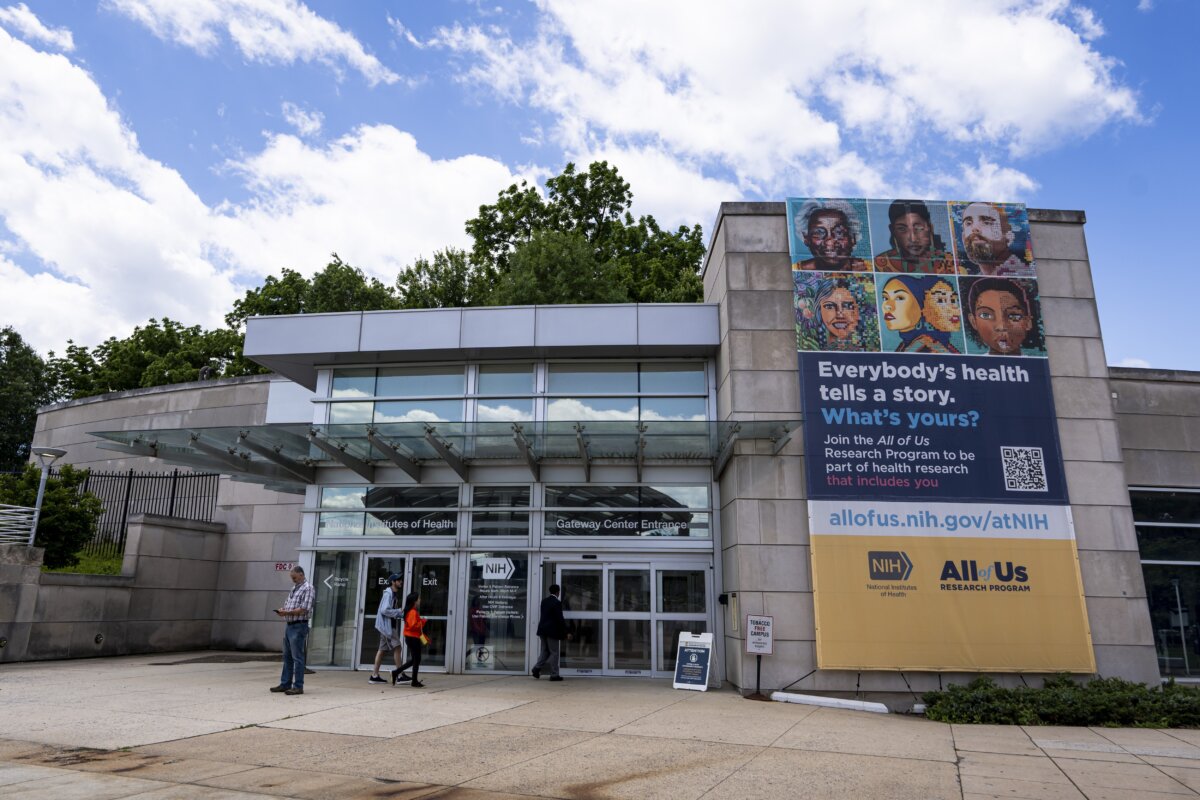
The National Institutes of Health (NIH) researchers who have been charged with allegedly smuggling viral pathogens into the United States previously flew or planned to fly viral samples to the United States, according to newly released emails.
Claude Kwe, who worked under Vincent Munster at the NIH’s National Institute of Allergy and Infectious Diseases, in 2024 brought DNA from 35 samples that tested positive for monkeypox, according to one of the missives.
“We’re eager to perform full genome sequencing on these samples,” Kwe wrote to an NIH official whose name was redacted, while cc’ing Munster.
A form filed with the NIH by Kwe said the samples contained or were derived from a select agent.
Munster in 2022 separately discussed having samples of a monkeypox strain called the Congo Basin clade shipped to the United States. An NIH official asked whether Munster had ever retrieved his luggage.
“Nope, so no Congo basin clade for now,” Munster wrote.
About a month later, a researcher said that the Defense Advanced Research Projects Agency wanted samples of coronavirus and that Munster should get in touch.
“Will do, numbnuts lost the first shipment,” he said.
In 2021 emails, Munster said he was going to have the Omicron variant of COVID-19 brought to the United States “without the involvement of NIH shipping,” prompting an official to warn him that doing so would risk a congressional inquiry. And in 2011, an outside researcher proposed that Munster could “hand carry” samples from Africa because of difficulties sourcing dry ice to ship them, the newly released documents show.
“NIH scientists charged with attempting to smuggle monkeypox into the United States had a years-long history of skirting rules for moving dangerous pathogens,” Sen. Rand Paul (R-Ky.), chairman of the Senate Committee on Homeland Security and Governmental Affairs, who released the emails, said in a statement.
Federal prosecutors recently accused Kwe and Munster of smuggling monkeypox from the Republic of Congo into the United States and lying to investigators by stating that they were transporting only diagnostics.
Emails from 2012 and released by Paul showed that the NIH labeled a shipment of MERS coronavirus to a laboratory in North Carolina as diagnostic rather than infectious. North Carolina officials alerted the NIH to the erroneous labeling.
Munster did not respond to requests for comment. A lawyer representing Munster did not respond by publication time to a request for comment. Kwe’s contact information could not be located, and he has not hired an attorney, according to the court docket.