


Not all of us can move our joints through a full range of motion, or do so without provoking discomfort or even pain. On this subject, I am slowly becoming an expert. As I age, I’ve begun to discover a variety of stiffnesses and “don’t go there” signals from my body, especially in the mornings, and have developed warm-up routines to help work them out.
Joints that are maintained by motion and exercise generally fare much better than joints that sit too much, and where limiting pathologies don’t stand in the way of any kind of exercise, it’s good to be consistent with activity.
For younger adults, it’s best to heed this now rather than wait for pain or stiffness. A surprising portion of my job deals with trying to fix problems that could have been avoided with a little attention and exercise in one’s younger years.
5 Partial Range Exercises for Whole-Body Maintenance
The following exercises take effective movements and slightly abbreviate them to make them accessible for people with painful or stiff joints, as well as for prevention. Although I always mention abbreviating exercise movements to keep them effective for those who can’t achieve full movement arcs during exercise, we’re going to flip the script in this series of movements by starting with limited ranges while encouraging you to move past the given ranges if you can.
This series of exercises focuses on having no limits—you can either be fully successful with the limited ranges listed, or you can exceed them to move as far as you comfortably can. It’s a win-win, regardless of age and ability.
My patients tolerate these exercises well, but I recommend speaking with your medical provider to ensure that they are right for you.
1. Mini Squat
The bodyweight squat is a classic, all-time great quadriceps exercise. However, it can be hard on some hips and knees and is initially somewhat unrewarding for those with weak leg muscles. The mini squat serves the same quad purpose well and can eventually help you progress to a full squat.
Step 1: Stand upright on a stable surface with a chair in front of you, with your feet approximately hip-width apart.
Step 2: Reach out and touch the chair to establish balance.
Step 3: Slowly sink into a squat until your knees reach approximately 45 degrees of flexion, taking two to three seconds to get there. Keep your back straight and your head up during the movement.
Step 4: Move slowly back into standing.
Step 5: Squatting down and then standing back up counts as one repetition. Try to perform three sets of 15 repetitions.
Modifications: If you find that you can move farther than 45 degrees of hip and knee flexion during squatting, by all means do so. I encourage you to really work on those joints to improve your range of motion. Also, many of us find that we steadily increase how far we can move our joints as they warm up, so take advantage of that freed-up range.
Why I Like It: The mini squat is very effective, even with its decreased range of movement. I don’t just like it—I love it, because it can be successful for people who would otherwise avoid squatting altogether.
2. Knee-Touch to Overhead-Reach
This exercise is a modified abbreviation of the touch floor/touch sky exercise, the benefit being that you don’t have to reach down as far. The overhead component is delightful and good for your shoulders, and the abbreviated downward movement helps you work around stiff or painful joints.
Step 1: Stand with your feet approximately hip-width apart, arms at your sides.
Step 2: Slowly bend your hips and knees and touch your knees with your hands. It’s a small movement for most people. Be sure to keep your head up while reaching. Hold the position for approximately five seconds.
Step 3: Slowly stand back up and reach your arms up as high as they can comfortably move.
Step 4: Reaching down and up counts as one repetition. I recommend performing three sets of 12 to 15 repetitions. Feel free to modify the sets and repetitions to make the exercise work best for you.
Modifications: Only reach down and up as far as you comfortably can, including your hips, knees, and shoulders. As the exercise progresses, you may find you can move deeper into the movements. Also, if you can bend down farther than your knees, I encourage you to do so. There’s no need to artificially limit yourself when you can do more.
Why I Like It: The knee-touch-to-overhead-reach exercise is still very effective, but it is a whole lot easier on tight or painful hips and knees.
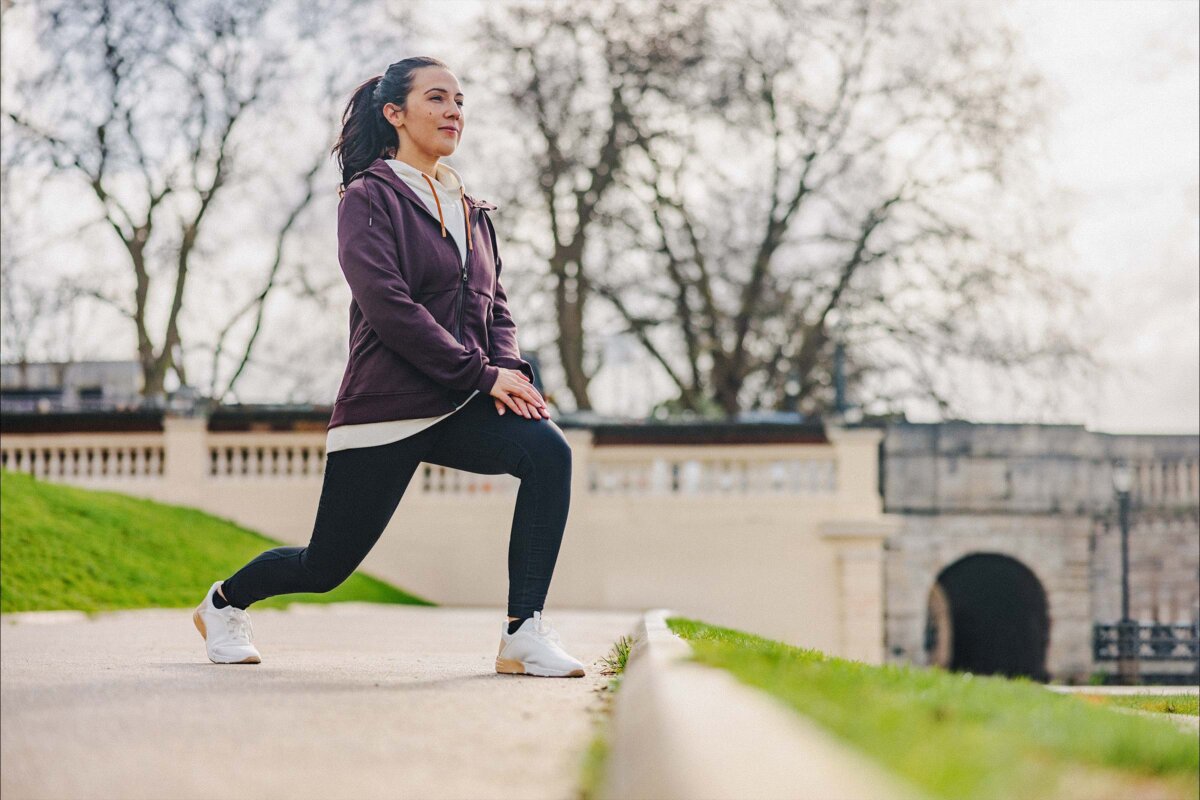
3. Partial Lunges
Lunge exercises are great for strengthening your glutes and quadriceps muscles. I have found, however, that some stiff or injured knees don’t tolerate these movements well. As you move into greater joint flexion, the joint stress increases and the pain begins to build. I often find that people can tolerate flexion to approximately half range—see if that’s true for you.
Step 1: Stand with your feet approximately hip-width apart. Keeping your left foot still, step approximately 3 feet forward with your right foot. Stand next to something stable if you struggle with balance.
Step 2: Slightly bend both knees and move into a half lunge by bending your right knee and hip to approximately 45 degrees each. Stop there, then move back up to the starting position.
Step 3: Moving down and then back up counts as one repetition. Try to perform three sets of 12 repetitions per side. You can alternate sides between sets, or you can perform all sets on one side before performing them on the other.
Modifications: Moving your joints to only 45 degrees shouldn’t be considered orthodoxy. If you find that you can go lower without experiencing significant pain, by all means do so.
Why I Like Them: Even when you’re moving at half the normal range, partial lunges provide powerful strength benefits. They also work on your balance.
4. Dumbbell Floor Press
The bench press primarily targets your triceps and pectoral muscles, with some benefit for your core muscles as well. However, many people have painful shoulders, and limiting movement as needed for this exercise makes sense.
Step 1: Lie on the floor and hold a 2-pound dumbbell at chest level. Your elbow should be on the floor, and your forearm should point straight up.
Step 2: Slowly push the weight straight up toward the ceiling until your elbow is straight, and then slowly lower it back down.
Step 3: Pushing the weight up and then returning it down counts as one repetition. Try to perform three sets of 12 repetitions.
Modifications: If your shoulder still gives you problems, you can hold the weight in both hands to perform the activity with both arms at the same time. Although I gave directions for a single arm press, you can hold a 2-pound weight in each hand and perform simultaneous movements if that better suits your preferences and abilities.
Why I Like It: Limiting the shoulder joint’s overall movement can allow painful shoulders to participate in the bench press.
5. Partial Bridge
Glute bridges are excellent exercises, but pain, weakness, and even decreased coordination can conspire to limit your ability to perform these exercises to their full potential. Limiting how far you move, however, can make this exercise successful for you.
Step 1: Lie on a flat surface with your arms by your sides, your knees bent, and your feet flat on the floor.
Step 2: Slowly lift your hips to approximately four to six inches off the floor and hold for 15 seconds before lowering back down.
Step 3: Raising up and lowering back down counts as one repetition. Try to perform three sets of four repetitions.
Modifications: Feel free to experiment with sets and repetitions to make the exercise work best for you—including moving into a full-bridge position.
Why I Like It: Using a smaller range of motion can help make this exercise more successful for people with back pain or limited mobility.
You don’t have to abandon exercise just because your joints hurt. This partial-range exercise set allows you to exercise while protecting you from unnecessary pain. I suggest performing these exercises at least three times per week, and up to five days per week for the best overall benefit. Good luck, and I hope they work well for you.
About the Fitness Model: Aerowenn Hunter is a health editor for The Epoch Times. She’s an accredited yoga therapist with three decades of teaching experience.
Views expressed in this article are the opinions of the author and do not necessarily reflect the views of The Epoch Times. Epoch Health welcomes professional discussion and friendly debate. To submit an opinion piece, please follow these guidelines and submit through our form here.