



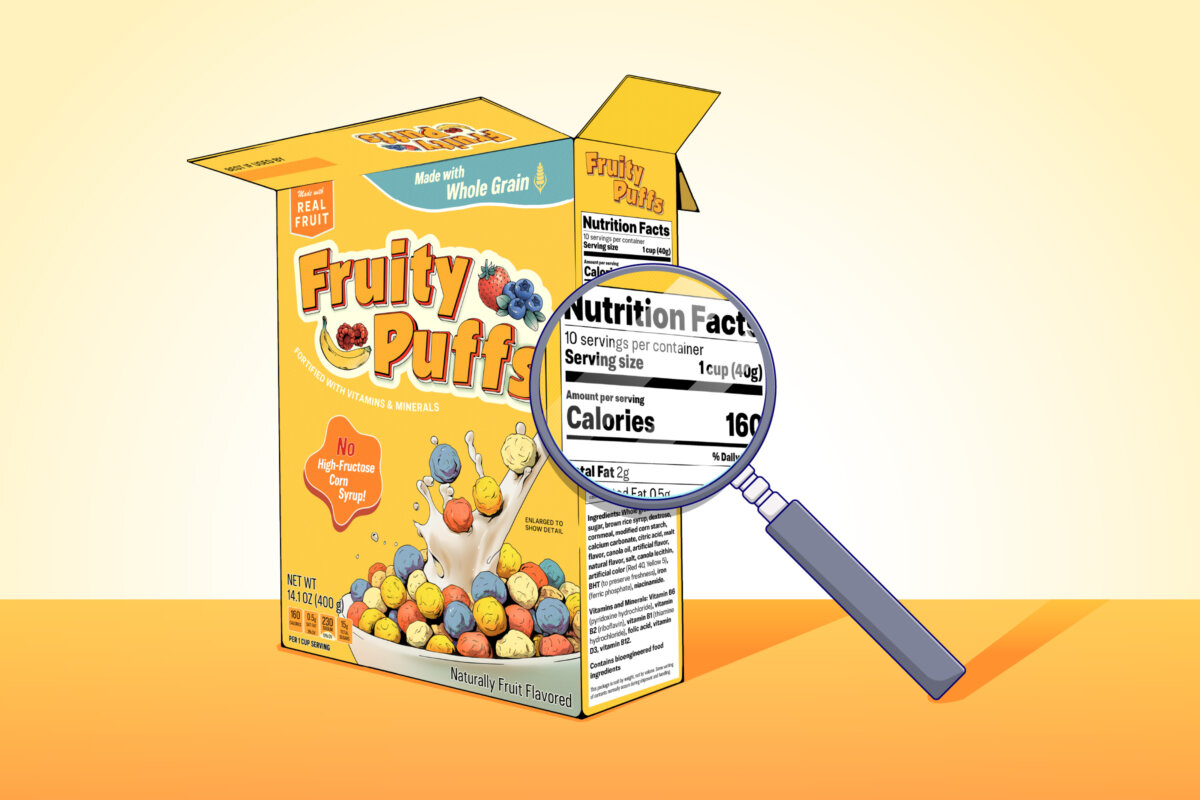
You grab a granola bar that looks like the healthiest option on the shelf. The box promises real fruit, whole grains, and no high-fructose corn syrup. It feels like the smart choice.
Flip the box over, though, and the story changes, with a list of more than a dozen ingredients you don’t recognize, from soy lecithin to tocopherols. The front speaks your language. The back reads like another dialect.
With about 70 percent of the U.S. food supply now ultra-processed, learning to decode nutrition labels has become as essential as reading a bank statement.
Learning to read the back of the box shifts power from food companies back to you—and protects your health along the way. Deciphering takes less than a minute once you know where to look.
Why the Front Misleads
In the United States, the front of a package is prime marketing real estate. Words and phrases such as “natural” and “made with real fruit” are designed to persuade, not inform. Only a handful of terms, such as “low fat” and “high fiber,” are regulated. Most carry no official meaning.
Researchers call marketing as such the “health halo”—a feel-good claim that makes the whole product appear virtuous. In one study, identical cookies labeled “organic” were judged by participants to be lower in calories and worth paying more. A recently published review of nearly 600 products found no link between front-of-package claims and actual nutrition—and in some cases, the more claims made, the worse the food.
As people get busier and food costs climb, the lure of cheap, easy, and tasty ultra-processed foods grows stronger. Most are calorie-dense, aggressively marketed, and designed to be easy to overeat. You won’t see the word “ultra-processed” on any package, but the clues are there if you know where to look.
The One-Minute Back-of-Box Read
The front of the box is marketing, the back is disclosure. A quick four-step scan takes less than a minute.
Step 1: Serving Size
Start at the top of the label. “Serving size” is not advice—it’s a snapshot of what Americans actually eat in one sitting, set by the FDA and drawn from national surveys. Since most of us overeat, the official numbers may be larger than what’s nutritionally ideal.
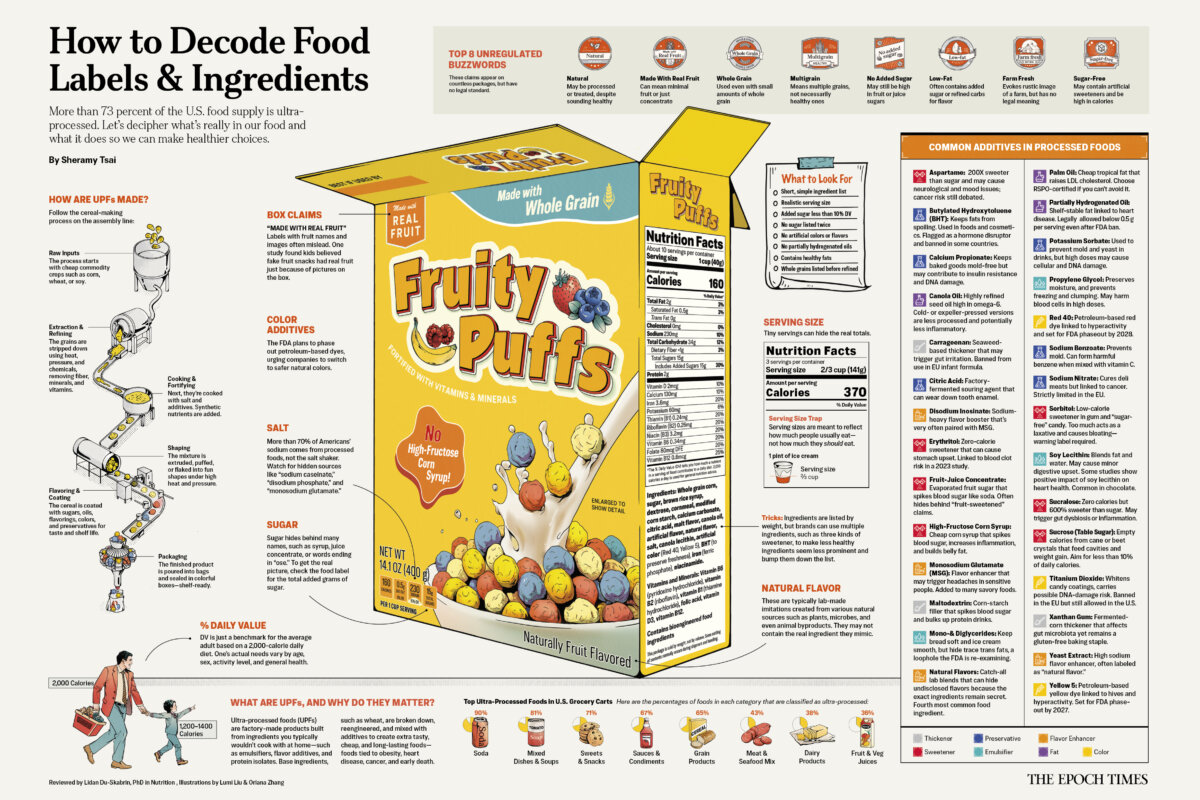
(Click here to see enlarged version of the infographic above.)
Packages shrink serving sizes to make calories, sugar, and sodium look smaller. An iced tea label may claim the bottle contains three servings, though most people finish it in one. Research shows people underestimate portions of pizza, pasta, and drinks by 30 percent to 46 percent—a gap that helps explain why calories creep higher than expected.
The FDA acknowledged the misrepresentation of portion size in 2016, when it updated labels. Few people stop at half a cup of ice cream or a small soda. Now, ice cream is listed as two-thirds of a cup, and a 20-ounce soda counts as one serving.
Step 2: Sugars, Sodium, and Carbs
While serving size sets the frame, sugar and sodium are the next place to look. Total sugars include what’s natural, such as fruit and milk. The line to watch is “Added Sugars”—the sweeteners stirred in at the factory.
The Daily Value, which is the maximum amount recommended each day, is 50 grams a day of added sugar on a 2,000-calorie diet, roughly the sugar in a bottle of soda. The American Heart Association recommends less: 36 grams for most men, 25 grams for most women. A flavored yogurt might have 15 grams of sugar, nearly half of it added.
Sodium is similar. The cap is 2,300 milligrams, but Americans average closer to 3,400. And more than 70 percent isn’t from the salt shaker—it’s baked into bread, soup, frozen meals, even cereal. A single “light” frozen entrée can pack half a day’s worth of salt into one sitting.
Nutrition writer Nina Teicholz suggests cutting through the noise by going straight to the carbohydrate line. “The largest body of science points to the unhealthy effects of excessive sugar and starches,” she told The Epoch Times in an email. “When I shop, I always look at the carbohydrate content on the facts panel.”
The key isn’t hitting a perfect number but knowing the quality. Carbs from fruits, vegetables, and intact grains are different from the refined starches and added sugars that act like straight sugar in the body, spiking blood glucose without keeping you full.
Step 3: Ingredients
The ingredient list is the label’s truth serum. Items are listed by weight, so the first three usually define the food. If those are sugar, refined flour, or oil, that’s the backbone.
Companies also use “ingredient splitting,” which involves scattering sugars under names like brown rice syrup, dextrose, or juice concentrate so none looks dominant. Add them up and compare with the Added Sugars line.
Grain claims can mislead, too. A 2020 Public Health Nutrition study found nearly half of U.S. adults mistook breads labeled “multigrain” or “wheat” for healthier options. Unless the first ingredient says “whole,” it probably isn’t.
Sugar and salt hide in plain sight. Sweeteners end in “-ose” or show up as syrups, honey, or molasses. Sodium disguises itself as monosodium glutamate or disodium phosphate. And “natural flavors” may sound wholesome, but are usually lab-made.
If the ingredient list is long and reads like a science experiment, put it back.
Step 4: Portion Math and Percent of Daily Value
“% Daily Value” is your shortcut to context. It shows how much one serving contributes to an average 2,000-calorie diet. As a general rule, 5 percent or less is low, and 20 percent or more is high.
So if a soup lists 40 percent of your sodium, you’ve nearly maxed out by lunch. On the flip side, 10 percent of fiber or calcium can help you toward your daily goals.
The system was meant to make nutrition intuitive, but many people misread it, assuming bigger numbers are always better. The trick is balance: aim low for nutrients to limit—sodium, added sugar, saturated fat—and high for fiber, vitamins, and minerals.
Moving Away From the Label
We teach kids to read. We teach them to manage money. But most of us were never taught to read the labels on the food we buy every day. Nearly 60 percent of the calories American children consume come from packaged, processed foods. Poor diet has now overtaken smoking as the leading cause of preventable death worldwide.
The granola bar on the shelf may promise health, but the real story is in the fine print. Flip the box, and you flip the power back to yourself.
The deeper power, though, may be in skipping the box altogether. Fruits, vegetables, eggs, meat, grains cooked from scratch—these foods don’t need decoding. Choosing them sidesteps marketing tricks and ingredient lists entirely.
“Before UPF, we used the term ‘junk food,’ which I think worked well,” Teicholz said. “We all know that cookies, crackers, cereals, sodas, and candy are junk food. If we avoided those foods, common sense—and the science—tells us we’d be healthier.”
Your Quick Label Survival Guide
- Start at the top: Serving size frames everything. Eat double, and you double the numbers.
- Check sugar: Added Sugars should stay under 10 percent of daily calories—about 50 grams, or one soda. Less is better.
- Scan sodium: Keep below 2,300 milligrams a day. Most of it hides in packaged soups, frozen meals, and restaurant food.
- Watch for carbs: Refined starches act like sugar in the body, spiking blood glucose without lasting fullness.
- Check first 3 ingredients: They tell the story. Look for “whole” before the grain, not “multigrain.” Multiple sweeteners equal more sugar than it seems.
- Read % Daily Value: 5 percent or less is low, 20 percent or more is high. Aim low for sodium, sugar, and saturated fat; high for fiber, vitamins, and minerals.
- Watch for red flags: Long chemical lists, artificial colors, partially hydrogenated oils, natural flavors.