



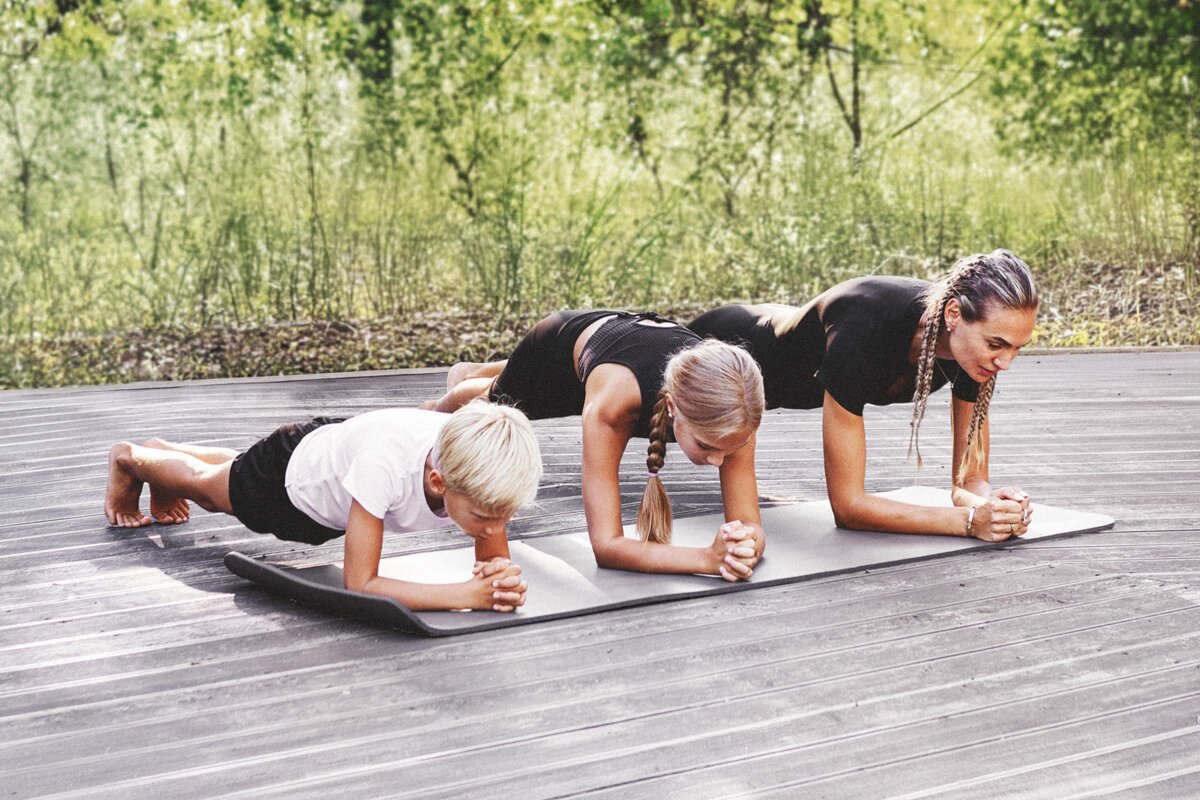
Slouching, poor posture, or a habitual forward-leaning stance are mostly the result of weak muscles. Insufficient core and gluteal muscle strength are the most common culprits. One simple and effective full-body exercise—the plank—can strengthen your core, activate your glutes, and thus improve posture and reshape your body.
How Do Plank Exercises Improve Posture?
Planks are a classic core muscle training exercise that engage the abdominal, back, and gluteal muscles by maintaining a plank position. In addition to improving core stability, the plank exercise deepens postural control, increases muscle endurance, and indirectly enhances fat burning.
Common unfavorable postural appearances, such as hunchback, forward head posture, and protruding abdomen, often reflect insufficient core and gluteal muscle function, which are crucial for stabilizing the spine and pelvis. When the trunk lacks stability of its own, the body compensates by over-reliance on other muscles to maintain balance, leading to an undesirable postural inclination.
Plank exercises improve posture by:
1. Strengthening Core and Gluteal Muscles: Planks primarily work the abdominal and back muscles while also engaging the gluteal muscles that connect to the lower limbs, thereby improving trunk and lower limb stability.
2. Training the Body to Maintain a Neutral Spinal Posture: Those with hunchbacks or forward head posture often cannot maintain a neutral spinal alignment. Plank exercises help correct and maintain proper posture, keeping the head naturally aligned with the spine and preventing excessive forward tilting.
3. Enhancing Stability of Tendons, Ligaments, and Muscles: Plank is a static support exercise that trains the constructive collaboration of deep core muscles while reinforcing the tenacity and stability of tendons, ligaments, and muscles.
6 Plank Exercises
Plank exercises can be done in minimal space and little time—no gym or special equipment required.
Practice Tip: When performing any plank exercise, avoid sagging your lower back or raising your hips, and maintain core engagement and stable breathing. Beginners can start with shorter durations and gradually increase the duration for safe, effective posture improvement.
1. Basic Plank
Step 1: Lie face down with elbows on the ground, feet shoulder-width apart, toes on the ground.
Step 2: Tighten your abdominal and leg muscles to lift your body, supporting your weight between your elbows and toes.
2. Plank With Hip Rotation
Step 1: Begin in basic plank pose.
Step 2: While maintaining core stability, rotate your hips alternately to the left and right.
3. Plank With Leg Raised
Step 1: Begin in basic plank pose.
Step 2: Keeping your lower leg straight, alternatively raise your left and right legs.
4. High Plank
Step 1: Lie face down with hands on the ground, palms directly under shoulders, feet shoulder-width apart, toes touching the ground.
Step 2: Engage your core and leg muscles, straighten your arms, and rise onto palms and toes while keeping your body in a straight line.
5. High and Low Plank
Step 1: Begin in a high plank position, then bend each arm alternately, placing your elbows on the ground to return to the basic plank position.
Step 2: Straighten each arm alternately, placing your palms on the ground to return to the high plank position. Alternate between the two positions.
6. Plank Walk
Step 1: Begin in a standing position, bend forward, and place your hands on the ground.
Step 2: Keeping your feet in the same position, shift to your toes and use your hands to support yourself as you crawl forward until your body forms a straight line and a high plank pose.
Step 3: Alternately support yourself with your hands and crawl backward, moving back to the starting standing position.
Consistent practice of a variety of plank exercises helps to improve posture, reduce back pressure, and enhance body control, balance, and injury resistance in daily activities and sports.