



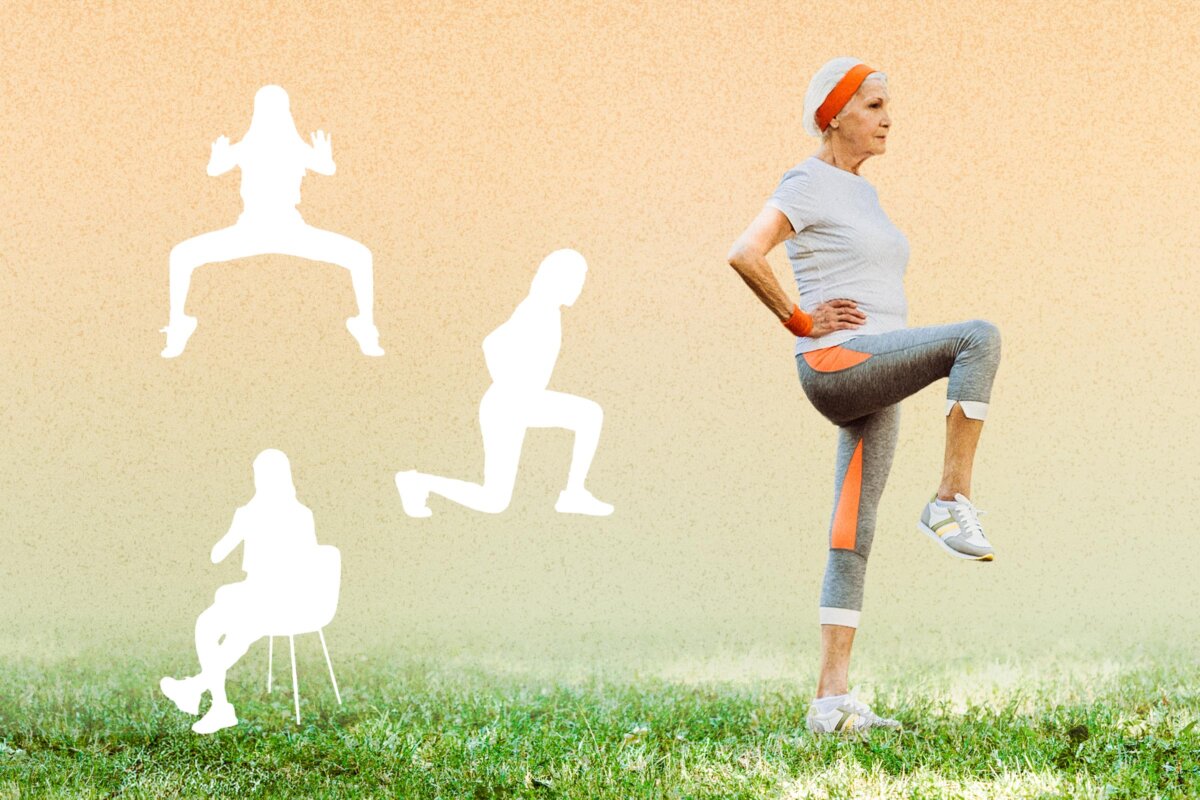
It is often thought that health and longevity depend mainly on diet, but lower-body strength is also a key factor. Here, I share four glute and leg training exercises to strengthen lower-body muscle groups, prevent leg degeneration, and maintain good mobility.
After age 20, muscle mass typically decreases by about 1 percent per year. For every 2 pounds of muscle lost, the basal metabolic rate drops by about 50 calories. This is especially true for the muscles in the hips and legs—once they atrophy, injuries become more likely, and mobility is affected. As physical activity declines, the rates of both physical and mental aging often accelerate. Therefore, lower-body strength and mobility are essential for overall physical function and staying active.
2 Simple Tests
Before starting training, you can use two easy tests to assess your lower-body strength and balance.
Sit-to-Stand Test
Sit on the floor and try to stand up directly using both feet, without holding onto any support. Then slowly sit back down.
If you can complete this steadily, it indicates good lower-body strength and stability. If you wobble, struggle to stand firmly, or need additional support, it suggests your glutes and legs need strengthening.
Single-Leg Sock Test
While standing, lift one foot and try to put on a sock while balancing on the other leg. If you can maintain balance and complete the movement, it shows good lower-body strength and balance. If you struggle to stay balanced, it means your core and lower-body muscles need strengthening.
Even if your test results aren’t ideal, there’s no need to worry. Muscles, bone density, and the nervous system can all be improved through training. With regular exercise, you can slow degeneration and gradually improve.
4 Glute-Leg Exercises
If you want to increase lower-body muscle mass, simple walking or brisk walking is often not enough. Targeted strength training for specific muscle groups is still necessary to effectively stimulate muscle growth.
Here are four recommended glute and leg exercises:
1. Lunge With High Knee
This movement strengthens both the thighs and glutes.
Step 1: Stand with your feet shoulder-width apart, arms relaxed at your sides or with your hands on your hips.
Step 2: Step one foot back into a large stride and lower into a lunge until both knees are at about 90 degrees. The back knee should come close to the floor without touching it, and the front knee should not go past the toes.
Step 3: Push through your front foot to stand, driving your back leg forward and upward, lifting the knee as high as your hip. Repeat the sequence of “step back, lunge, knee lift” for several repetitions, then switch to the other leg.
2. Grand Plié
The grand plié exercise targets the glutes, thighs, ankles, and Achilles tendon.
Step 1: Stand with your feet turned slightly outward in a natural “V” shape, with your stance about 1.5 to 2 times shoulder-width apart. Keep your back straight and your core engaged. You may hold on to a wall or the back of a chair for support.
Step 2: Lower into a squat while keeping your torso upright, aiming to bring your thighs parallel to the ground. Once stable, rise onto your toes, then slowly lower your heels. Repeat several times. Throughout the movement, keep your body as steady as possible—only your heels should move up and down.
3. Chair Pistol Squat
The chair pistol squat mimics everyday sitting and standing, effectively strengthening the thighs and glutes.
Step 1: Sit at the front edge of a chair with both feet flat on the floor. Lean your upper body slightly forward without relying on the backrest.
Step 2: Lift one foot off the ground and use the other leg to stand up, then slowly sit back down. Alternate legs, maintaining balance throughout the movement.
4. Pistol Squat From the Ground
This exercise builds core stability and control in the glutes and legs.
Step 1: Lie on your back with your arms relaxed at your sides. Bend one knee while keeping the other leg straight.
Step 2: Curl your body into a ball shape and use the momentum of rolling forward, along with the strength of your glutes, to rise onto the foot of the bent leg. The other leg should not touch the ground during the movement. Alternate legs.
As we age, strong legs and glutes are the foundation of staying active and independent. Regular exercise and targeted strength training don’t just slow muscle loss—they help you sustain your mobility, vitality, and quality of life.
Exercise doesn’t have to be perfect—just commit to moving your body regularly, one step at a time.