



Weakness is the enemy, and I have spent my career battling it. Almost every patient who has ever come into the clinic has demonstrated some degree of weakness, and with it often comes decreased safety and a decline in function. When weakness persists, it can become permanent. Battle it away, and you can help patients recover all or most of their former abilities.
It is surprising how fast you can lose strength after a physical mishap or illness or fall into a rut of not exercising and decreased activity. It can seem nearly impossible to regain muscle strength. Never fear, however, because I have a solution for you.
Exercises that encourage sustained resistance loading and movement repetition go a long way toward restoring your strength. The following exercises can efficiently accomplish exactly what we are looking for.
5 Pushing Exercises to Help Maximize Your Strength
The following exercises can help you regain lost or weakened muscle strength. They involve consistent, stable movements without fast transitions or balance challenges, making them accessible to most of us. They also provide an excellent workout for both your upper and lower body.
My patients generally tolerate these exercises well, but I suggest discussing them with your medical provider to ensure that they are right for you.
1. Chair Dips
Chair dips can be performed using almost any firm seating surface and allow you to accurately focus on your shoulders, triceps, and pectoral muscles.
Step 1: Sit at the front edge of a stable chair.
Step 2: Place your palms on the surface of the chair and slide forward, supporting your weight on your hands. Straighten your knees and let your feet move out in front of you.
Step 3: Slowly lower yourself carefully until you reach 90 degrees of elbow flexion, then push back up. Position your arms so that your elbows bend more to the rear than to the sides.
Step 4: Moving down and back up counts as one repetition. Try to perform three sets of 15 repetitions.
Modifications: Cannot go very low with your arms? Just go as low as you can before coming back up. Most of my patients gain strength quickly with this exercise, and I am willing to bet that you will too. You can also keep your feet closer to you to decrease the overall effort of the activity by letting your legs carry some of the weight instead of placing all of it on your arms.
Why I Like Them: Chair dips provide a wonderful workout for your shoulders, chest, and triceps, making them a “get everything” kind of exercise for your upper body.
2. Chair Squats
While we are in that chair, I have another excellent exercise for you: chair squats. With chair squats, you are using the muscles of your legs and core to push yourself up out of a chair—repeatedly. Pushing up targets your gluteal and quadriceps muscles and also improves your balance. Chair squats are an excellent means to maximize your safety and independence with transfers and mobility.
Step 1: Sit at the front of your seat with your feet hip-width apart and your arms reaching straight out in front of you.
Step 2: Shift your weight forward and slowly stand up, keeping your arms in place as you rise.
Step 3: Once you are standing, slowly return to nearly sitting. Instead of sitting all the way down and relaxing, however, just touch down lightly before rising back up. Sitting all the way down allows the involved muscles to relax, whereas just touching the chair keeps them tense and maximizes the exercise’s effectiveness.
Step 4: Standing up and sitting back down counts as one repetition. Try to perform three sets of 15 repetitions.
Modifications: If full squats are too much, feel free to do partial squats. Over time, you will likely be able to perform full squats. You can also sit all the way down before standing back up to allow your muscles brief rests until you become stronger.
Why I Like Them: Chair squats build a great deal of power in your lower body, especially your gluteal muscles and the quadriceps muscles along the front of your thighs, allowing you to stand with more authority and potentially maximizing your balance.
3. Dumbbell Shoulder Press
The dumbbell shoulder press is an overhead movement that targets arm musculature and the deltoid muscles of the shoulders.
Step 1: Holding a 2-pound weight in each hand, sit at the front of a chair and then lean back until your shoulders touch the chair. Bend your elbows and position the weights by your shoulders.
Step 2: Slowly push your hands straight up toward the ceiling.
Step 3: Once you move your arms all the way up, slowly lower them back down to the starting position, without pausing. As soon as your hands lower all the way back down, start moving them back up again into the second repetition.
Step 4: Moving your arms all the way up and then back down counts as one repetition. Try to perform three sets of 15 repetitions.
Modifications: If your arms do not go all the way up, push them up as far as you can, which will still be effective. With practice, you should be able to move your arms all the way up and look good while you do so.
Why I Like Them: This exercise builds strength and improves shoulder range of motion through overhead movement.
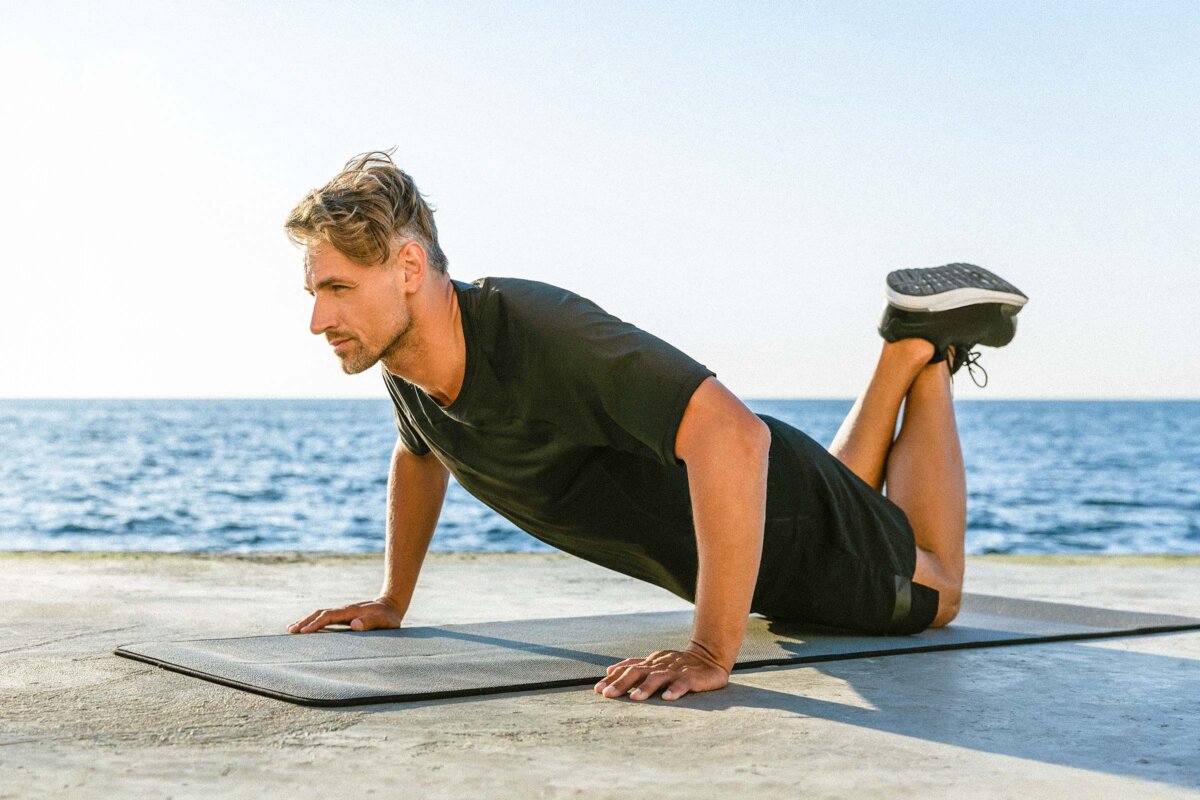
4. Push-Ups
Push-ups are a classic chest- and arm-strengthening exercise, and all you need to perform them is a firm, flat surface.
Step 1: Start on your hands and knees, then straighten your legs until you are bearing weight on your toes and hands. Keep your elbows straight and your arms straight up and down.
Step 2: Slowly lower yourself by bending your elbows until either your chest touches the floor or you go as far as you can.
Step 3: From here, move up until you are supporting your weight on your hands and toes again. Moving down to the floor and then pushing back up counts as one repetition. Try to perform three sets of 15 repetitions.
Modifications: Feel free to lower your knees to the ground to simplify the exercise. You can also abbreviate how far you lower into the push-up if you struggle to rise back up from all the way down.
Why I Like Them: You just cannot go wrong with push-ups as long as your shoulders can tolerate the movement. They are a no-nonsense exercise and highly efficient for working your chest and arm muscles.
5. Dumbbell Floor Chest Fly
While pushups are an excellent chest and arm exercise, chest flies follow up with a strong focus on your chest muscles.
Step 1: Lie on your back with a 2-pound weight in each hand, and arms out in a T-position.
Step 2: Push the weights straight up toward the ceiling until your elbows are straight and the weights are touching.
Step 3: Slowly lower the weights laterally toward the floor. You can slightly bend your elbows to reduce strain on your shoulders, but you ultimately want to be able to touch the weights or your hands to the floor when you lower all the way down.
Step 4: Once you lower the weights to the floor—or as far as you can—raise them back to the starting position. Lowering the weights and then raising them back up counts as one repetition. Try to perform three sets of 12 repetitions.
Modifications: If you cannot lower the weights all the way down—and many people can’t at first—just lower them down as far as you can at first while maintaining your form. You can also use lighter weights if that works better for you or even forego weights altogether at first to make sure the activity is successful.
Why I Like Them: Dumbbell chest flies directly dial in on your chest muscles, but in an accessible way. It is excellent for both stretching and strengthening.
Together, these exercises can help maximize your strength and functional independence. If something has happened recently that has reduced your strength or endurance—or if you simply have not been able to work out and maintain your strength the way you used to—these exercises could very well be your ticket back to your former glory. I recommend performing them three to five times per week. Good luck, and I think you will like them.
About the Fitness Model: Aerowenn Hunter is a health editor for The Epoch Times. She is an accredited yoga therapist with three decades of teaching experience.
Views expressed in this article are the opinions of the author and do not necessarily reflect the views of The Epoch Times. Epoch Health welcomes professional discussion and friendly debate. To submit an opinion piece, please follow these guidelines and submit through our form here.